National Gallery of Art Impressionism and Post-Impressionism
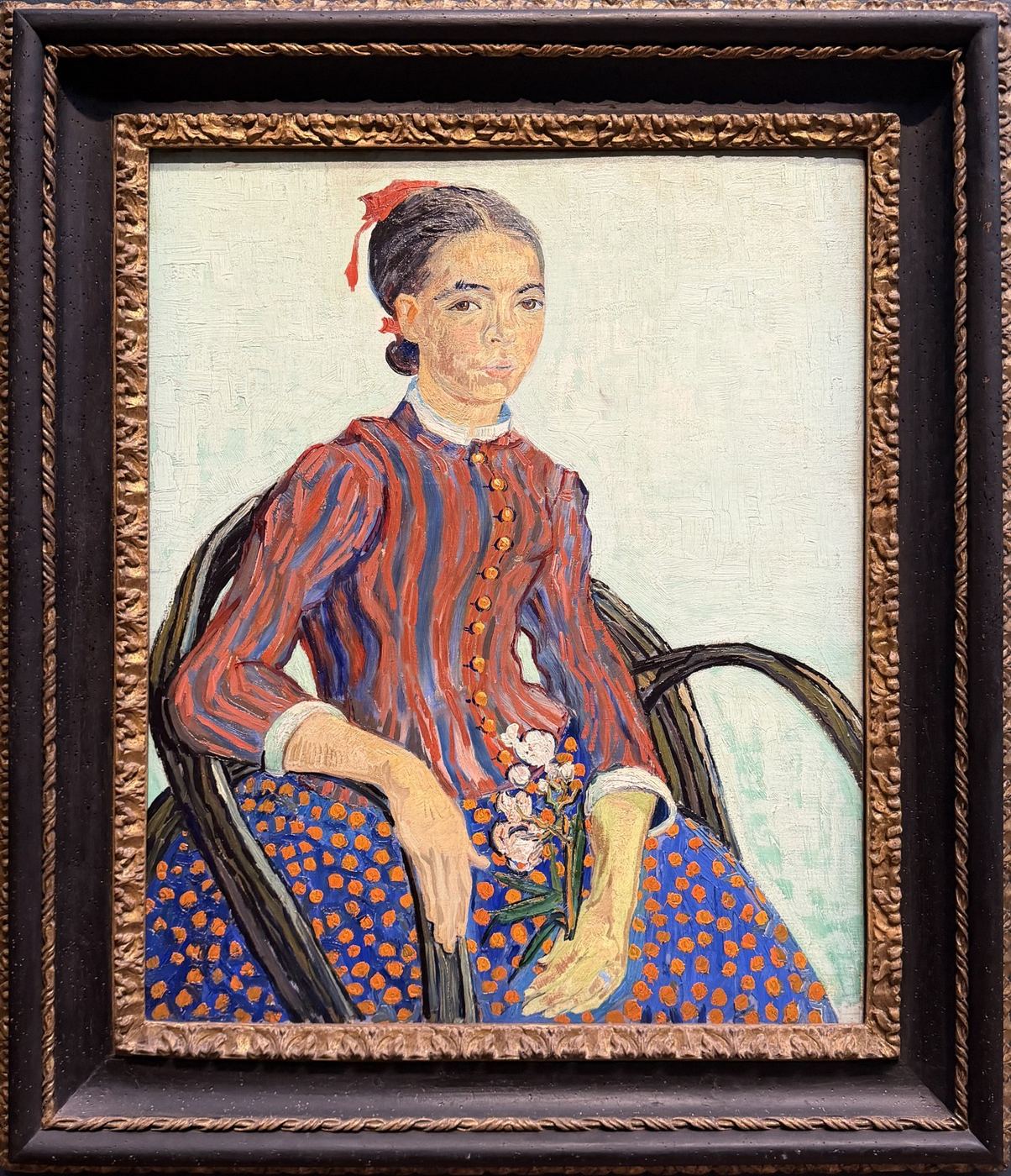
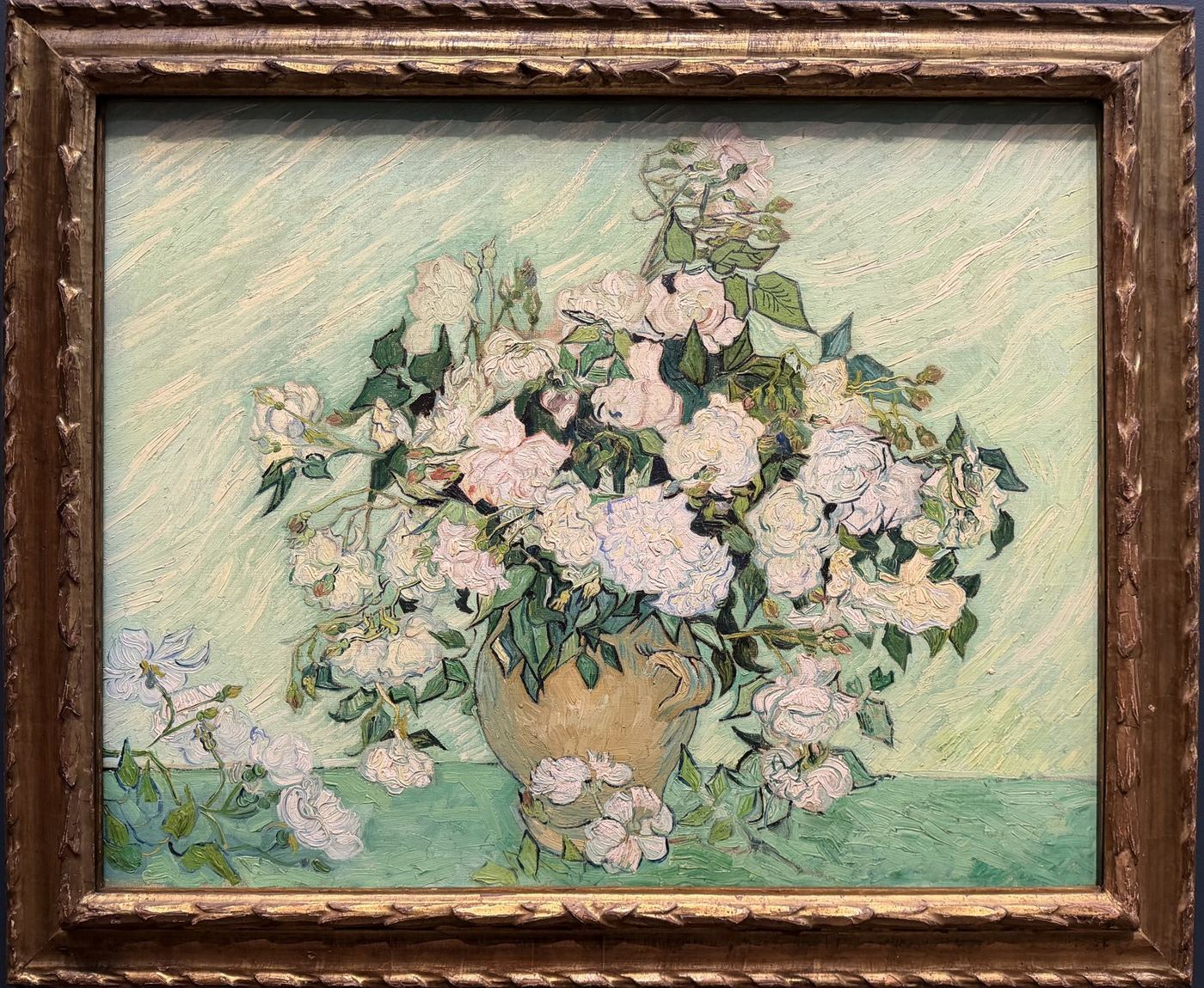
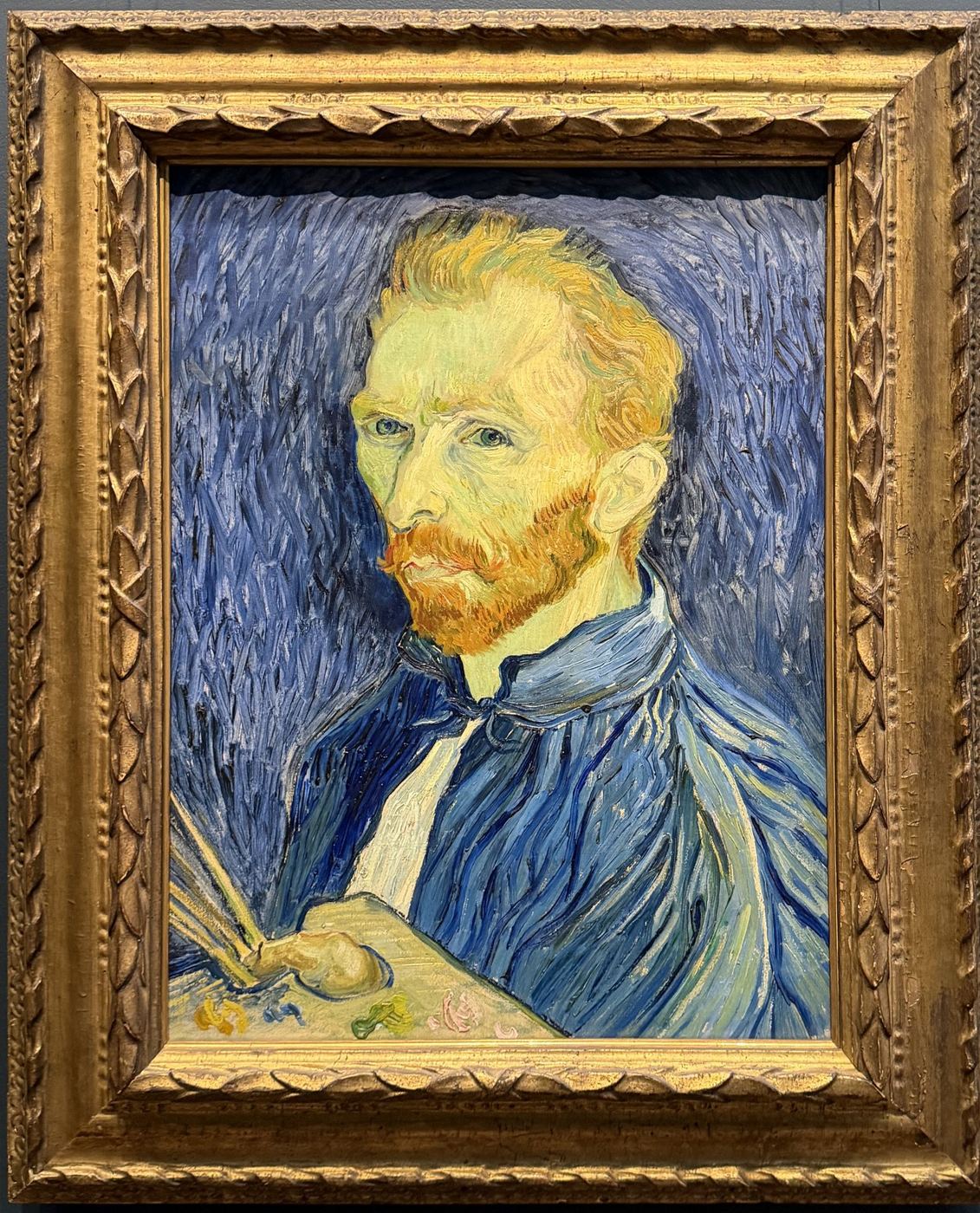
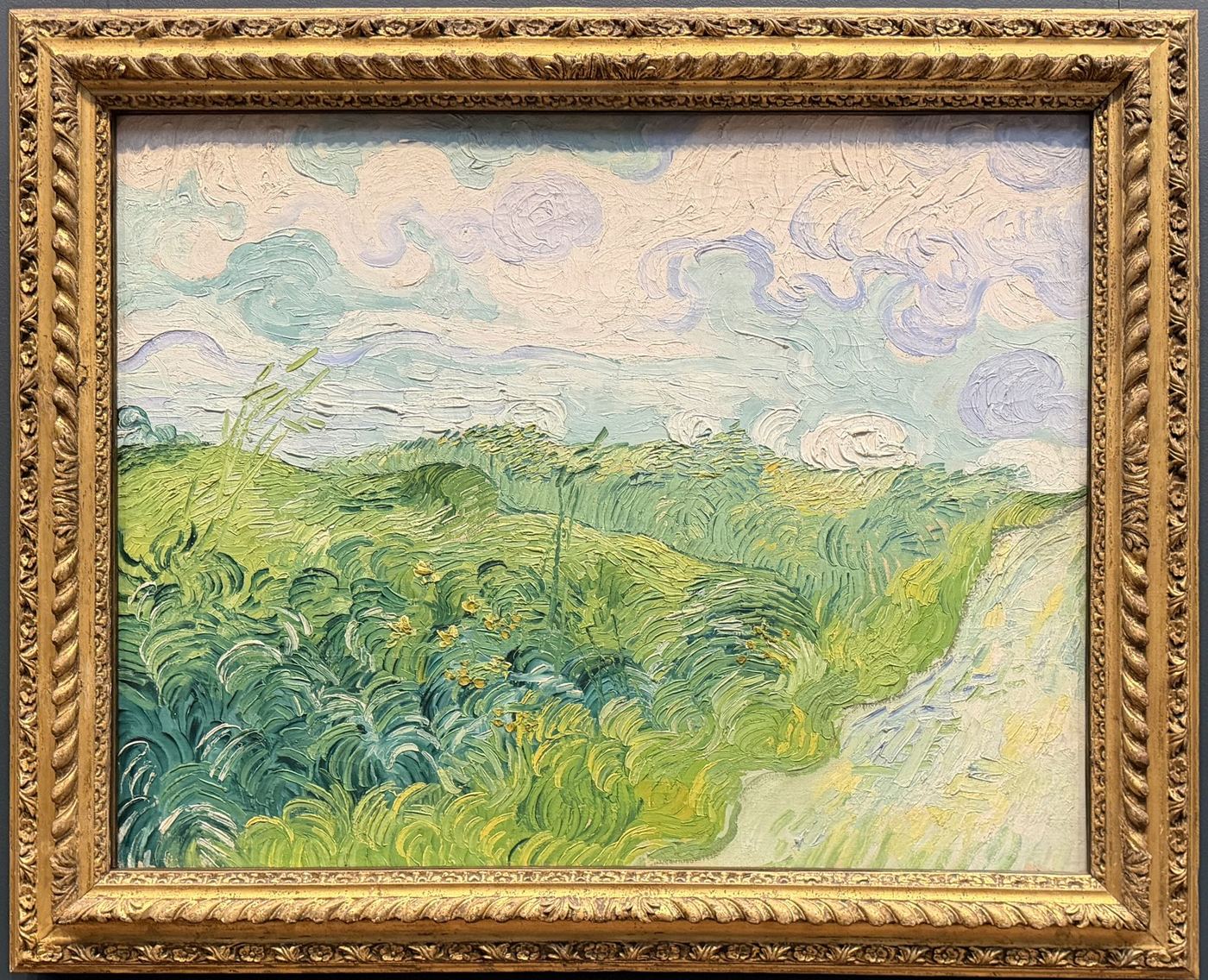
One hundred twenty-eight works in ten galleries on the West Building's main floor, walked from Monet's Argenteuil in M85 to Manet's Paris in M89. Tap a painting to hear its stop: the label, the picture itself, and what to look for with a maker's eye.
Every stop carries the wall label, a description of the picture, what to look for, and researched background, with the artist's own words where a source prints them verbatim. Ten short segments, the critics, and twenty detours, each a tile in the grid at its place in the walk: the war, the collectors, the politics, and the fate of these pictures.
Pick a painting
Tap paintings or segments to X them off or clear them. Tap Done when finished.
Twenty minutes: nine stops that carry the argument
Each artist in a lane, each work at the date on its card. Slide sideways; tap a work to hear its stop. Dashed means circa; a bar means a date range; undated works sit at the right.
Room 1
Gallery M85: Impressionism
The museum calls this room simply Impressionism, and its panel states the program: these painters worked "quickly, often outdoors," using "flickering brushwork to convey the fleeting effects of changing light." Nine pictures hang here, four by Monet, two by Caillebotte, and three by Renoir, dated 1874 to 1899.
The panel also names the places: "Argenteuil, Chatou, Vétheuil," small towns along the Seine that the railroad kept within reach of Paris. Water and gardens carry most of the room: Monet's bridge and boats at Argenteuil, Caillebotte's rowers, three gardens, and a lily pond.
Then the room turns to people: Monet's wife and son on a hill, and three Renoir girls, one of them a dancer. In each, watch how the touch changes between the figure and the setting around it.
The wall panel, verbatim
Impressionism
Impressionist artists were devoted to depicting the
world around them. Painting quickly, often outdoors, they
used flickering brushwork to convey the fleeting effects
of changing light. Alive with color and a vivid sense of
atmosphere, their paintings capture direct visual experiences.
Many of the works here are set in small towns where the
artists lived and worked: Argenteuil, Chatou, Vétheuil. These
were largely rural places along the Seine River that offered
sunlit, flower-strewn fields or sparkling reflections on water.
An expanding rail network allowed artists to continue
developing their modern styles. They depicted suburban
leisure while maintaining contact with Paris, the capital city.
1
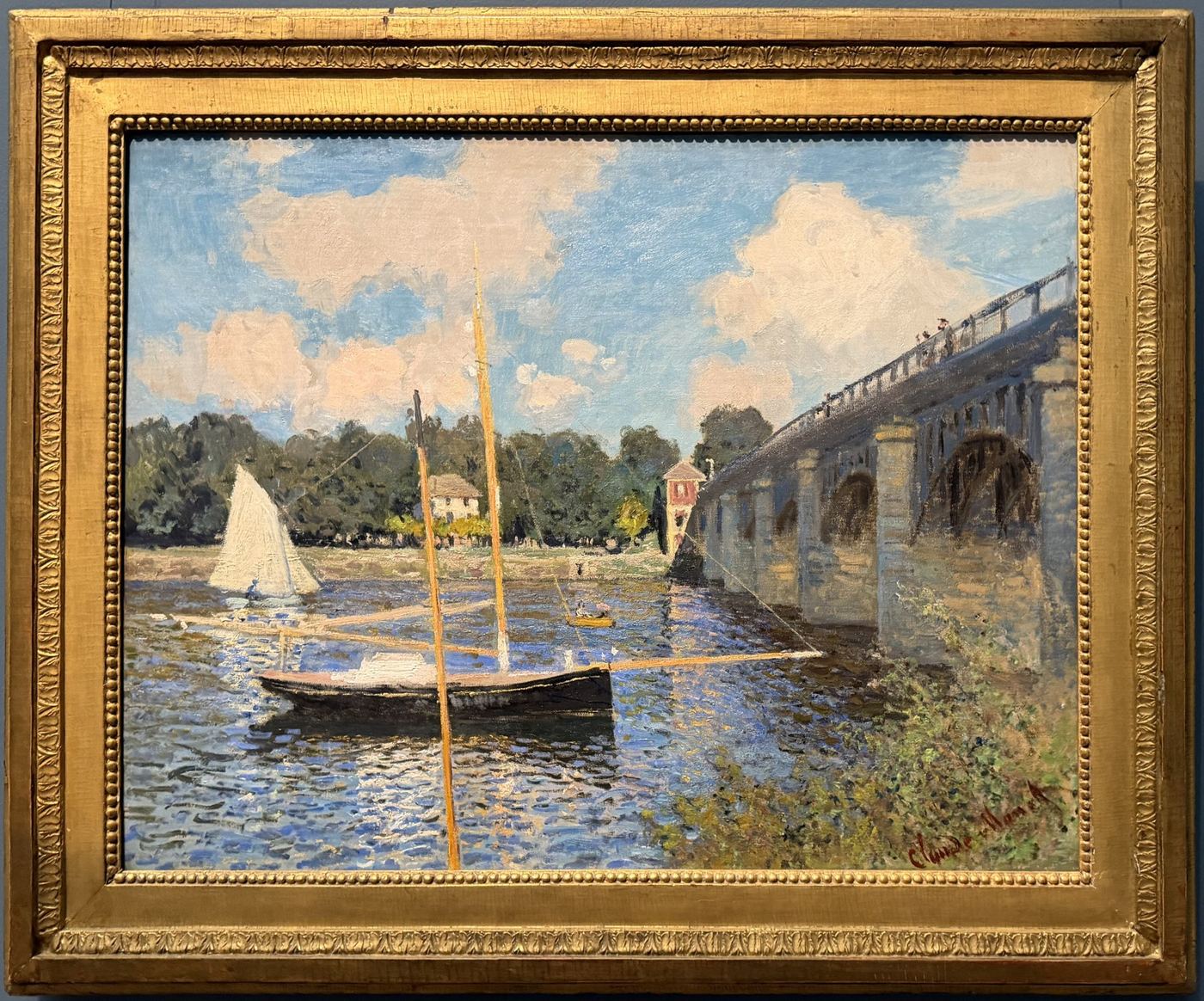
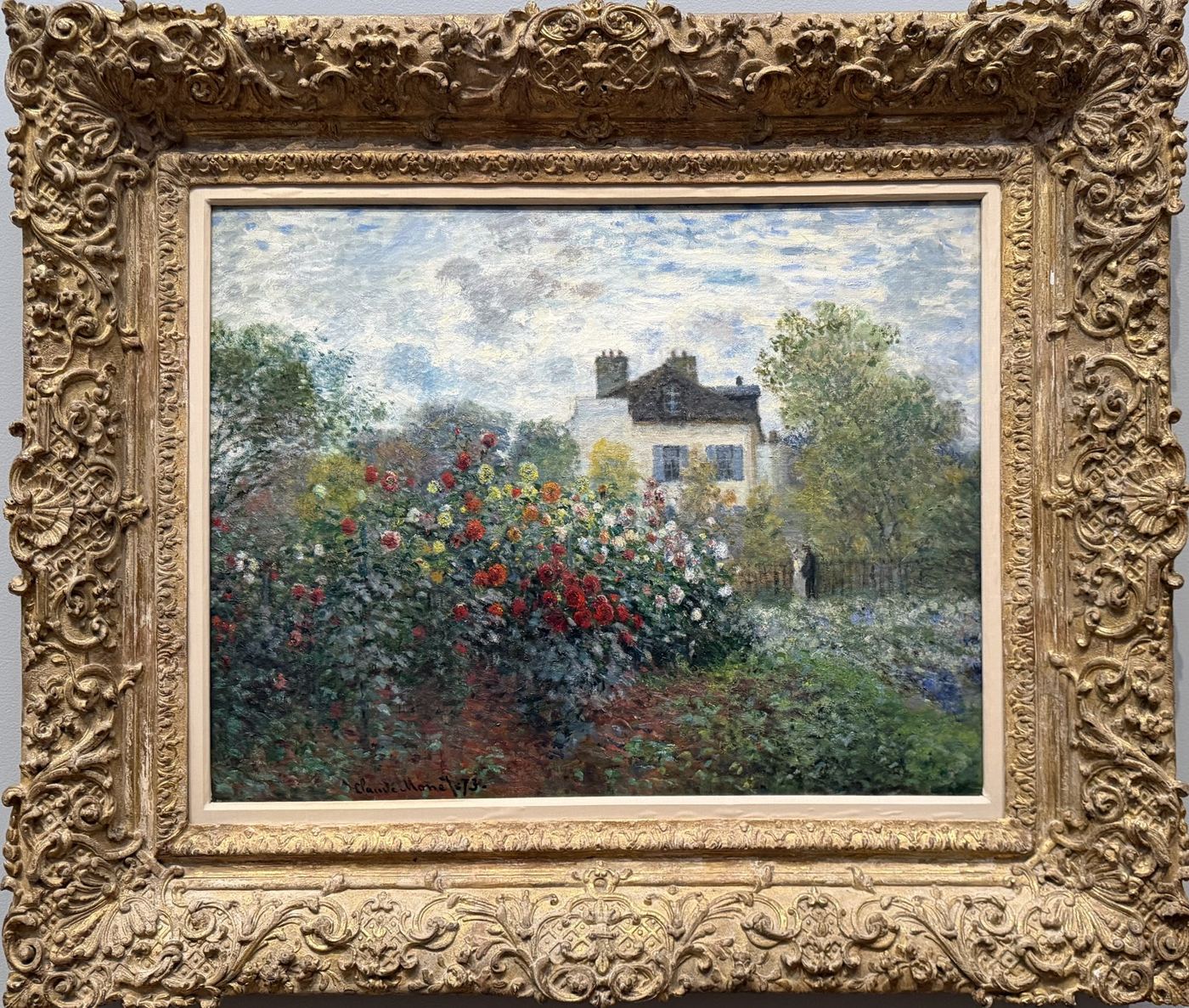
Claude Monet
The Bridge at Argenteuil
French, 1840 – 1926 1874 oil on canvas Collection of Mr. and Mrs. Paul Mellon 1983.1.24
The wall cardThe Bridge at Argenteuil, 1874
The pictureA river scene split by a bridge. The bridge enters at the right edge and runs diagonally into the middle distance on heavy piers and round arches, with a few small figures at the rail. In the center a dark-hulled sailboat sits moored, its tall yellow mast rising past the treeline, and a second yellow pole crosses in front of the hull and runs off the bottom edge. Beyond it a white sail leans on the water, a small yellow rowboat carries two figures, and a pink tower-like building stands at the bridge's far end against a dense green bank. Cumulus clouds drift over a pale blue sky, and the water breaks into dashes of blue, white, and ochre. Green brush fills the lower right, where the red signature sits.
Beyond the labelThe National Gallery's own text sets the scene: the pleasure boats on this stretch of the Seine "drew tourists to Argenteuil." The bridge carried its own recent history, since Monet had earlier painted Argenteuil's highway bridge under repair after it was blown up in the Franco-Prussian War. The picture's first private owner, from 1890, was Henri Vever, the Paris jeweler whose Art Nouveau pieces at the 1900 World's Fair made his name and who was one of the earliest Europeans to collect Japanese woodblock prints; it left his hands at his sale in 1897. [X01-01, X01-10, X01-11]
In his words"When you go out to paint, try to forget what objects you have before you, a tree, a house, a field or whatever. Merely think here is a little square of blue, here an oblong of pink, here a streak of yellow, and paint it just as it looks to you, the exact color and shape, until it gives your own naïve impression of the scene before you." (Monet's advice to Lilla Cabot Perry, as she recalled it.)
Look forLook at the water against the poles. The river is broken color: short horizontal dashes of blue, white, violet, and ochre set side by side and barely blended, so the surface reads as scattered light, not modeled form. The yellow poles are single long strokes laid over that field, with the water strokes visibly running underneath. The clouds are the thickest paint here, creamy impasto that stands up off the thinner blue around it.
Photo IMG_7344; label IMG_7343
2
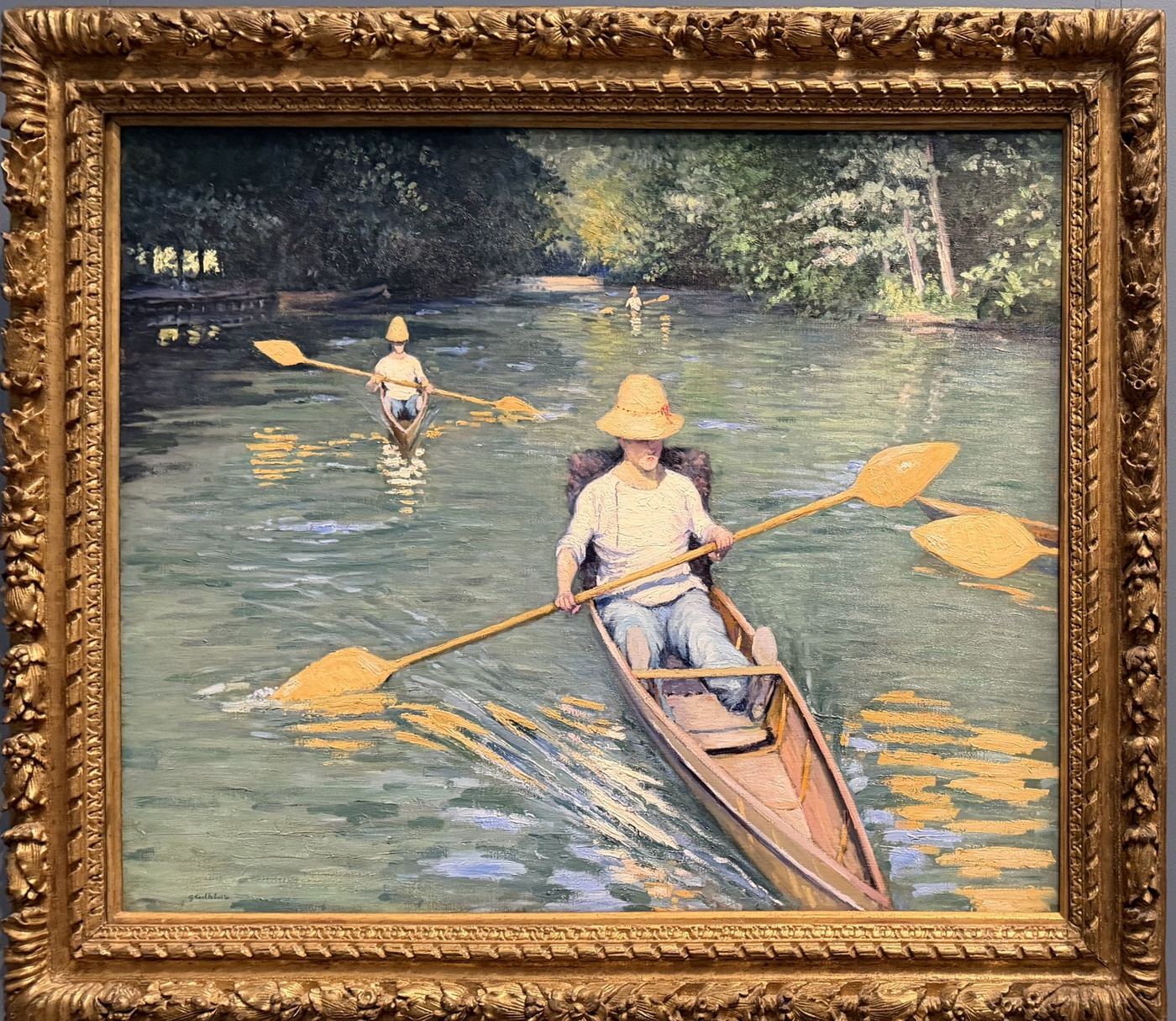
Gustave Caillebotte
Skiffs
French, 1848 – 1894 1877 oil on canvas Collection of Mr. and Mrs. Paul Mellon 1985.64.6
The wall cardSkiffs, 1877
The pictureThree rowers in narrow skiffs come straight at you down a green river. The nearest fills the lower right: a man in a straw hat, white shirt, and pale blue trousers, seated low with his feet braced, pulling a double-bladed paddle whose yellow blades reach nearly across the canvas. His wooden hull runs on a steep diagonal toward the bottom edge, sharply foreshortened, and a white wake fans out behind the left blade. A second rower, also in a straw hat, follows at middle left, and a third is a small figure far down the channel. Yellow blades from a fourth boat cut in at the right edge. Trees close in on both banks, dark at left and sunlit at right. The viewpoint is high, looking down onto the water. Signed at lower left.
Beyond the labelCaillebotte painted this on the Yerres, the small river at his family's country estate, in a run of 1877 and 1878 pictures of swimmers, fishermen, rowers, and canoeists. He showed it at the fourth Impressionist exhibition in 1879 as Flat-Bottom Canoes on the Yerres. The National Gallery reads the high viewpoint, perhaps taken from Japanese prints, as a way to stress how easily these flat-bottomed boats tipped, and the zigzag of the rowers as a progression through time and space that shows his interest in photography. Caillebotte, himself a sailor and boat designer, died in 1894 without children, and the canvas stayed with his family until 1966. [X01-02]
In his wordsNo verified quote found for this work.
Look forThe paddle blades are the thickest paint on the canvas: yellow laid on as a stiff paste, ridged and almost modeled, so they catch the gallery light like low relief. The water around them is thin by comparison, flat horizontal strokes of gray-green. The reflections of the blades repeat the same thick yellow as broken horizontal bars. The rower's shirt is also built up in impasto; the trees are thinner and smoother.
Photo IMG_7346; label IMG_7345
3
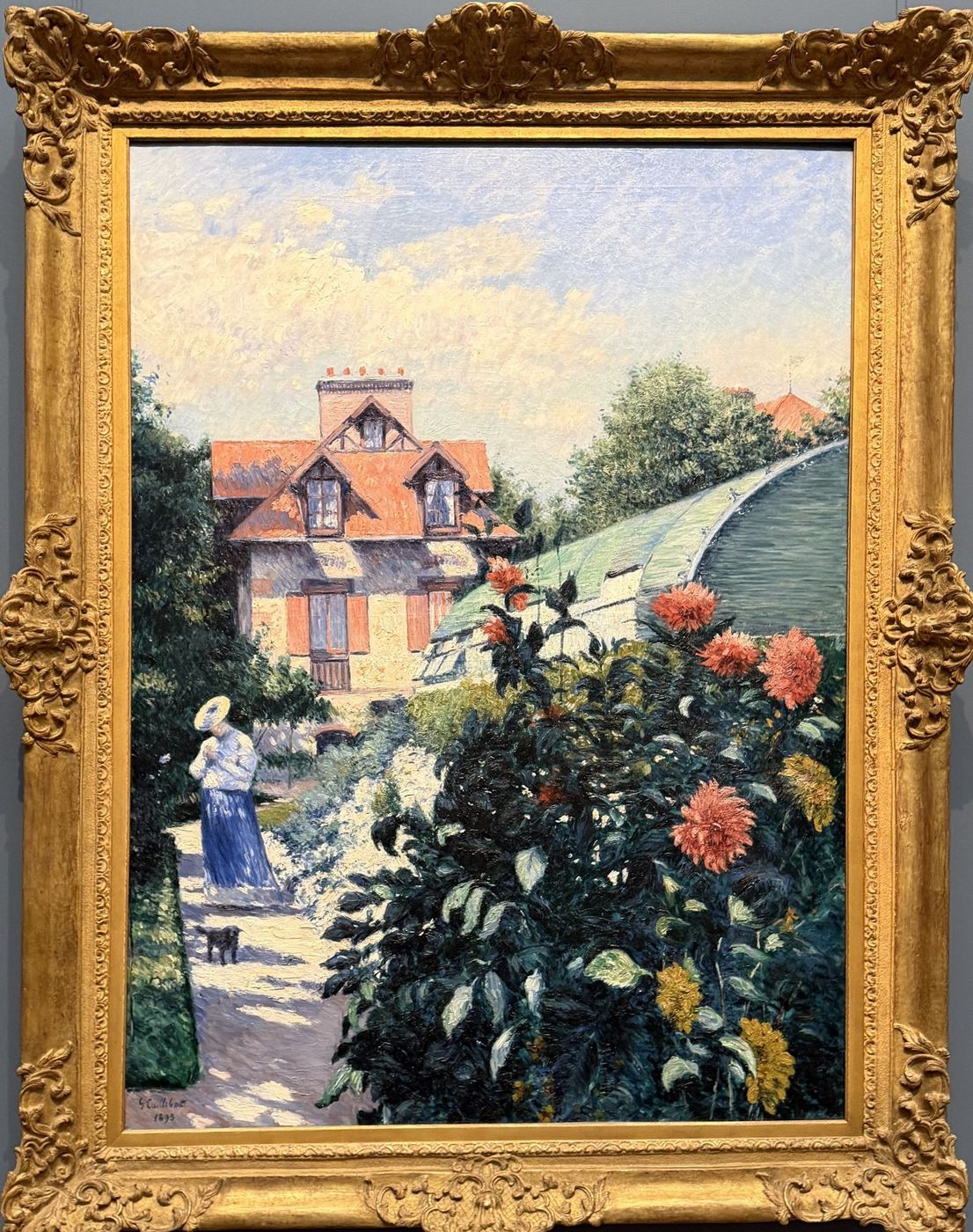
Gustave Caillebotte
Dahlias, Garden at Petit Gennevilliers
French, 1848 – 1894 1893 oil on canvas Gift of the Scharffenberger Family 2016.48.1
The wall cardDahlias, Garden at Petit Gennevilliers, 1893
The pictureA tall upright garden view. On the right, a heavy, dark green dahlia bush pushes into the foreground with coral-red and yellow heads the size of a hand. On the left, a sunlit path runs back toward a half-timbered house with a steep orange roof, two dormers, a central gable, and a row of chimney pots. A woman in a white blouse, blue skirt, and white hat walks the path with her head bowed, and a small black dog stands at her feet. Behind the dahlias, a long, curving green roof with glazed panels at its base sweeps toward the right edge. The sky is pale and warm, its clouds built of dabs, and the shadows on the path are blue-violet. Signed and dated at lower left.
Beyond the labelCaillebotte and his brother Martial bought this land at Petit Gennevilliers, across the Seine from Argenteuil, in 1881, after both their parents had died; he later bought his brother out and largely traded Paris for gardening, painting, and sailing, and he and Monet swapped gardening advice. The museum calls the woman on the path likely the woman Caillebotte lived with, Charlotte Berthier, to whom he left a sizable annuity. He painted this in 1893, died the next year of pulmonary congestion while working in this same garden, and the picture hung in the retrospective Durand-Ruel mounted in 1894. The museum hangs it near Monet's Vétheuil garden on purpose: the two canvases are the same size. [X01-03, X01-12, S0687, S0246]
In his wordsNo verified quote found for this work.
Look forEvery surface here is woven from short, loaded strokes that change direction with the form: crosshatched in the sky, flat and horizontal on the path, curling with the petals on the dahlia heads. The impasto is thick enough that the sky has the texture of knit wool at arm's length. Each dahlia leaf is one or two strokes, a dark body with a lighter, cooler edge pulled along one side.
Photo IMG_7348; label IMG_7347
4
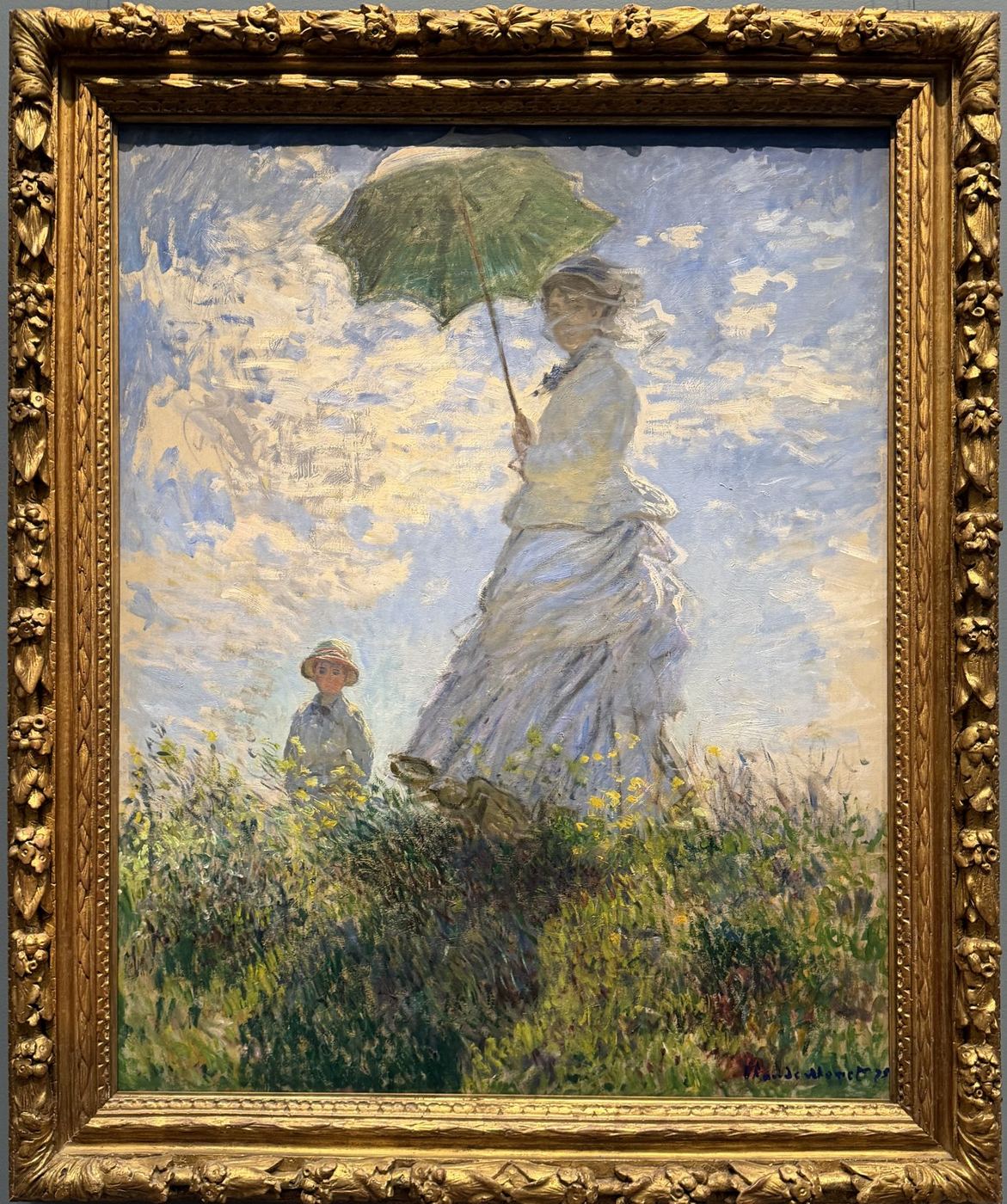
Claude Monet
Woman with a Parasol — Madame Monet and Her Son
French, 1840 – 1926 1875 oil on canvas Collection of Mr. and Mrs. Paul Mellon 1983.1.29
The wall cardWoman with a Parasol — Madame Monet and Her Son, 1875
The artist’s wife Camille stands on a hill with their son Jean behind her. Monet worked quickly to record this moment. Sketching the sky in chaotic strokes of blue and gray, he left areas of canvas exposed in his haste. The grass is more densely painted in short brushstrokes of green, blue, and brown. Small dabs of yellow suggest buttercups, and the color is reflected on Camille’s sleeve. The dense slashes of brilliant white on the back of her skirt and jacket catch the light. Completed in a single outdoor session, this is a celebration of color and light.
The pictureYou look up at a woman standing on a rise, set against the sky. She holds a green parasol tilted toward the light, and a veil blowing across her face half hides it. Her white dress and jacket are shaded in blue and violet, and the skirt swings to the left in the wind. A boy in a straw hat stands lower at left, cut off at the waist by the hill. Tall grass fills the bottom third, green with yellow flowers. Above, white and cream clouds are driven across a blue sky in diagonal sweeps, and the two figures are the only things that rise into it. Signed and dated at lower right.
Beyond the labelMonet had moved to Argenteuil in late 1871, with Manet's help in finding lodging. The museum's catalogue is a shade more careful than the wall card: it says the picture was painted outdoors, probably in a single session of several hours, and that Monet meant it to feel like a family outing interrupted, not a formal portrait. At the second Impressionist exhibition in 1876 its spontaneity and naturalness were praised, and that year it went from Monet to Georges de Bellio, a Romanian-born collector trained in medicine who helped Monet with money and with medical care for his family, and who in 1878 bought Monet's Impression, Sunrise. [X01-04, X01-09]
In his wordsNo verified quote found for this work.
Look forStand close to the upper left of the sky. Between the strokes, the pale cream priming shows through untouched, and the blue is dragged into still-wet white, wet into wet, so the colors streak instead of sitting side by side. There is also a scrubbed, grayish patch with loose linear marks that resolve into nothing; it reads as a passage begun and wiped back. Compare the skirt, where the whites are thick, opaque slashes.
Photo IMG_7349; label IMG_7350
5
Claude Monet
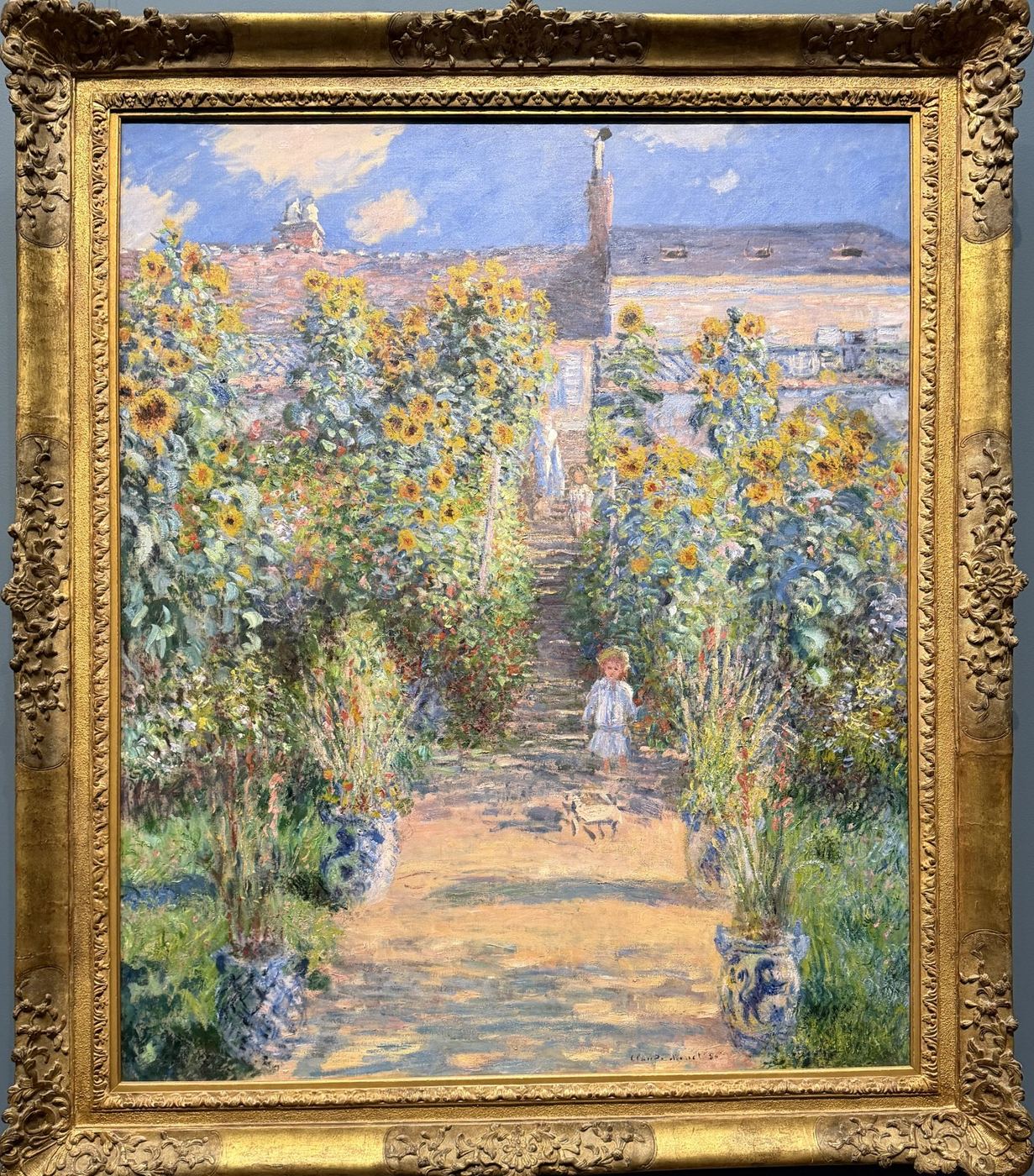
The Artist’s Garden at Vétheuil
French, 1840 – 1926 1881 oil on canvas Ailsa Mellon Bruce Collection 1970.17.45
The wall cardThe Artist’s Garden at Vétheuil, 1881
The pictureA tall canvas looking straight up a garden path toward a house. The path, sunlit peach with blue-violet shadows, rises to a flight of steps and the house's pink-tiled roof and chimney, with more roofs and a pale building at right. Sunflowers taller than a person line both sides, their heads yellow disks with dark centers, among dense foliage flecked with small red flowers. Four blue-and-white glazed pots stand in pairs along the path, two near and two farther up. A small child in white stands mid-path with a small object, perhaps a toy, at its feet, and two more figures, one taller, stand near the top of the steps. The sky is blue with a few white clouds. Signed at lower right.
Beyond the labelMonet moved to Vétheuil in 1878 with his ailing wife Camille, their two young children, and the family of his former patron Ernest Hoschedé, and money was short; even so, he painted nearly 300 pictures there in three years. This is the largest of four closely related canvases of the garden; in 2018 the National Gallery hung it beside the smaller version from the Norton Simon Museum in Pasadena, long thought to be its study, the first time the two had been together since they were painted. Before that showing, the Gallery's conservator Ann Hoenigswald spent months taking a discolored natural resin varnish off this canvas, and said, "The minute I got the varnish off, it just soared." Monet kept the picture until 1910. [X01-08, S0234]
In his wordsNo verified quote found for this work.
Look forWatch the shadows. The shade on the path is not darkened yellow but a cooler color laid alongside: lavender and blue strokes next to peach and cream, nearly as light, so the path stays bright even in shadow. The strokes on the path run horizontally across it; on the foliage they turn every direction. The pots are drawn with quick dark-blue calligraphy over white, not modeled.
Photo IMG_7351; label IMG_7352
6
Claude Monet
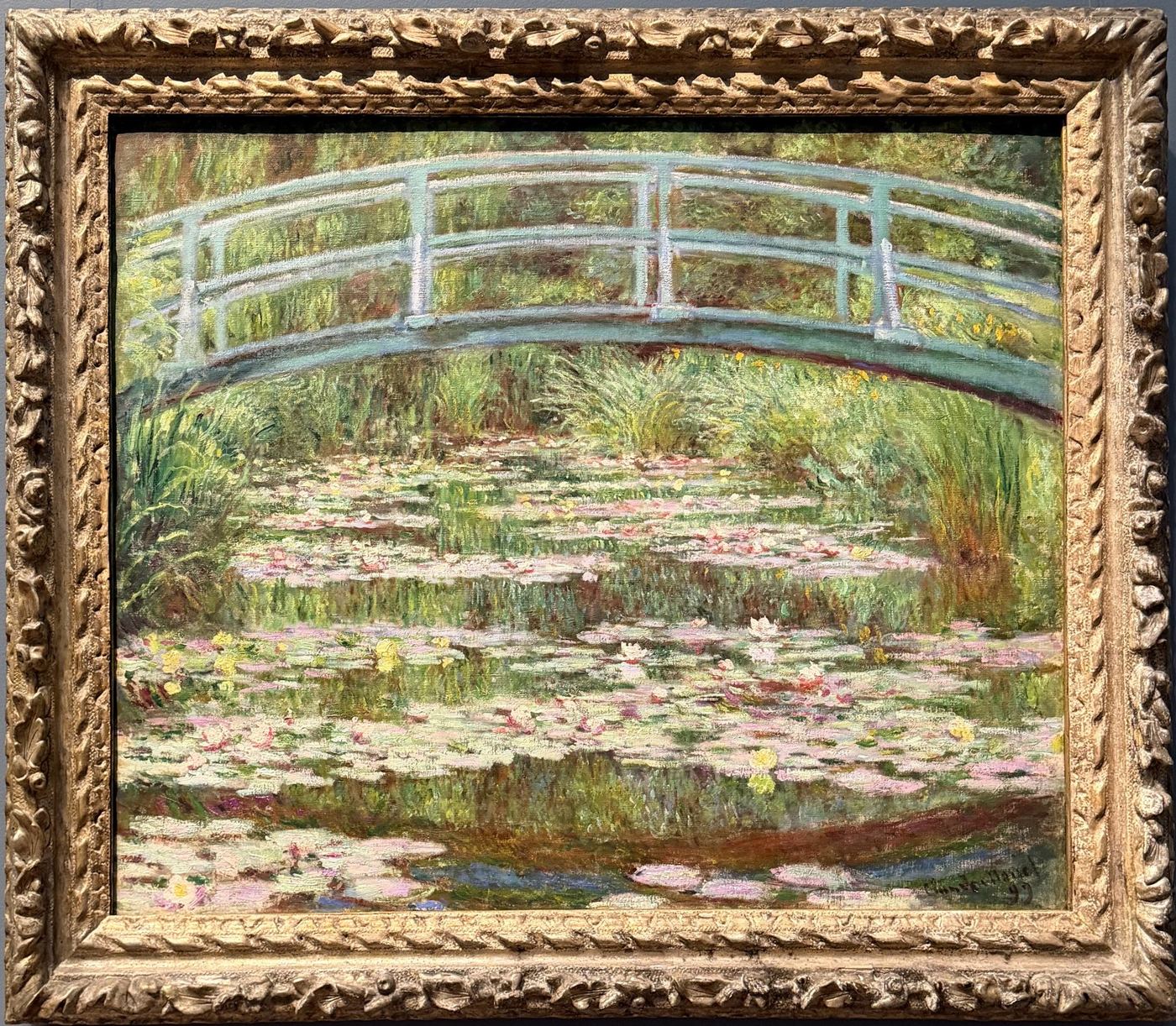
The Japanese Footbridge
French, 1840 – 1926 1899 oil on canvas Gift of Victoria Nebeker Coberly, in memory of her son John W. Mudd, and Walter H. and Leonore Annenberg 1992.9.1
The wall cardThe Japanese Footbridge, 1899
Gift of Victoria Nebeker Coberly, in memory of her son John W. Mudd, and Walter H. and Leonore Annenberg 1992.9.1
The pictureNo sky and no horizon. A pale blue-green footbridge arcs across the upper third of the canvas, cut off at both edges, its railing a double line of uprights and bars. Behind it is a wall of green, grasses, reeds, and foliage up to the top edge. Below the bridge, the pond recedes in horizontal bands of lily pads, broken by strips of dark reflection where the pads part. The blossoms are flicks of pink, white, and yellow, larger near you and smaller toward the bridge. Tall reeds rise from the banks at left and right. Signed and dated at lower right.
Beyond the labelMonet bought this marshy plot across the railroad tracks in early 1893 and asked the village council for leave to divert a stream into it; he designed the bridge, the shape of the pond, and the plantings himself. In 1899 he painted twelve views from this one spot, and when they were shown at Durand-Ruel's gallery in 1900, several critics mentioned his debt to Japanese art, while Gustave Geffroy wrote of "a calm pool, immobile, rigid, and deep like a mirror." The museum also reads the closed wall of green, with the top of the arch set just under the canvas edge, as an echo of the walled garden of medieval pictures. Durand-Ruel bought this canvas from Monet in January 1900; the Carnegie Institute in Pittsburgh bought it in 1920 and kept it until 1953. [X01-05, S0236]
In his wordsNo verified quote found for this work.
Look forThe railing carries a pale, stiff paint dragged across the surface so it catches on the canvas weave and breaks up, leaving the texture of the cloth visible through the stroke. That is dry brush, and it gives the rails their sparkle without a drawn highlight. The pads, by contrast, are horizontal bars of wetter paint, and they shrink as they recede: the perspective is done with stroke size.
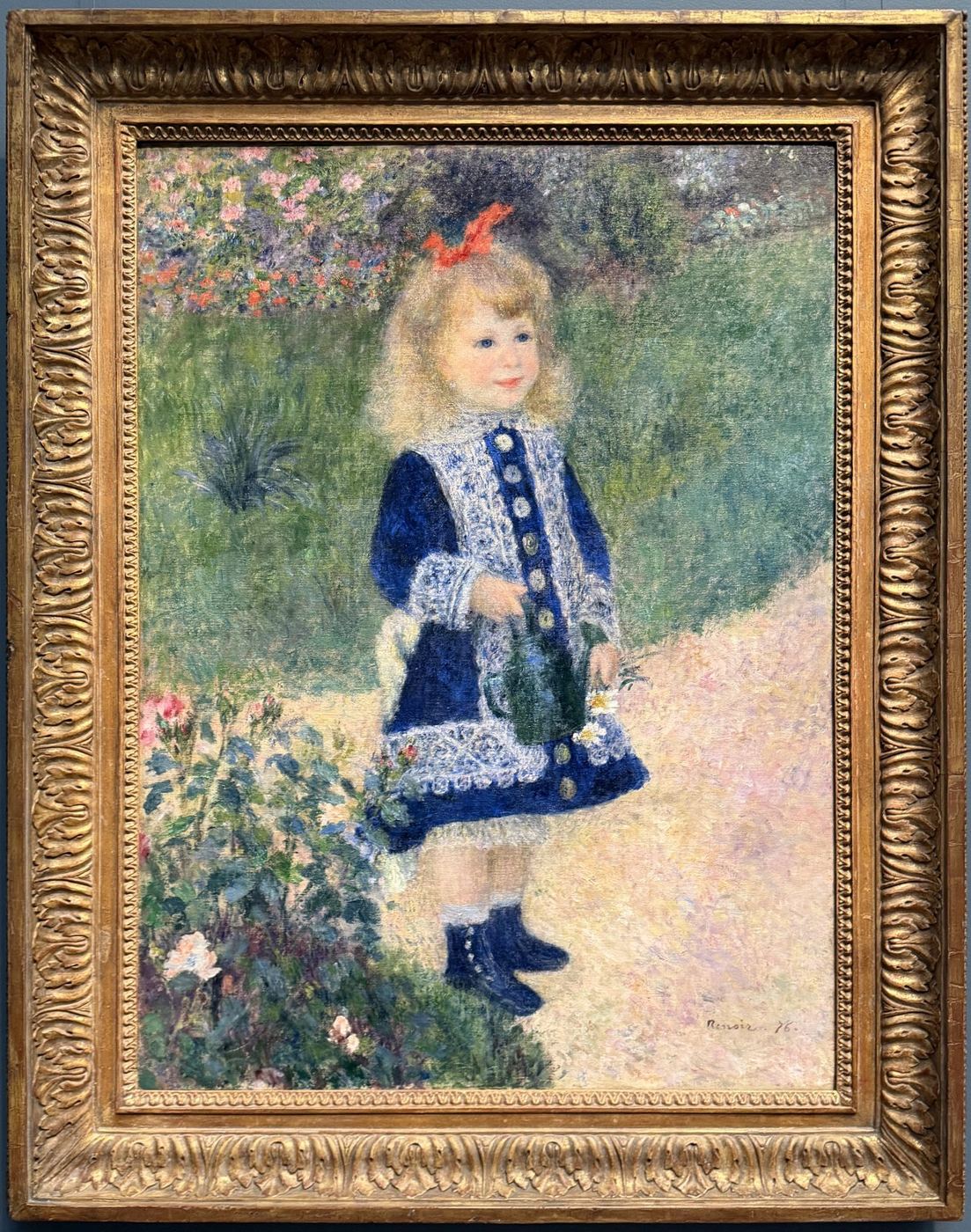
Label match: the card is the context photo taken just before the work; its subject, a small girl in blue holding a watering can, confirms the pairing.
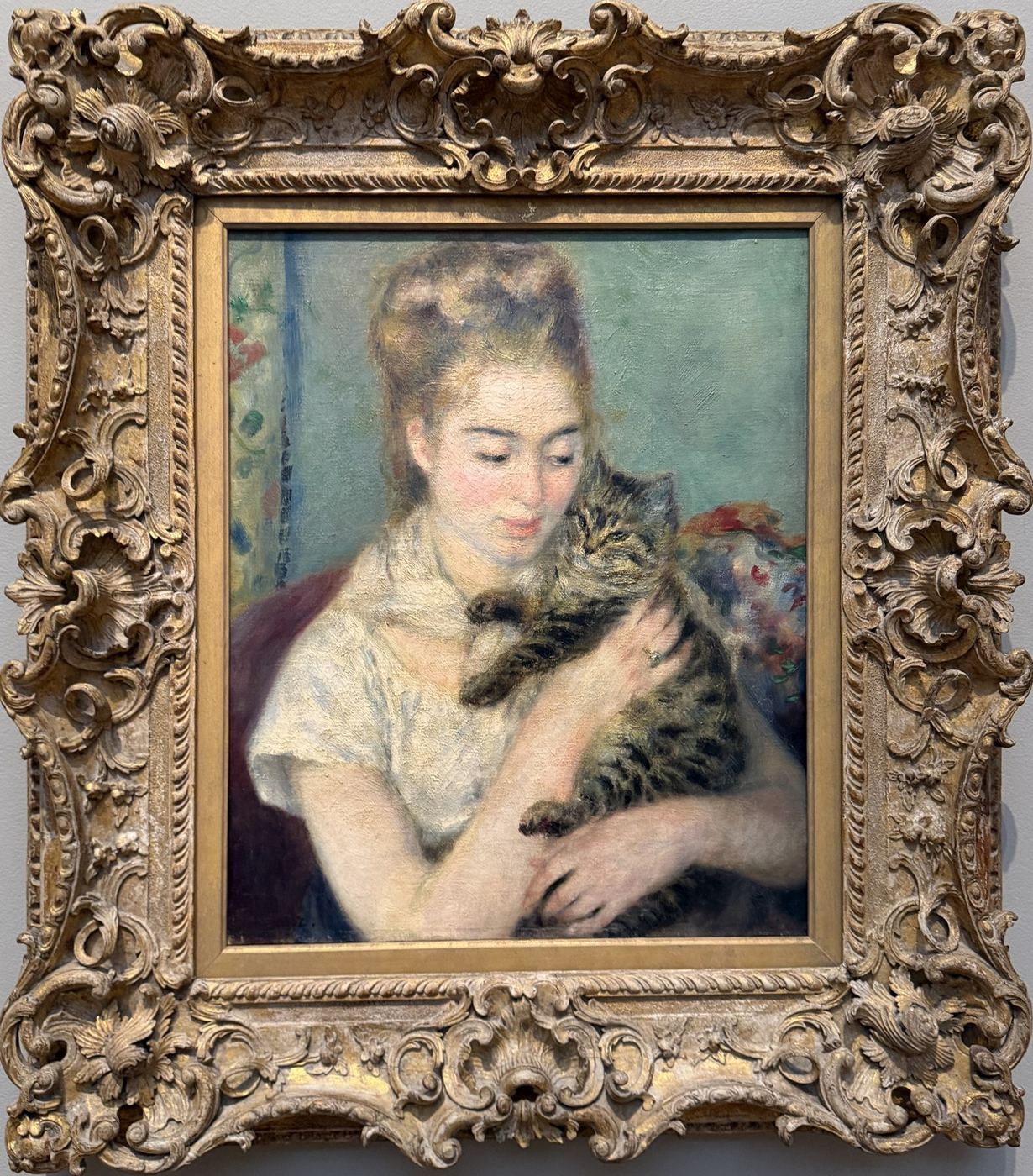
The wall cardA Girl with a Watering Can, 1876
The pictureA small girl stands full length on a garden path, turned slightly toward our right and looking off past us. She wears a deep blue dress with a broad white lace front and cuffs, a row of brass buttons, and white petticoat at the hem, with white socks and dark buttoned boots; a red bow sits in her blond hair. Her right hand holds a green watering can at her waist, and her left holds a few daisies. The path, pink and cream, curves behind her to the right. A rosebush with pale pink blooms fills the lower left, a bed of red and pink flowers sits at upper left, and the rest is lawn. Signed and dated at lower right.
Beyond the labelThe National Gallery dates this to 1876, the year Renoir began painting anecdotal scenes of women and children, and sees in it a mature Impressionist style adjusted to the needs of figure painting. Several names have been proposed for the girl, and the museum finds none convincing: more likely a neighborhood child whose looks pleased him, since a girl with the same curly blond hair, dressed the same way, turns up in other Renoir paintings. The museum's provenance says it was possibly commissioned around 1876 for the Sellière collection in Paris, and Chester Dale bought it in 1931. [X01-06]
In his wordsNo verified quote found for this work.
Look forCompare the face to everything around it. The face and hands are smoothly blended and soft-edged, with almost no visible stroke. The lawn, path, and flowers are broken color: small separate dabs of pink, cream, lilac, and green. The lace is thick white flicked over the dark blue, and the blue of the dress is laid in broad, darker strokes beneath it.
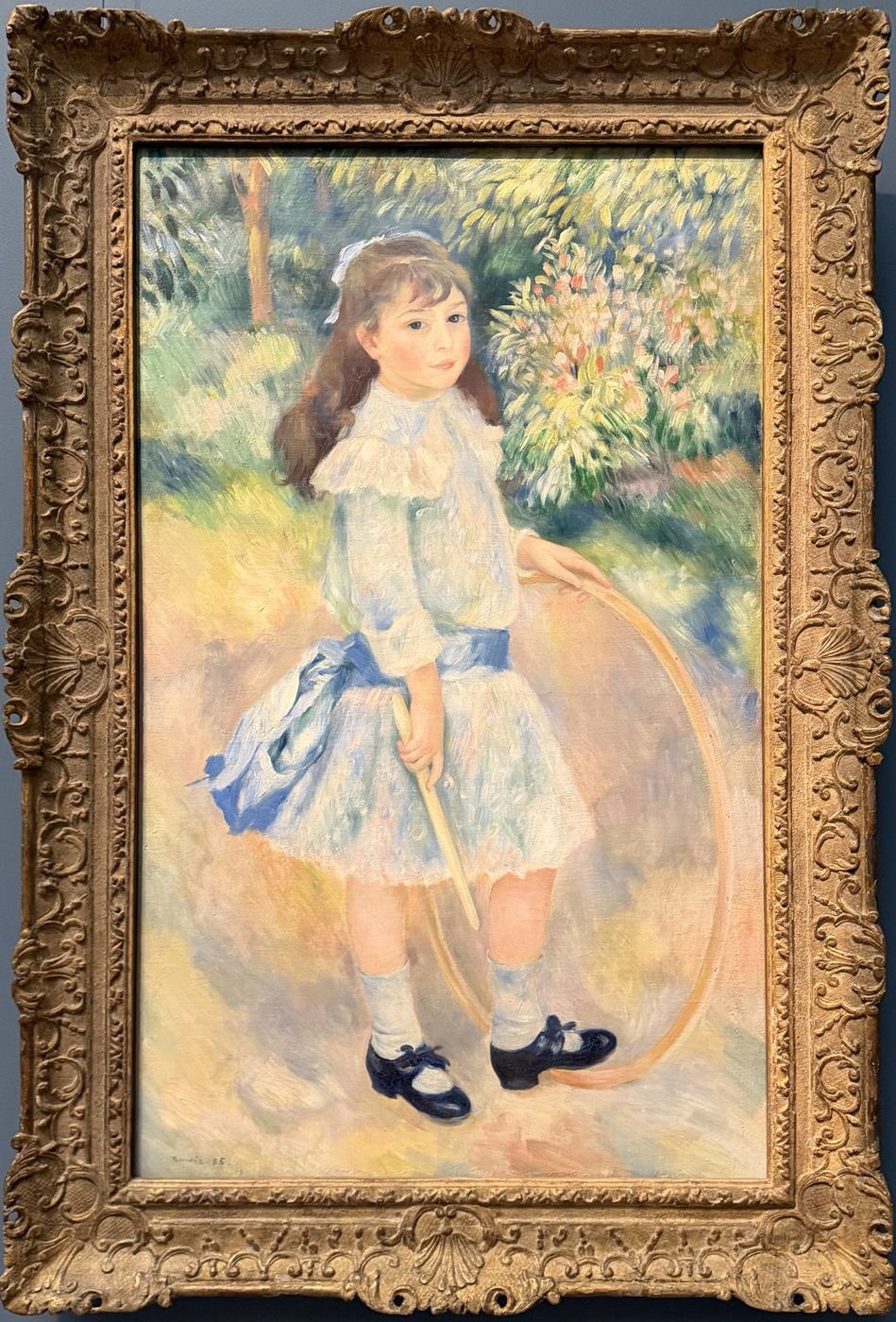
The pictureA girl stands full length in a garden, body angled to our left, head turned to look straight at us. Long brown hair falls past her shoulders, held by a white ribbon. Her white dress has a ruffled collar and a wide blue sash tied at the hip in a loose bow. In her right hand she holds a short stick upright; her left hand rests on the rim of a large hoop that stands beside her, its far edge running down to the path near her feet. She wears white socks and black shoes with bows. Behind her is a soft, sunlit garden: a tree trunk at upper left, a flowering shrub at upper right, and a pale, warm path. Signed and dated at lower left.
Beyond the labelThis was a commission: the museum's provenance records that the girl's father, Senator Étienne Goujon, ordered it, and that it passed to her husband, E. Chapuis, who sent it to auction in Paris in 1920 and then withdrew it. By 1931 it belonged to Max Silberberg, a Jewish industrialist and collector in Breslau, who sold it among nineteen works at the Galerie Georges Petit in Paris in June 1932, where Chester Dale bought it; from 1935 the Nazis forced Silberberg to sell most of what remained, and he and his wife were killed at Auschwitz. It dates from 1885, the years when Renoir, after a trip to Italy, was turning from Impressionism toward a more disciplined technique for portraits and figures. [S0227, X01-13, X01-15]
In his wordsNo verified quote found for this work.
Look forThe finish changes across the figure. The face is the most worked passage: the eyes and mouth have crisp edges and the cheeks are blended. The dress and background are loose, feathery strokes running in many directions. The black shoes are dense, opaque, and hard-edged, the strongest darks on the canvas. The hoop is a single long, even stroke of tan.
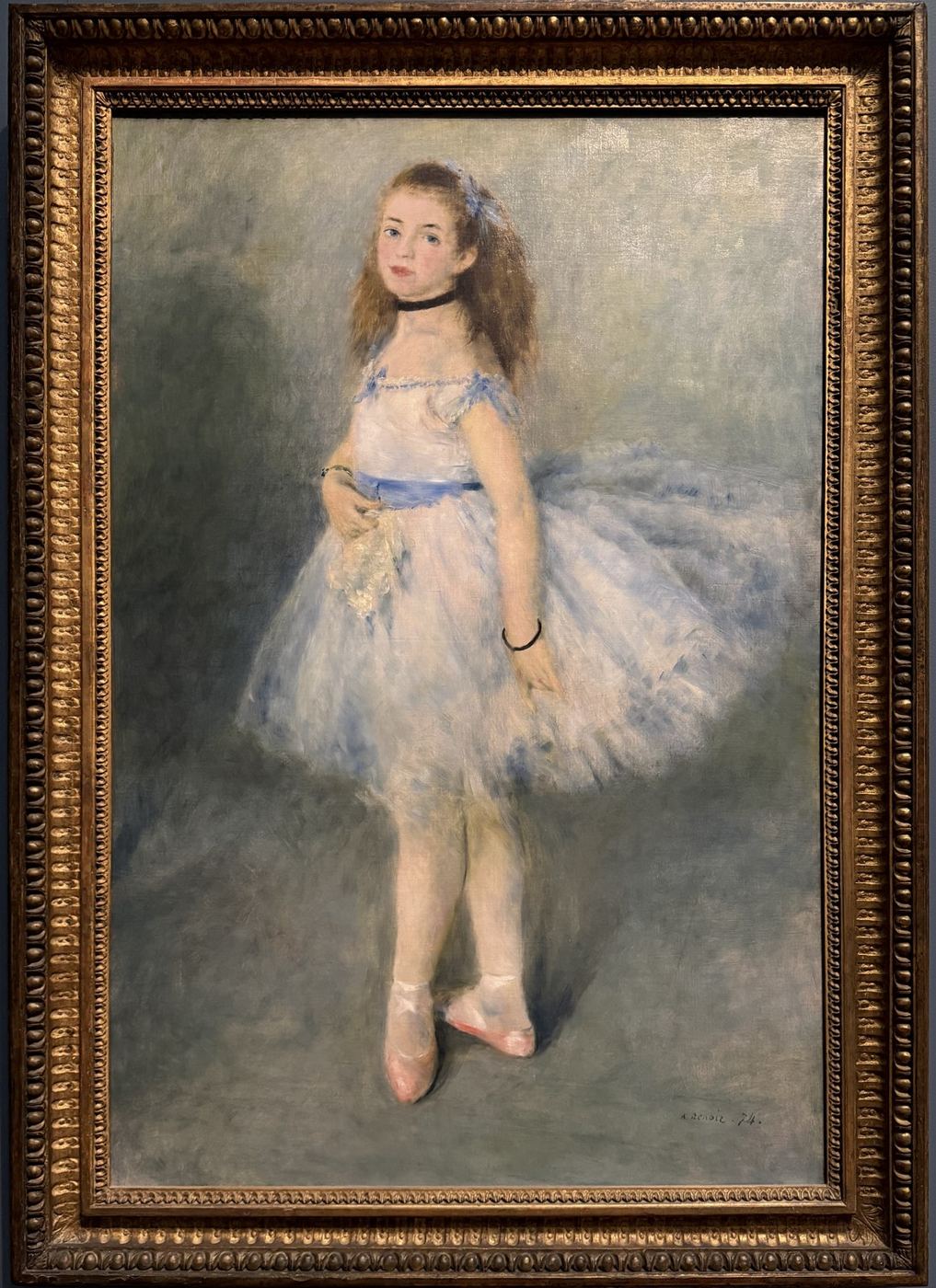
The pictureA young dancer stands full length against an empty gray-green background: no stage, no room, only a shadow on the floor behind her. Her body is angled to our left and her face turns to us. Her feet are crossed, the front one turned out, in pink satin slippers tied at the ankle. Her tutu is a broad, airy bell of white shot with blue, a blue sash circles her waist, a black ribbon is tied at her throat, and a blue ribbon sits in her long reddish-brown hair. She wears a bracelet on each wrist, and her right hand holds something white and frothy at her waist. Signed and dated at lower right.
Beyond the labelThis was one of seven works Renoir showed at the first Impressionist exhibition in April 1874, and his pictures were received better than most of the group's. Critics split over this one: some called it little more than a sketch with weak drawing, while one wrote that it is "true to life and has a fine and nervous elegance in its truth." The National Gallery thinks the model is almost certainly Henriette Henriot, a young actress who posed for Renoir in the mid-1870s, though Renoir never named her; the Frick Collection's 2012 catalogue calls her a young dancer of the Paris Opera, and the Frick stresses that his contemporaries found the bright palette and energetic brushwork audacious. Four years after the show, the collector Charles Deudon bought it. [X01-07, X01-14]
In his wordsNo verified quote found for this work.
Look forThe background is a thin, scumbled gray-green brushed in loose sweeps, so the canvas weave shows across most of it. The tutu is built in feathery strokes of white with blue worked in wet into wet, the edges left soft so the skirt dissolves into the air around it. The face and arms are smoother and more closely modeled. At her feet, darker gray strokes pulled up to the slippers make the shadow that keeps her from floating.
Photo IMG_7359; label IMG_7360
Room 2
Gallery M84: Cezanne
Gallery M84 is a room of Cezanne alone: thirteen canvases dated from about 1876 to 1906. The cards give his life as 1839 to 1906, so the latest of them comes from the year he died. Six are landscapes, four are figures, and three are still lifes, so you can watch one painter take on each subject across thirty years.
The landscapes run from the outskirts of Paris and the Seine to Provence, which one card calls the region "where he was born and raised." Two cards tell you what to watch for. On The Peppermint Bottle, some passages are painted "with crisp precision" while others are "looser and sketchier." On Houses in Provence, short strokes are "applied diagonally from left to right" and build depth "purely through color."
The credit lines name Chester Dale (five works), Eugene and Agnes E. Meyer (three), Mr. and Mrs. Paul Mellon (two), Ailsa Mellon Bruce (one), and the W. Averell Harriman Foundation (one). Houses on a Hill comes from the White House Collection, and its card carries a no-photography mark.
10
Paul Cezanne
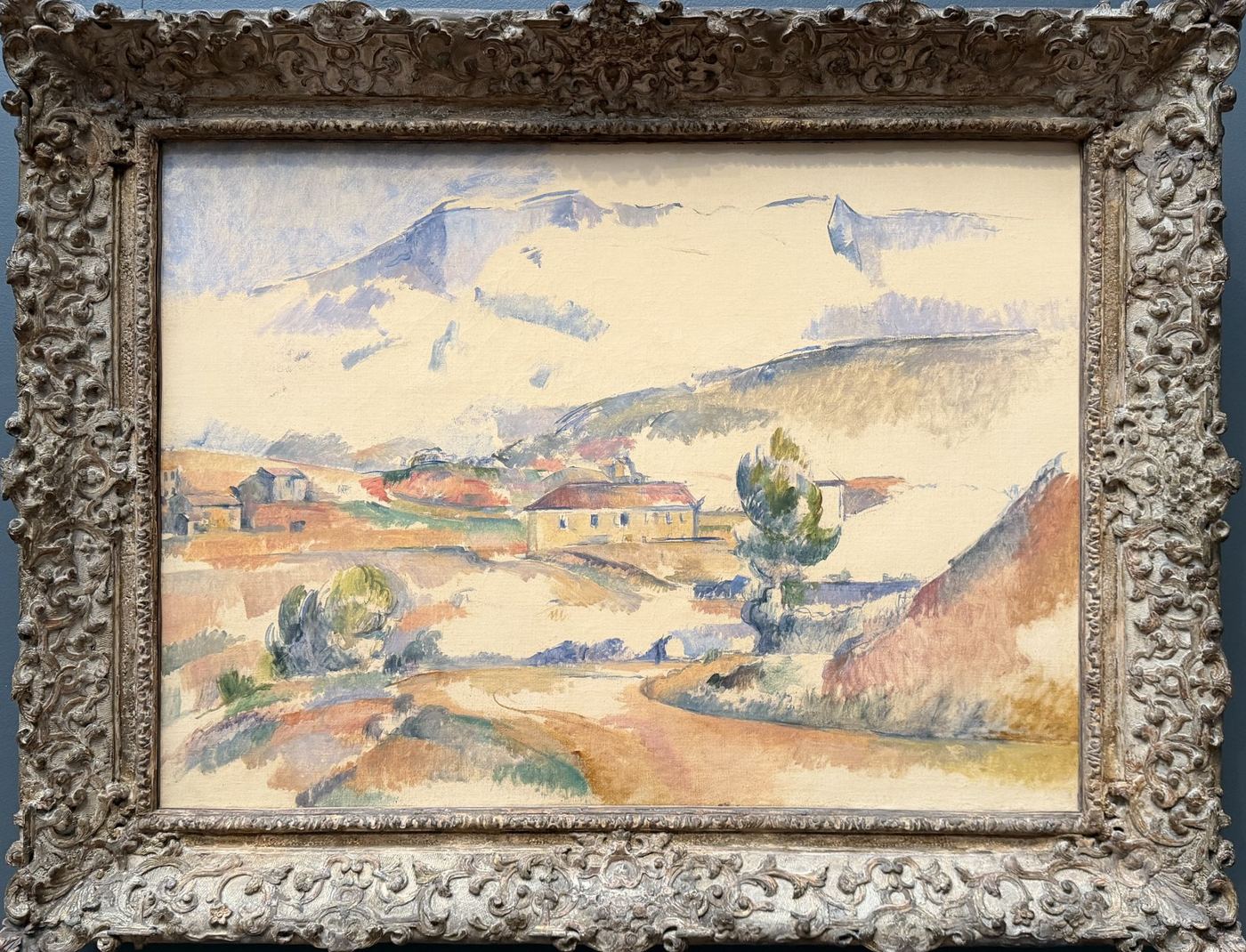
Montagne Sainte-Victoire, from near Gardanne
French, 1839 – 1906 c. 1887 oil on canvas Gift of the W. Averell Harriman Foundation in memory of Marie N. Harriman 1972.9.4
Label match: The same label is visible at the right edge of the work photo; the card prints the artist's name without the accent (Cezanne).
The wall cardMontagne Sainte-Victoire, from near Gardanne, c. 1887 Gift of the W. Averell Harriman Foundation in memory of Marie N. Harriman 1972.9.4
The pictureA wide view across a valley under a pale sky. The mountain at the top is drawn in a few strokes of lilac and blue rather than built up as a mass; its ridge runs left to right and ends in a sharp peak at the right. Much of the sky and the middle distance is unpainted cream ground. Below, a yellow house with a red roof sits at the center, a cluster of farm buildings to its left, and a small pine stands to its right. A pale road curves from the bottom edge toward the right, past a pink and ochre slope that fills the right corner. Blue-green bushes sit at lower left. The color is thin and light throughout, closer to watercolor than to oil.
Beyond the labelCézanne spent the autumn of 1885 and the months after it in Gardanne, a small hilltop town near Aix, and one account reads the paintings he made there as already faceted in a way the Cubists later took up. The museum keeps the Gardanne title, but a 2017 exhibition in Martigny, Switzerland, catalogued this canvas as the mountain seen from the Bayeux bridge at Meyreuil, so the exact vantage is still argued. Its half-covered surface earned it a place in a 2000 exhibition in Vienna and Zurich titled Cézanne: Finished -- Unfinished. Averell and Marie Harriman bought it in 1931, and from 1993 to 1997 it went back to France, lent to the American ambassador's residence in Paris while the ambassador was Pamela Harriman, Averell's widow. [S0218, X02-07, X02-10]
In his words"I imagined the shadow to be concave, whereas in fact it's convex, it disperses outward from the center." (As reported by Joachim Gasquet.)
Look forGet close to the sky and the slopes between the strokes. Those cream areas are reserves: primed canvas left bare, not paint. The color is thinned enough to sit on the ground like a wash, each stroke laid once and left, and the mountain's ridge is a drawn blue line rather than a modeled form. The unpainted ground supplies the light.
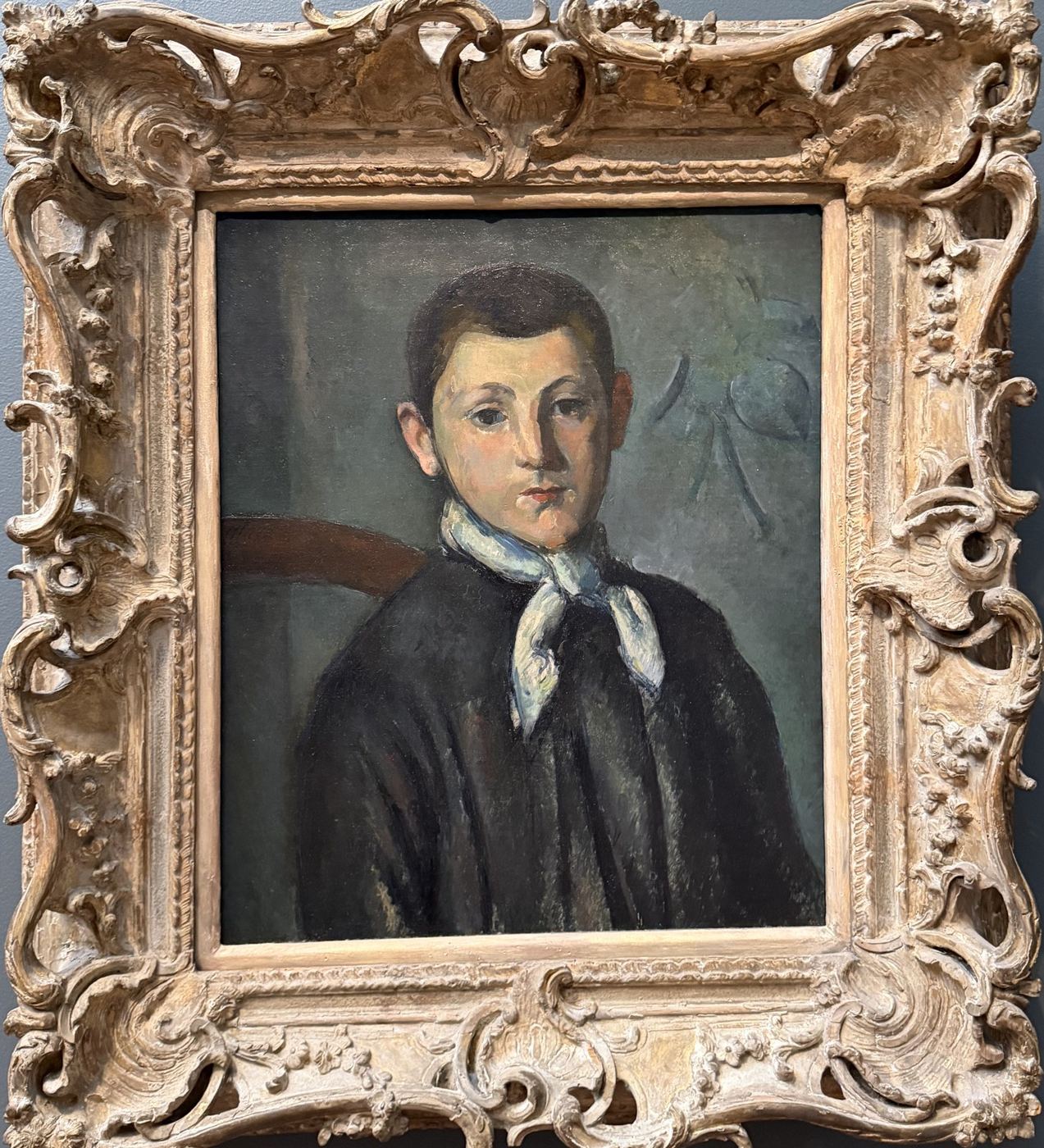
The pictureA boy shown to the chest, his body set at a slight angle and his face nearly frontal, looking out just past us. Short dark hair, large ears, and a long straight nose; the side of the face on our right falls into an olive shadow. A white scarf, knotted at the throat, hangs in two ends, its folds marked with strokes of blue. His dark jacket is laid in with broad strokes of black, brown, and gray. Behind his shoulder at our left is a curved red-brown chair back. The background is a gray-green, with a few looping blue lines at upper right that describe a pattern or an object never resolved.
Beyond the labelLouis Guillaume was the son of friends of the artist and a friend of Cézanne's own son, Paul. The two boys sat together again for Cézanne's Mardi Gras, now in the Pushkin Museum in Moscow, Paul as Harlequin and Louis as Pierrot -- the costume theme you meet at Stop 15. The art historian Meyer Schapiro found the eyes here "without spiritual light." The picture was in Ambroise Vollard's stock by 1906, hung at the Salon d'Automne in Paris that year, the year Cézanne died, and went to the American collector Egisto Fabbri in Florence around then. [X02-15, X02-14, X02-17, S0219, X02-05]
In his wordsNo verified quote found for this work.
Look forLook at the scarf against the jacket. The white is impasto, laid on in short loaded strokes that stand up from the surface, with blue pulled into it while both were wet to model the folds. The jacket around it is thinner and broader. The face is built from small flat patches of warm and cool color set side by side, each a plane, rather than blended into a smooth turn.
Photo IMG_7364; label IMG_7365
12
Paul Cezanne
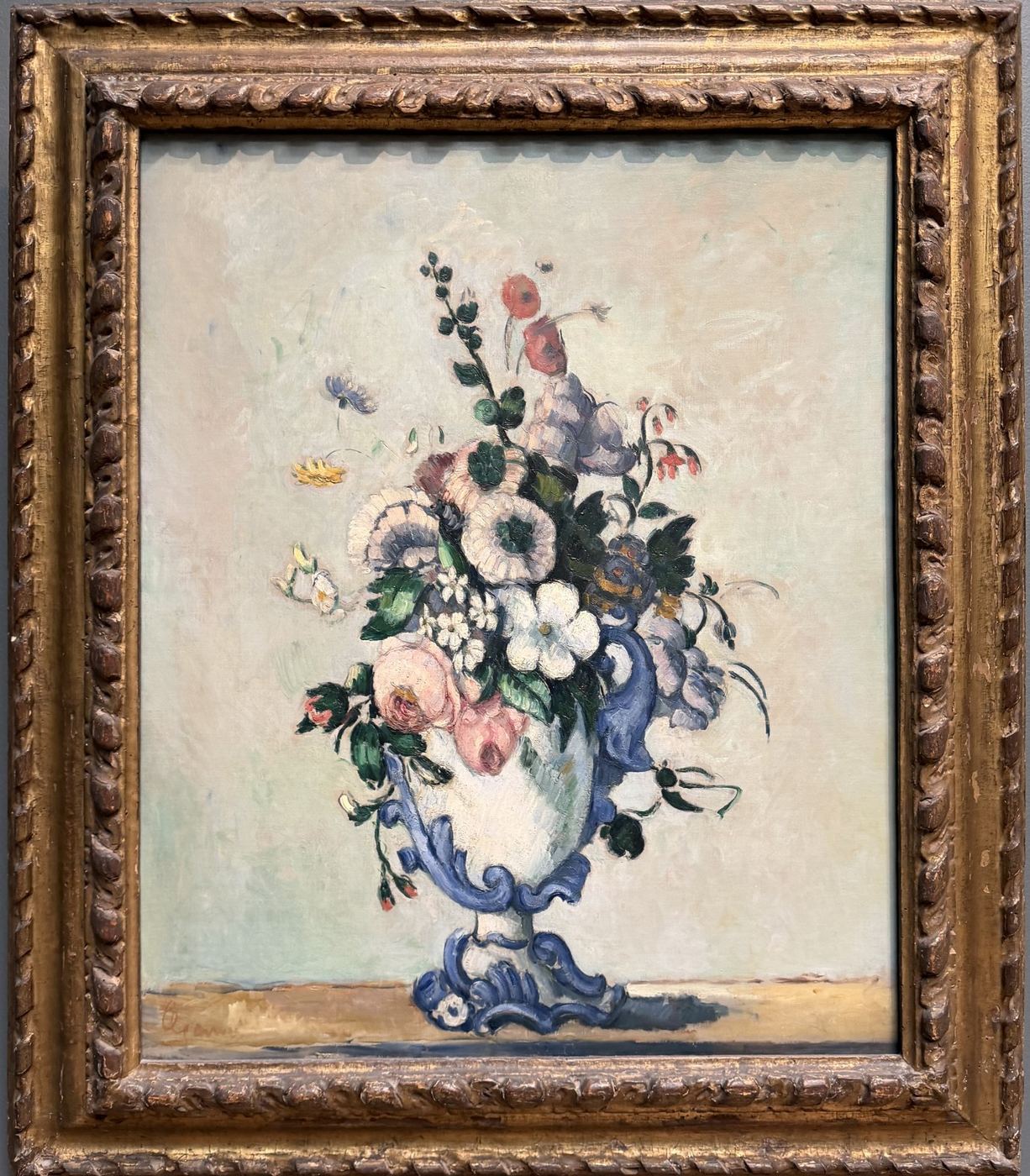
Flowers in a Rococo Vase
French, 1839 – 1906 c. 1876 oil on canvas Chester Dale Collection 1963.10.105
The wall cardFlowers in a Rococo Vase, c. 1876
The pictureA white vase with blue rococo scrolls at its handles and foot stands on a tan ledge against a pale gray-green wall. The bouquet rises in a loose pyramid: pink roses low on the left, white and blue-centered blossoms in the middle, lavender flowers to the right, and a red bloom at the top on a thin stem. Dark green leaves set off the lighter flowers. A few stray blossoms float at the left, barely attached to the bunch. The vase casts a blue-gray shadow to the right along the ledge. A signature in red script sits at lower left on the ledge.
Beyond the labelThis is probably a gift from Cézanne to Gustave Caillebotte, the painter and collector who by the 1877 Impressionist exhibition was renting the space, choosing the works, and hanging them; the museum lists this picture as possibly shown there. Caillebotte left his collection, five Cézannes among it, to the French state, which refused this canvas; it stayed with his estate until 1932 and reached Chester Dale that November. In between, it hung at the 1905 Salon d'Automne, the show where the critic Louis Vauxcelles called Matisse, Derain, and their circle "fauves," wild beasts. [S0208, X02-11, X02-12]
In his wordsNo verified quote found for this work.
Look forCompare the flowers with the wall behind them. The petals are impasto, each one a twist or dab of loaded paint that keeps its ridge, so the bouquet stands off the canvas physically. The wall is a thin layer of crisscrossed strokes in pale green, pink, and gray. The blue scrolls of the vase are drawn with a single loaded brush, each curl one pass.
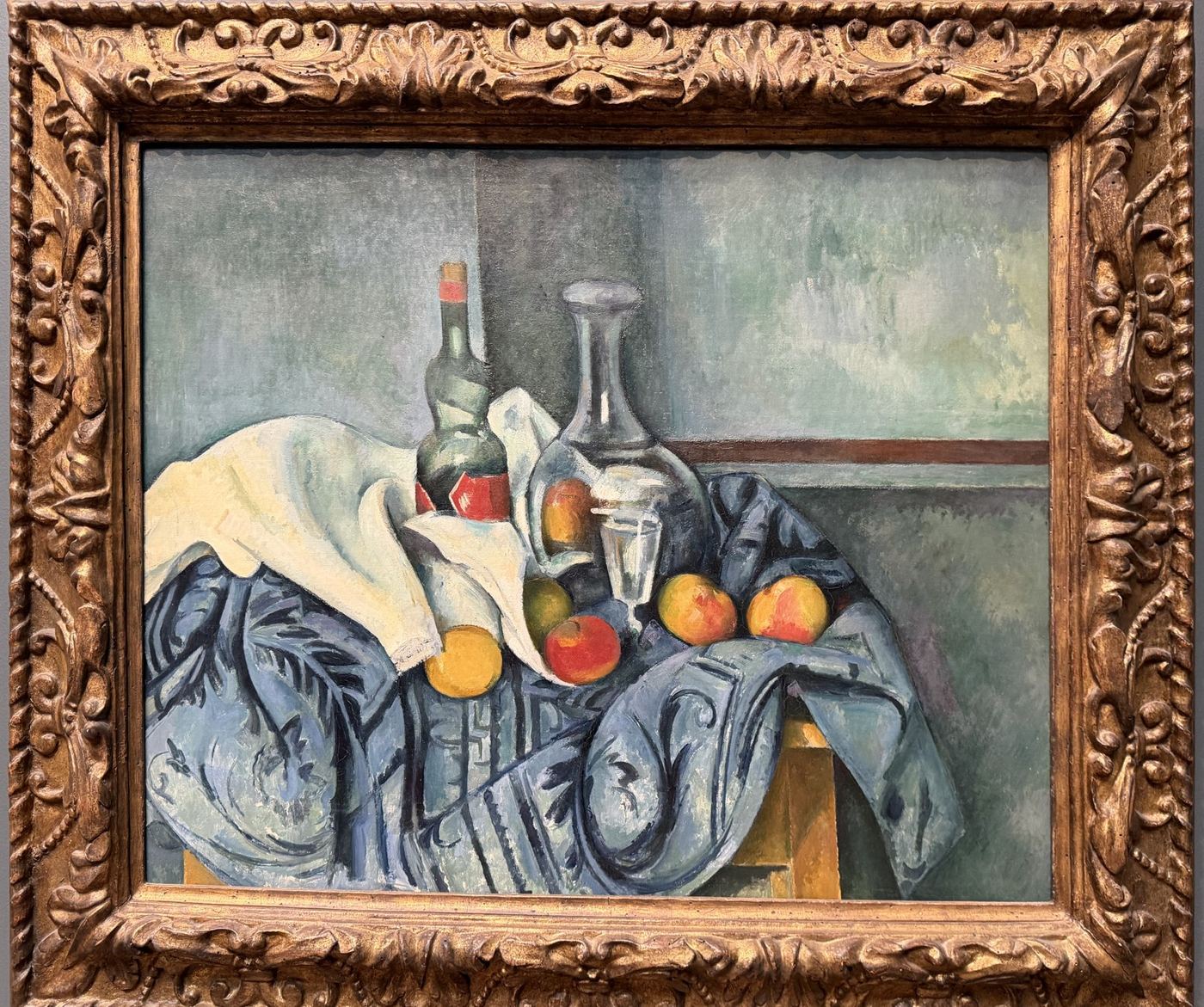
Can you imagine what Cezanne was thinking as he arranged and painted this still life? Follow the objects like stepping stones for the artist’s gaze moving across the painting. Cezanne depicted some spots, like the contours of the peppermint bottle, with crisp precision. Other parts of the painting are looser and sketchier — the glass seems to melt into the decanter behind it. Some pieces of fruit are firmly nestled within the fabric, while others float, almost falling. Notice how the glass vessels become more misshapen the longer you look at them. This “still life” is hardly still at all.
The pictureA tabletop crowded against a gray-green wall, which is split by a vertical edge and crossed at the right by a brown horizontal molding. At left stands a dark green bottle with a red label and a red band at the neck; beside it is a clear decanter with a long neck, an apple seen through its glass, and in front of it a small stemmed glass. A white napkin spills from the left across a blue cloth patterned with dark blue scrolls. Fruit sits in the folds: a red apple and a green one by the glass, two orange-red ones at the right, and a yellow one at the napkin's lower edge. An ochre table corner shows under the cloth at lower right. Blue lines outline the fruit and the glassware.
Beyond the labelChester Dale bought this picture in November 1927, and the next year it was number one in the Cézanne exhibition at Wildenstein Galleries in New York, under the title Grand Nature Morte, French for large still life. In 1929 it was lent to the new Museum of Modern Art for its first loan exhibition, the November 1929 show of van Gogh, Gauguin, Cézanne, and Seurat. [S0226, X02-13]
In his wordsNo verified quote found for this work.
Look forLook where the stemmed glass meets the decanter. The glass is drawn in a few white and gray strokes, and its outline lets the decanter's color run straight through it, so the two vessels share an edge. Painters call that kind of open, shared edge passage. The green bottle beside them keeps a firm, dark contour, and the blue cloth's pattern is drawn on top of its flat strokes with a loaded brush.
Photo IMG_7368; label IMG_7369
14
Paul Cezanne
Houses on a Hill, Provence (Maisons sur un colline)
French, 1839 – 1906 1904 – 1906 oil on canvas White House Collection
Label match: No accession number is printed; a no-photography icon (a crossed-out camera) is printed below the credit line; the same label is visible at the right edge of the work photo; the card prints 'un colline' as spelled.
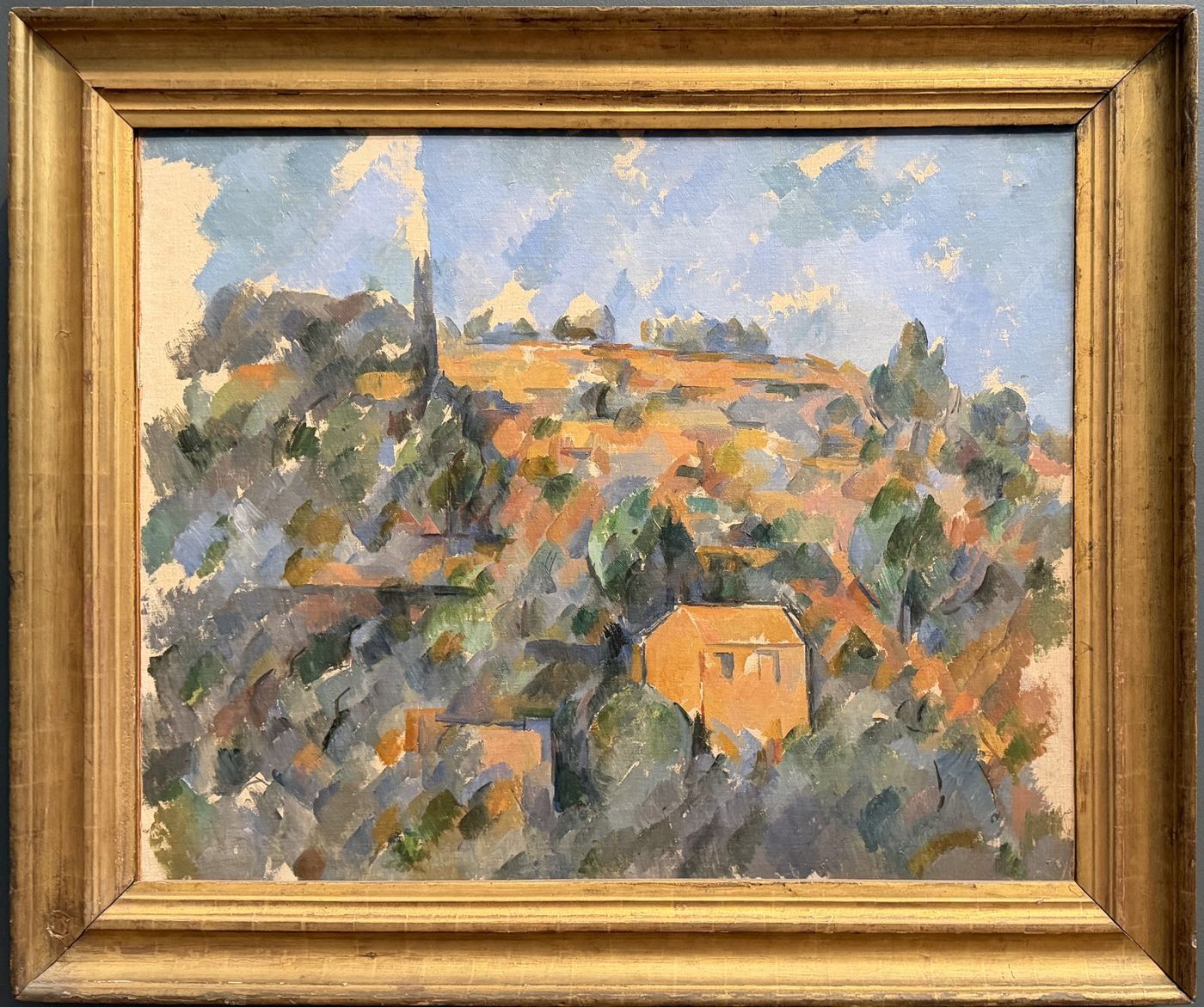
The wall cardHouses on a Hill, Provence (Maisons sur un colline), 1904 – 1906 [no-photography icon]
The pictureA hillside seen from below, built out of patches. The blue sky at the top is broken by many gaps of bare cream canvas. An orange-ochre crest runs across the upper third with small trees along it, and a tall dark cypress, left of center, rises into the sky. The slope below is a mosaic of short, blocky strokes of green, blue-gray, ochre, and orange that never resolve into single trees or fields. Low at center right, an orange house is a plain cube with dark window openings and blue contours, a lower building to its left and a round dark green tree in front. A strip of unpainted canvas runs down the left edge.
Beyond the labelThis canvas belongs to the White House. It is one of eight Cézannes left by Charles A. Loeser, an American collector living in Florence who died in 1928; his will let the President choose eight of his Cézannes "to adorn the White House," and the Los Angeles Times critic Christopher Knight wrote in 2013 that Loeser required them to be shown together, as an ensemble, and that only two of the eight had spent much time inside the house. Loeser and another American in Florence, Egisto Fabbri, gathered dozens of Cézannes between them, 15 for Loeser and 32 for Fabbri, and three other canvases in this room, Stops 11, 16, and 17, passed through Fabbri's hands or probably did. [X02-03, X02-16, X02-04, X02-05, X02-06, S0219, S0209, S0211]
In his words"the sensations of colour which produce light give rise to abstractions that prevent me from covering my canvas" (Letter to Émile Bernard, 1905.)
Look forThe bare canvas works as a color here. The light gaps in the sky, the strip down the left edge, and the patches at lower left are the cream ground held in reserve. The strokes are separate and roughly rectangular, the flat of the brush often visible, laid side by side with little overlap and almost no blending. You can count them.
Photo IMG_7370; label IMG_7371
15
Paul Cezanne
Harlequin
French, 1839 – 1906 1888 – 1890 oil on canvas Collection of Mr. and Mrs. Paul Mellon 1985.64.7
Label match: Paired by sequence and content: the label was photographed immediately after the work, the label photo shows the same laurel-carved gilt frame at its left edge, and the subject is a harlequin.
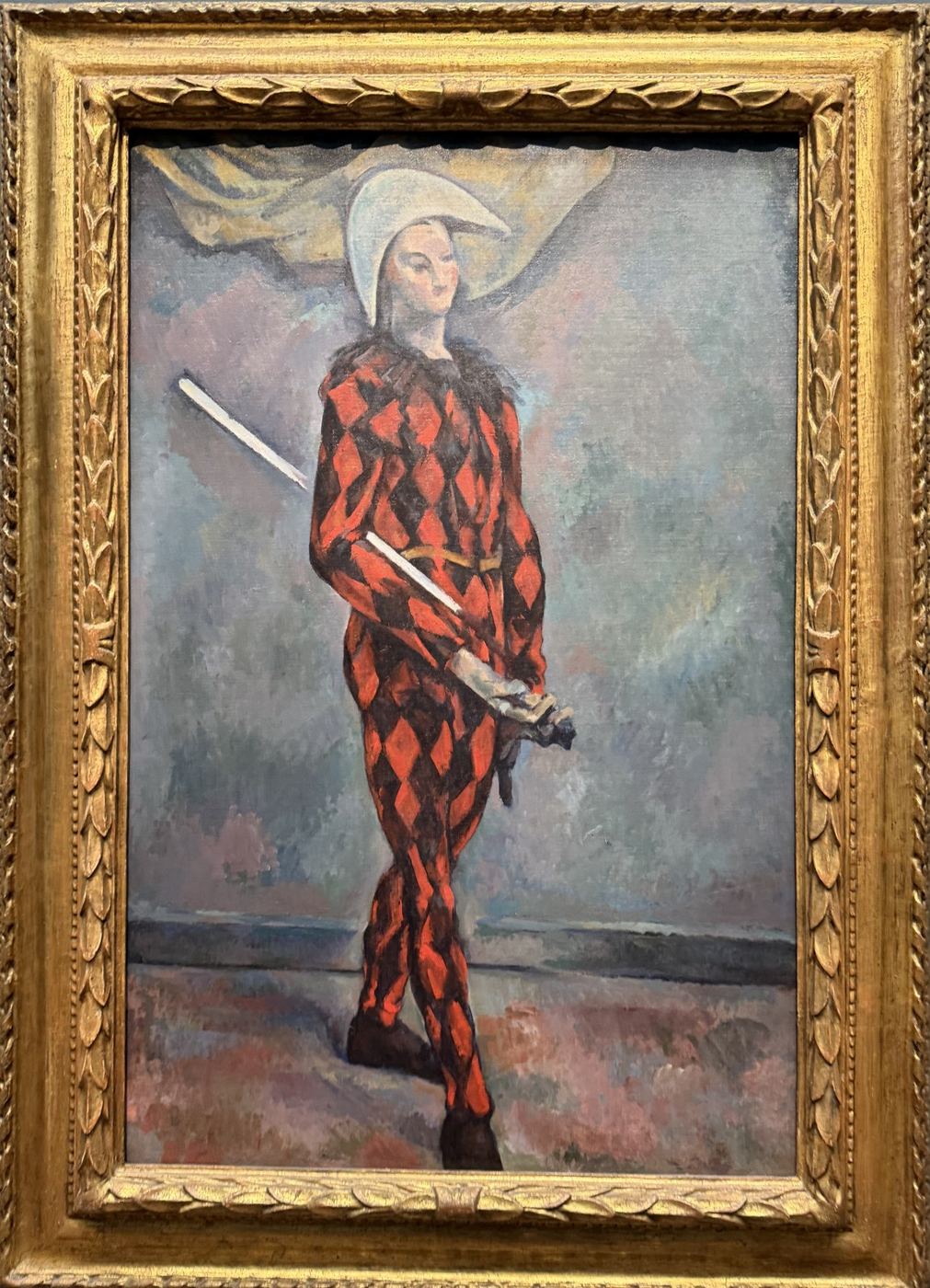
The wall cardHarlequin, 1888 – 1890
The pictureA full-length figure in a tight red-and-black diamond costume stands against a gray-violet wall. He wears a white crescent-shaped hat; his face, pale and long, tilts a little with the eyes lowered. A white baton runs on a diagonal under his right arm to his hands, which meet at the hip, one in a pale glove, with something dark hanging below them. A tan belt crosses the waist. He is caught mid-step, legs crossing, one black slipper set ahead of the other on a mauve and rose floor. A dark band where wall meets floor runs behind his calves. At upper left a yellow-cream curtain hangs in a loose swag behind the hat. The figure fills nearly the whole height of the tall, narrow canvas.
Beyond the labelCézanne's son Paul posed for this figure. It is one of four costume pictures from 1888 to 1890, a Mardi Gras with Harlequin and Pierrot and three variants on Harlequin alone, and the museum reads the face here as an impassive mask, a step further from portrait than the son's face in Mardi Gras. Harlequin's diamond costume, bicorn hat, and wooden sword come from the commedia dell'arte, the Italian stock comedy, and the same character runs from Watteau's Italian Comedians to Picasso's Family of Saltimbanques. [S0207]
In his wordsNo verified quote found for this work.
Look forLook at the diamonds. They are flat patches of red and black with no modeling inside them; the roundness of the legs and torso comes from how the diamonds narrow and bend at the edges, the way a printed pattern wraps a form. The wall behind is worked in short, overlapping strokes of gray, blue, and pink, a looser texture that keeps the figure reading as the hard, finished shape.
Photo IMG_7372; label IMG_7373
16
Paul Cezanne
Houses in Provence: The Riaux Valley near L’Estaque
French, 1839 – 1906 c. 1883 oil on canvas Collection of Mr. and Mrs. Paul Mellon 1973.68.1
Label match: Pairing certain: the extended label is visible in the work photo to the right of the frame; 'mas' is printed in italics on the card.
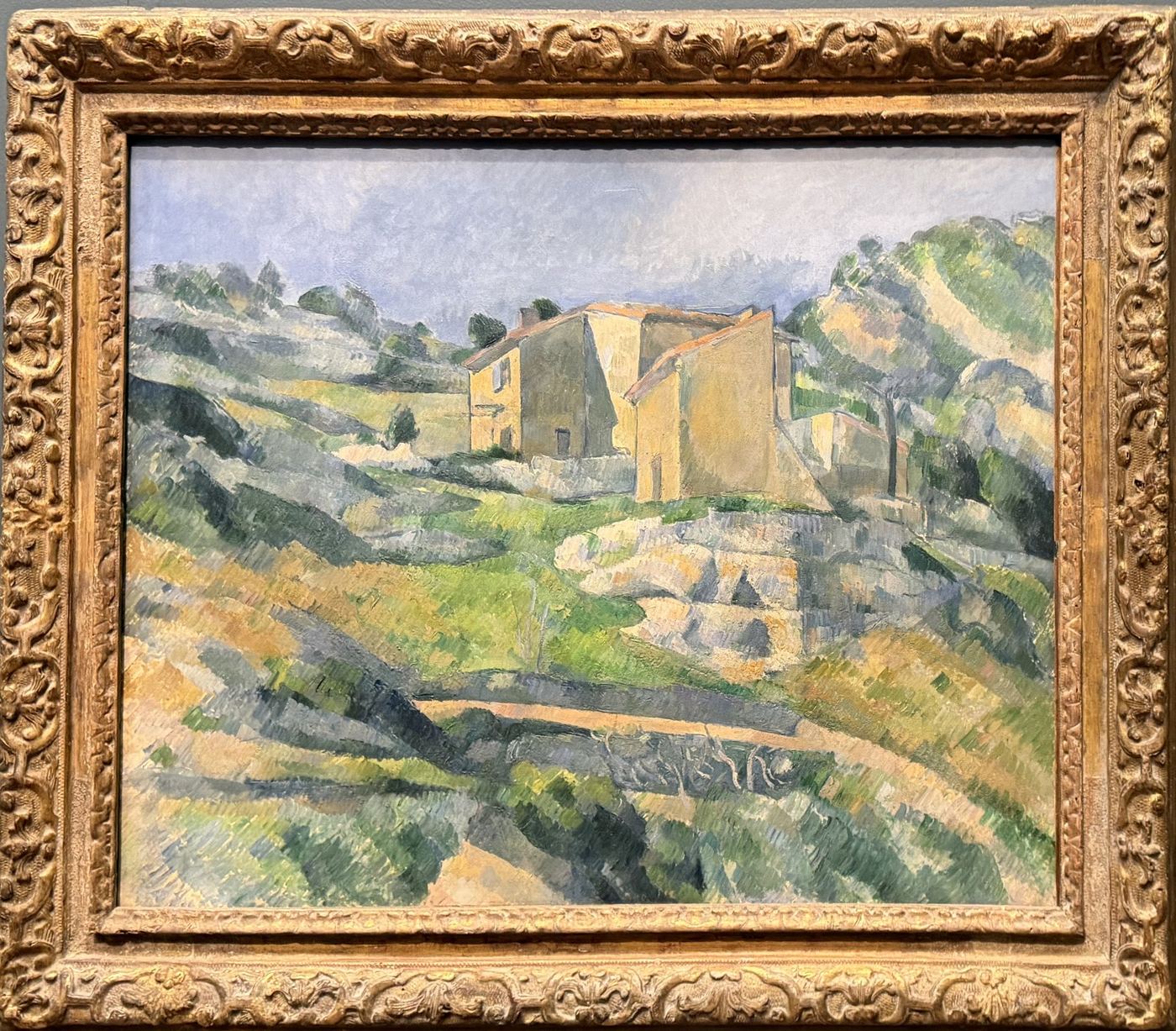
The wall cardHouses in Provence: The Riaux Valley near L’Estaque, c. 1883
Cezanne was deeply attached to Provence, the region in southern France where he was born and raised. He often painted its sundrenched terrain. Here Cezanne depicts a mas, a traditional Provençal farmhouse with bright yellow walls and a red tiled roof. Its architecture is solid and imposing. In contrast, he suggests the surrounding landscape with short strokes of paint applied diagonally from left to right. These directional brushstrokes lead the eye up and across the canvas, creating a sense of movement. This allows Cezanne to establish depth purely through color rather than relying on light and shadow.
The pictureA yellow farmhouse, two or three joined blocks with red tile roofs and a chimney, sits on a rise left of center, seen from below. Its sunlit faces are pale yellow, the shaded ones a cooler ochre and gray. The hillsides around it are built from short, parallel strokes of green, yellow, blue-gray, and lilac, slanting together in blocks. A pale rock ledge steps down below the house at the right, and a pinkish path or terrace edge cuts across the lower half on a diagonal. A green mountain slope fills the upper right. The sky is a thin, even lilac-blue. The lower left is a dense weave of green and ochre.
Beyond the labelL'Estaque, a fishing village on the bay of Marseille, was where Cézanne's mother rented a house for many years, and where he and Hortense Fiquet first went in 1870 while he was avoiding military service in the Franco-Prussian War, a relationship and later a son he kept secret from his parents. The museum sets this open landscape against Château Noir at Stop 20, painted some twenty years later, where a web of branches screens the view and the sky turns leaden. In 1920, when it was probably already in Egisto Fabbri's collection in Florence, it hung in the one-man Cézanne show at the Venice Biennale. [X02-01, S0200, S0209]
In his words"It’s like a playing card. Red roofs against the blue sea…" (Letter to Camille Pissarro, 1876.)
Look forLook at a patch of hillside from close range. The strokes are short and parallel, laid in blocks that slant together, a kind of hatching done with a loaded brush. They do not follow the contours of the land; they sit across them, and the shift from one block to the next marks a change of plane. The house walls, by contrast, are painted in flatter, broader strokes that keep their mass.
Photo IMG_7374; label IMG_7375
17
Paul Cezanne
Landscape near Paris
French, 1839 – 1906 c. 1876 oil on canvas Chester Dale Collection 1963.10.103
Label match: Pairing certain: the label is partly visible at the right edge of the work photo ('Paul Cezann', 'Landscape', 'Chester Dale C').
The wall cardLandscape near Paris, c. 1876
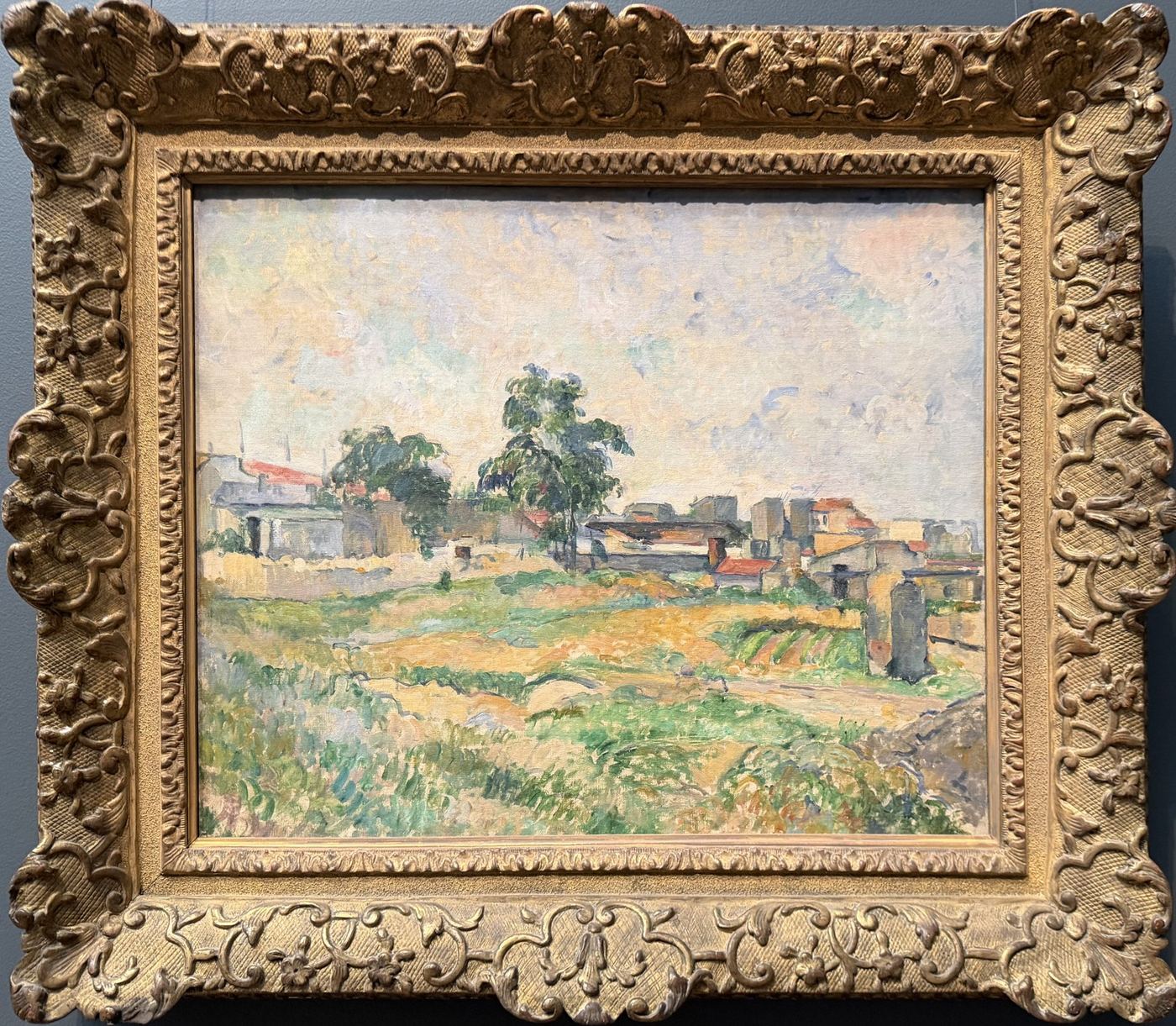
The pictureA flat, open field fills the lower half, painted in quick strokes of green, yellow, and ochre, with a few furrowed rows at center right. Across the middle runs a band of low buildings: white walls, red roofs, and gray-blue blocks, with two leafy trees rising above them left of center, the right one taller. At the right a gray stone post or pillar stands at the field's edge, and a dark brown mound enters the lower right corner. The sky takes nearly half the canvas, pale and warm, worked in small dabs of pink, yellow, blue, and cream. Small vertical marks, chimneys or poles, rise from the roofs at far left.
Beyond the labelThe title is generic, and the picture's own history shows how loose the label has been: lent to the 1928 Cézanne exhibition at Wildenstein Galleries in New York, it was catalogued as Environs d'Aix, the country around Aix in Provence, not Paris. The earliest showing the museum lists is the 1920 Venice Biennale, when it probably belonged to Egisto Fabbri in Florence. The museum dates it about 1876, a few years after Cézanne painted beside Pissarro at Pontoise and Auvers and took up working regularly out of doors. [S0211, S0201]
In his wordsNo verified quote found for this work.
Look forWatch the strokes in the field and the sky. They are short, curved, and broken, each a separate dab set next to the others, the touch the Impressionists used for light on a surface. Then walk to Stop 16, dated about seven years later, where the strokes are slanted, parallel, and laid in blocks. Here the stroke follows the grass; there it builds the plane.
Photo IMG_7376; label IMG_7377
18
Paul Cezanne
Still Life with Apples and Peaches
French, 1839 – 1906 c. 1905 oil on canvas Gift of Eugene and Agnes E. Meyer 1959.15.1
Label match: Pairing certain: the label is visible in the work photo to the right of the frame.
The wall cardStill Life with Apples and Peaches, c. 1905
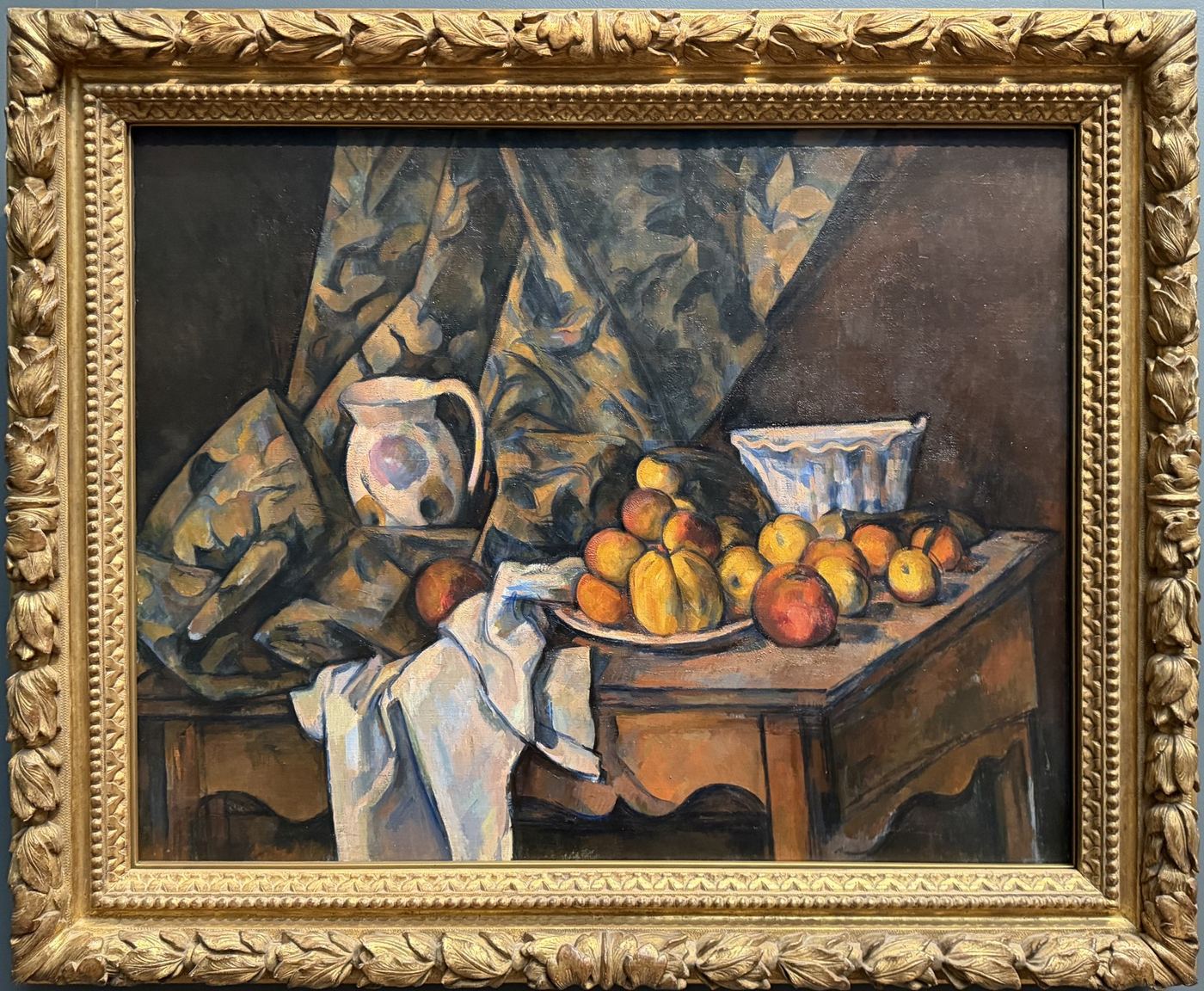
The pictureA wooden table with a scalloped apron, seen at an angle, carries a white plate heaped with yellow, orange, and red fruit, more fruit loose on the boards to the right, a flowered white pitcher at the left, and a blue-and-white bowl at the right. A heavy patterned cloth in ochre, slate blue, and brown hangs behind and falls in stiff folds across the left side of the table. A white napkin drops over the front edge left of center, and a single red apple sits just above it. The wall behind is dark brown, lighter at the right. At the center of the plate is a large ribbed yellow fruit. The tabletop seems to tip up toward us.
Beyond the labelThe table, the patterned cloth, and the flowered pitcher were props Cézanne kept in his studio and painted many times. The museum explains the tipped table, and the pitcher seen both in profile and from above, not as deliberate flattening but as the result of slow work: over days he moved his easel and painted each object from where he then stood. Edward Steichen, whom Agnes Meyer had met as a student in Paris, bought it in 1912 for Eugene and Agnes Meyer, who lent it to the Metropolitan Museum's 1921 loan show of Impressionist and Post-Impressionist painting as Still Life -- Peaches. [S0221, X02-08]
In his words"deal with nature by means of the cylinder, the sphere and the cone, all placed in perspective" (Letter to Émile Bernard, 1904.)
Look forLook at the napkin. It is built from flat planes of white, gray, and blue, each laid with a loaded brush and left alone, with dark blue lines drawn around the folds. The fruit gets the same treatment: an outline in blue or red, then patches of color set inside it, warmer toward the light. The patterned cloth behind is painted thinner and flatter.
Photo IMG_7378; label IMG_7379
19
Paul Cezanne
The Gardener Vallier
French, 1839 – 1906 1906 oil on canvas Gift of Eugene and Agnes E. Meyer 1959.2.1
Label match: Paired by sequence and content: the label was photographed immediately after the work, and the subject is a seated man in a dark coat and hat; the label photo is slightly blurred, so the accession number 1959.2.1 is read with low confidence (all other fields legible).
The wall cardThe Gardener Vallier, 1906
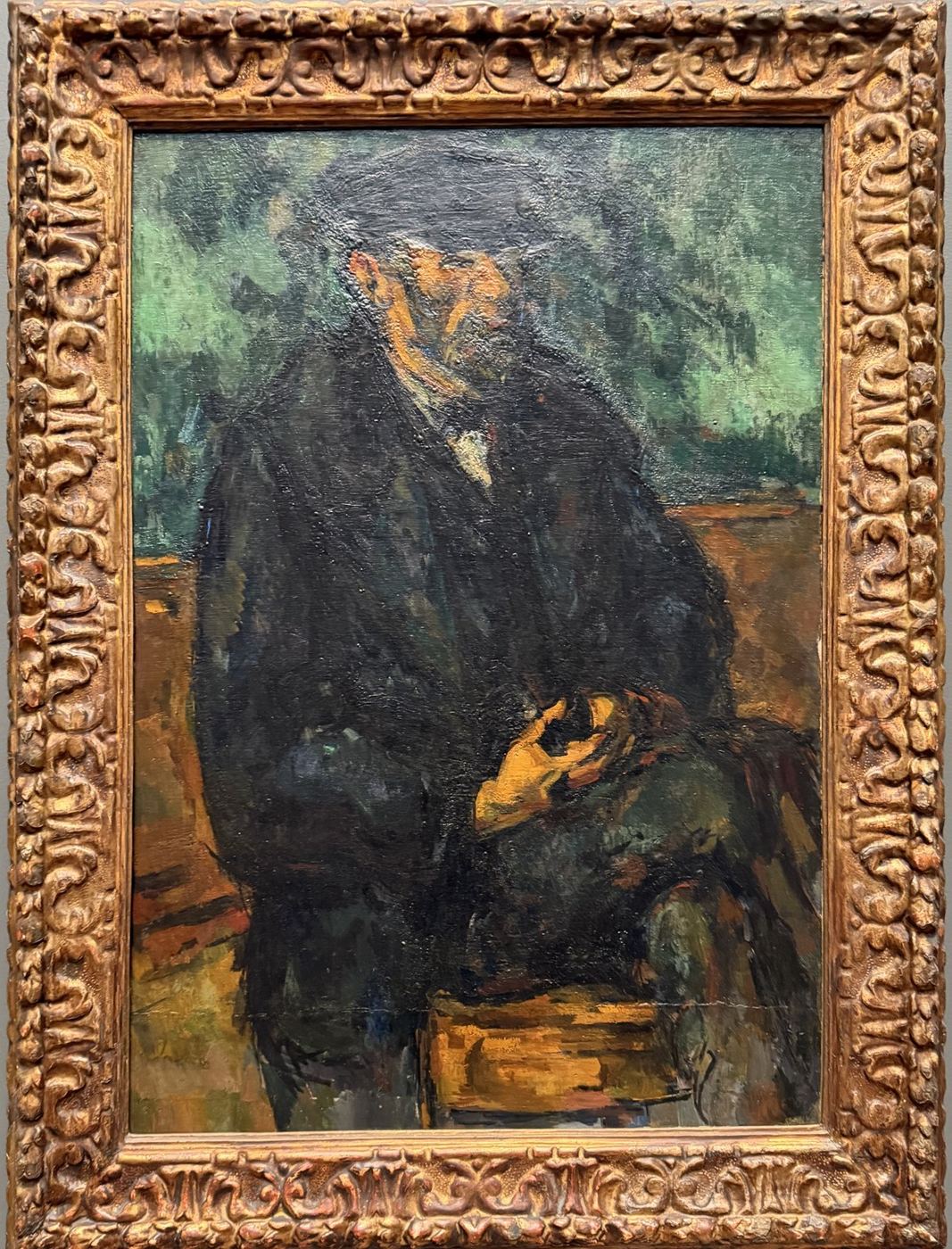
The pictureA man sits turned to our right, head bowed, in a dark coat that takes up most of the canvas. A dark hat shades his face; the face itself is a few strokes of orange and ochre, the features barely stated. A pale patch at the throat reads as a shirt or scarf. His hands rest together in his lap, the nearer one a raw orange. He sits on a chair or bench in brown and ochre, with an orange block at lower center below his knees. Behind him the upper background is a broken green and blue-green; below it a brown band runs across like a wall or terrace. Very little is sharp.
Beyond the labelOn 15 October 1906 Cézanne was caught in a storm while painting out of doors and collapsed on the way home; the next day he went out into the garden to work on a portrait of Vallier, fainted, and Vallier, who was sitting for him, called for help. He was put to bed, never left it, and died on 22 October; which Vallier canvas he was working on that day is not settled in the sources I opened. Vollard acquired this one, possibly from the estate, and in 1916 sold it, through Edward Steichen, to Eugene and Agnes Meyer, who lent it to the Metropolitan Museum in 1920 and 1921, where it was catalogued as A Sailor. [X02-07, S0230]
In his words"as a painter I am becoming more clairvoyant to nature, but that it is always very difficult for me to realize my feelings." (Letter to his son, September 1906.)
Look forGet as close as the guard allows. The surface is crusted: layer on layer of thick, dark impasto, worked over until it forms ridges and pits, most of all in the coat and around the head. The green background shows the same build-up. Against that crust, the hands and face are set down in a few strokes of bright orange that sit on top of it.
Photo IMG_7380; label IMG_7381
20
Paul Cezanne
Château Noir
French, 1839 – 1906 1900/1904 oil on canvas Gift of Eugene and Agnes E. Meyer 1958.10.1
Label match: Pairing certain: the label is visible in the work photo to the right of the frame.
The wall cardChâteau Noir, 1900/1904
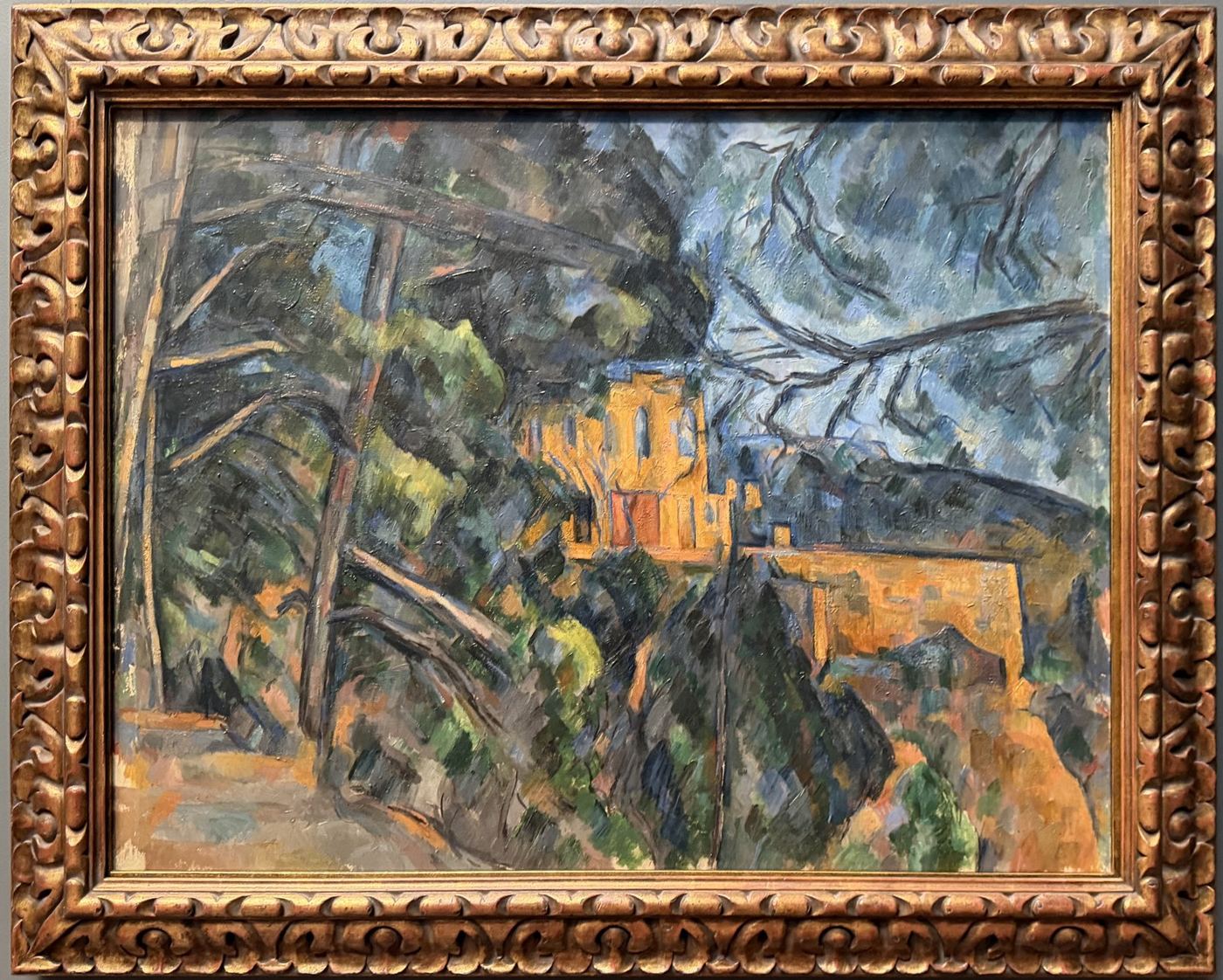
The pictureAn ochre-orange building stands at center right behind a screen of trees, its tall block pierced by arched window openings, with a reddish door below. A long lower wall runs off to the right. The left half of the canvas is woods: dark trunks and long diagonal branches drawn in dark blue lines across a mass of green, yellow, and blue-black patches. The sky at upper right is a heavy blue, almost as dense as the foliage, with dark branch lines running through it. A dark conical tree rises in the middle foreground against the building. A blue-gray ridge runs behind the building at right, and a pinkish-tan path or clearing opens at lower left.
Beyond the labelThe building had a reputation before Cézanne painted it: it was the subject of local legends and had earlier been called Château Diable, the Devil's Castle, and its Gothic windows and unfinished walls give it the look of a ruin. The museum reads it as one of the darker, more enclosed landscapes of his last decade, painted in the open air but as a long meditation, an attempt to "realize" -- his word -- his whole sensation of the place. It hung in London in the 1912 Second Post-Impressionist Exhibition at the Grafton Galleries and in New York at the Modern Gallery in 1916, and after passing to Marius de Zayas it was bought by Edward Steichen for Eugene and Agnes Meyer. Agnes Meyer had published the New York art magazine 291 with de Zayas and Alfred Stieglitz. [S0200, X02-08]
In his words"Unfortunately, the realization of my sensations is always a very painful process with me." (As reported by Ambroise Vollard.)
Look forLook at the branches in the sky. They are long, dark blue lines drawn with a loaded brush over color that was already down, like a contour drawn over a block-in. The sky itself is not thin: it is worked in the same short, thick strokes as the foliage, so sky and trees carry the same weight on the surface.
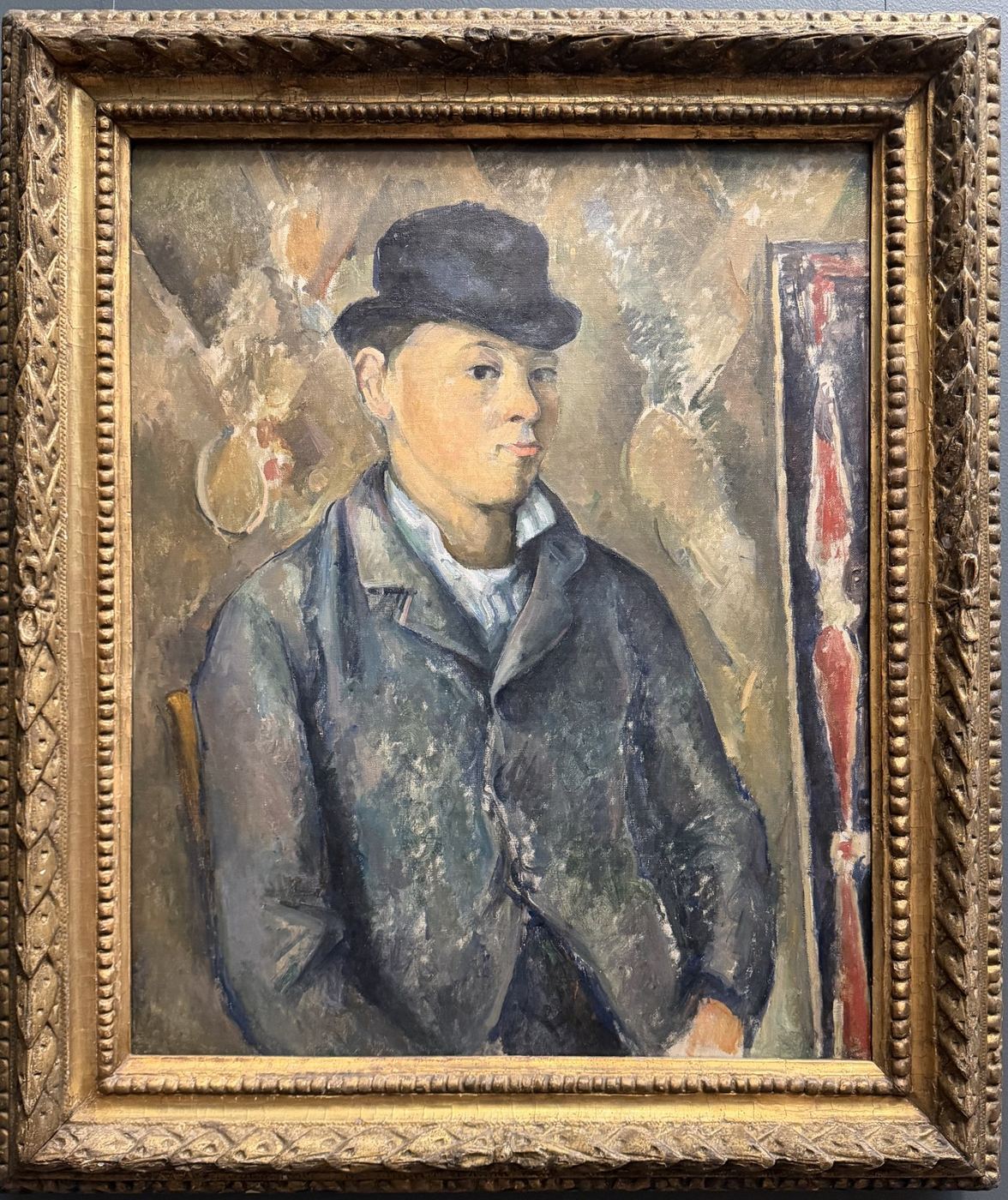
Label match: Paired by sequence and content: the label was photographed immediately after the work, and the subject is a boy in a bowler hat.
The wall cardThe Artist’s Son, Paul, 1886 – 1887
The pictureA boy in a dark bowler hat, seen to the waist, sits on a chair whose back shows at our left. His face is turned three-quarters toward us, eyes looking out, mouth closed. He wears a blue-gray jacket with wide lapels over a white shirt whose turned-up collar is striped in blue. One hand is out of sight; the other rests low at our right, a pink patch at the bottom edge. The wall behind is a pattern of large tan, peach, and olive shapes, a wallpaper or a screen. At the right a vertical band of red, white, and dark blue, perhaps a curtain edge or a screen, runs the height of the canvas.
Beyond the labelPaul was born in January 1872, and for six years Cézanne kept the boy and his mother, Hortense Fiquet, hidden from his own father, who found out in March 1878 through a careless letter from the collector Victor Chocquet. The museum dates this portrait 1886 to 1887: in April 1886 his parents married in Aix, and that October Cézanne's father died, leaving him far better off. The picture stayed in the family; Hortense inherited it and sold it in Monaco in 1918. [X02-07, S0217]
In his words"Do I have to tell you again you must sit like an apple? Does an apple move?" (As reported by Ambroise Vollard.)
Look forLook at the jacket. The blue-gray is dragged thin over what lies beneath, so the lighter layer breaks through in pale flecks: a scumble that reads like worn cloth. The face is smooth by comparison, built from a few flat warm planes. The background shapes are thin enough that the canvas texture shows in places.
Photo IMG_7384; label IMG_7385
22
Paul Cezanne
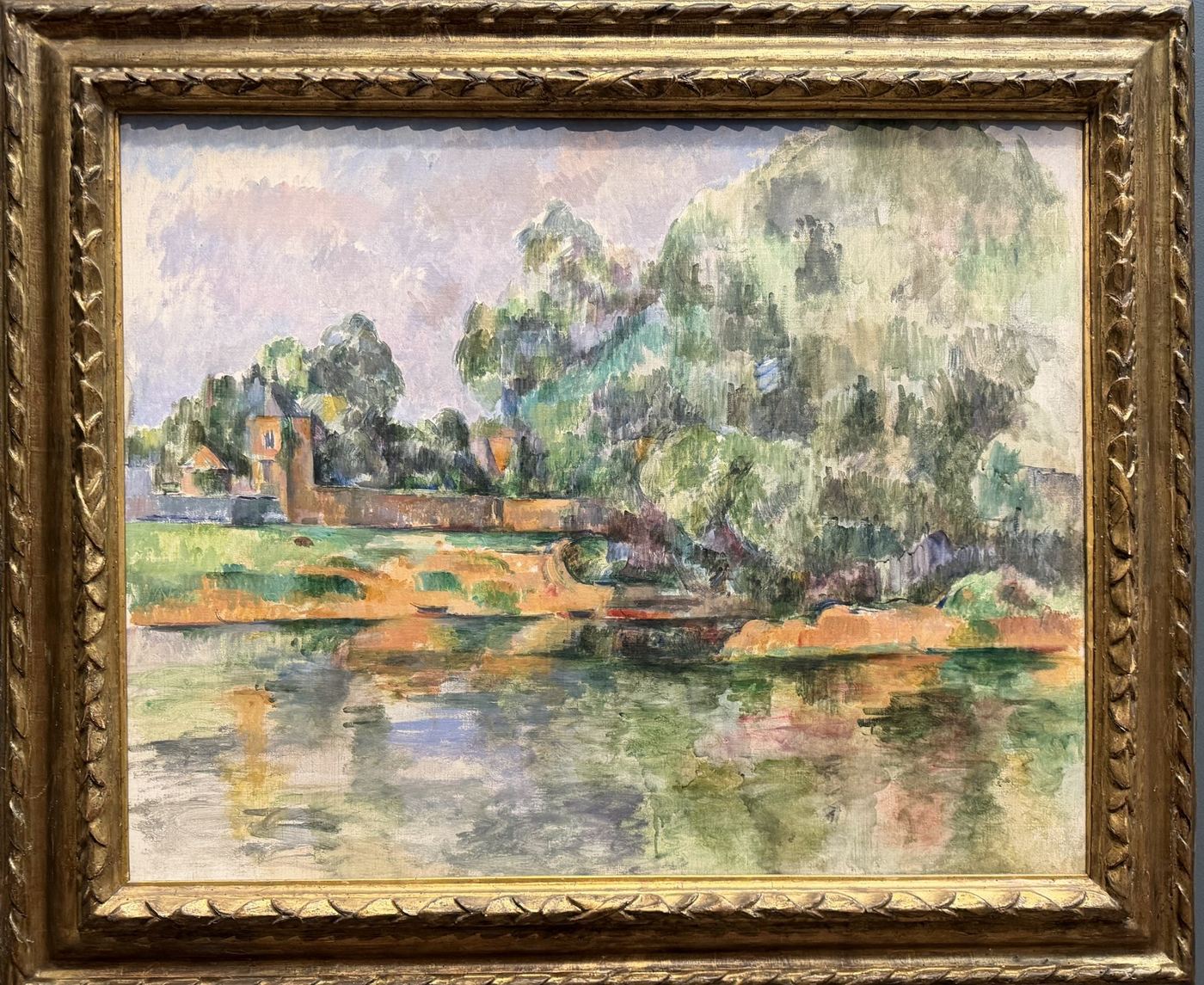
Banks of the Seine at Médan
French, 1839 – 1906 c. 1885/1890 oil on canvas Ailsa Mellon Bruce Collection 1970.17.21
Label match: Paired by sequence and content: the label was photographed immediately after the work, and the subject is a riverbank with trees and a house.
The wall cardBanks of the Seine at Médan, c. 1885/1890
The pictureA still river fills the lower half. On the far bank stands a long brick-red wall, a tall house with a pointed gable at left, smaller red roofs, and a dense bank of trees that rises into the upper right corner. The trees are a mass of soft, vertical strokes in green, blue-green, gray, and pale lilac, with little separation between them. An orange strip of bank runs along the water's edge at left center and again at right. In the water, reflections repeat the bank's green, orange, and lilac in looser, longer strokes, with runs and drips. The sky is a pale lilac and pink. Light canvas shows between strokes throughout.
Beyond the labelMédan is where Émile Zola, Cézanne's friend since childhood, set up a summer house in 1878, and Cézanne visited him there repeatedly between 1879 and 1882 and again in 1885; the museum notes that the exact spot in this picture has not been identified. In March 1886 Zola published L'Œuvre, a novel whose painter-hero fails and kills himself; Monet and Edmond de Goncourt saw Manet in the character, while Cézanne recognized himself in many details. It was long believed the two friends never spoke again, but a letter from 1887 shows the friendship lasted at least a while longer. [X02-07, S0201]
In his wordsNo verified quote found for this work.
Look forThis is close to a watercolor method in oil. The paint is thinned until it runs, and you can find drips trailing down through the reflections. Strokes go on side by side with the light ground showing between them, and little is reworked. Compare the thick, worked surface of Château Noir at Stop 20: same painter, opposite handling of the same medium.
Photo IMG_7386; label IMG_7387
Room 3
Gallery M83: Degas, Gauguin, and van Gogh
Gallery M83 hangs nineteen works: six by Edgar Degas, five by Paul Gauguin, six by Vincent van Gogh, and one each by Paul Sérusier and Jean-Louis Forain. The dates run from 1866, when Degas began The Fallen Jockey, to about 1899, the date of his Four Dancers. Degas gives you ballet rooms and racecourses; Gauguin moves from Breton girls in 1888 to the Tahiti his card describes; and the six van Goghs all date from 1888 to 1890, the last three years of the life his cards give him.
Five cards carry longer text, and several ask questions instead of settling them. Four Dancers asks, "But is this a stage at all?" Gauguin's Self-Portrait opens with "Are artists sinners or saints?" The Fallen Jockey card points to "the rump and raised tail of a horse that has since disappeared," left in place so we can "track the evolution of this painting." The Fatata te Miti and La Mousmé cards both frame a painter dreaming of a far-off place, Tahiti for one and Japan for the other.
The credit lines name Mr. and Mrs. Paul Mellon (seven works) and Chester Dale (five), with one each from the Corcoran's William A. Clark Collection, the Widener Collection, Ailsa Mellon Bruce, the W. Averell Harriman Foundation, Pamela Harriman, John Hay Whitney, and Alexander Mellon Laughlin and Judith Walker Laughlin.
23
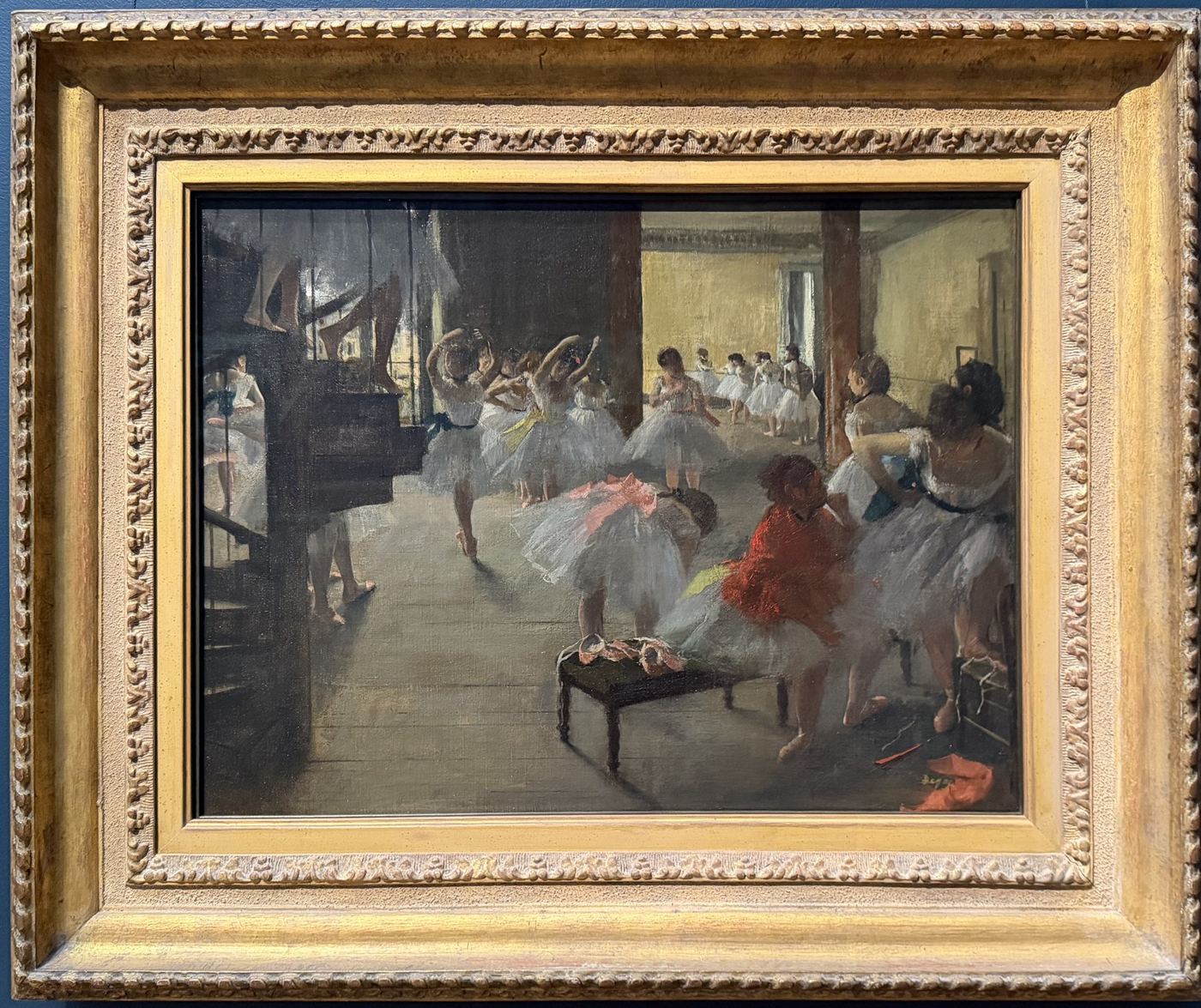
Edgar Degas
The Dance Class
French, 1834 – 1917 c. 1873 oil on canvas Corcoran Collection (William A. Clark Collection, 1926)
The wall cardThe Dance Class, c. 1873
2014.79.710
nga.gov/Corcoran
The pictureA rehearsal room seen from a corner, the floorboards running away from us on a steep diagonal. At the left a dark spiral stair fills the edge; two pairs of dancers' legs come down it, cut off by the top of the canvas, and another pair stands at its foot. In the middle distance a cluster of dancers in white gauze skirts raise their arms over their heads, and beyond them a long room with ochre-yellow walls and two brown pillars holds a row of small dancers at the barre. In the right foreground a heavier woman in a red shawl sits among the dancers with her head turned down, others adjust their bodices and shoes, and a low dark bench carries pink slippers. A red fan and a red cloth lie on the floor at lower right, beside the signature.
Beyond the labelIts first owner was Henry Hill, a collector in Brighton, England, who bought it in London in 1876; it was shown that April at the Deschamps Gallery in London and the next year in the Third Impressionist Exhibition in Paris. Hill was the same collector who bought Degas's café scene now known as L'Absinthe in 1876 and showed it under the title A Sketch at a French Café. In 1903 the canvas went to William Andrews Clark, the Montana copper king, and it came to the Corcoran Gallery with his collection in 1926 and to the National Gallery in 2014. [S0094, X03-17]
In his wordsNo verified quote found for this work.
Look forLook at the stair on the left. It is a nearly flat block of dark brown, thin enough that the canvas weave reads through it, while the skirts beside it are built from light, broken strokes of white and gray laid over darker paint. The legs on the stair are a few warm strokes, stopped hard by the edge of the canvas. The floorboards are long dark lines drawn with the brush tip into a thin brown layer.
Photo IMG_7393; label IMG_7394
24
Edgar Degas
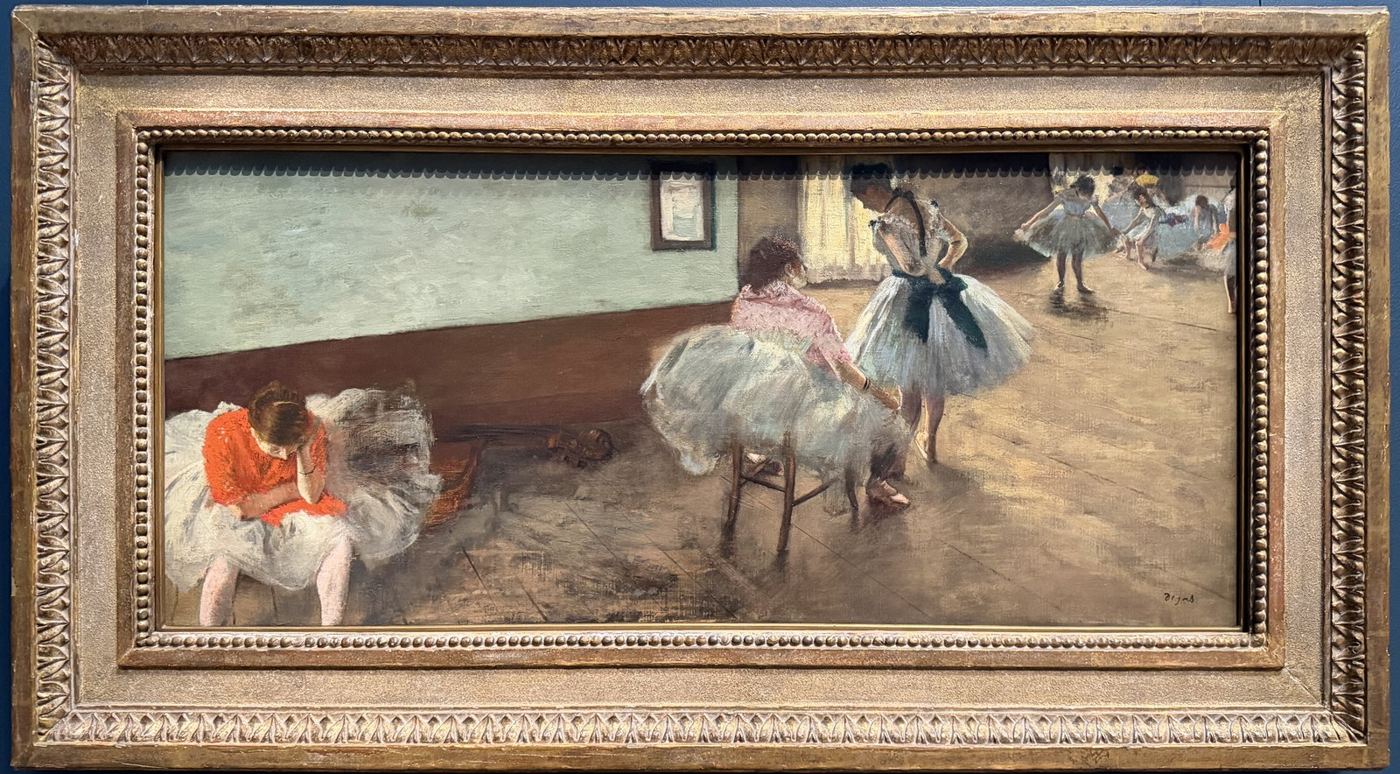
The Dance Lesson
French, 1834 – 1917 c. 1879 oil on canvas Collection of Mr. and Mrs. Paul Mellon
Label match: Paired by sequence: the label was photographed right after the work, and the scene matches. A speck above the n of Dance on the card is debris, not an accent.
The wall cardThe Dance Lesson, c. 1879
Collection of Mr. and Mrs. Paul Mellon 1995.47.6
The pictureA long, low canvas, about twice as wide as it is tall. The left half is mostly empty: a pale blue-green wall over a brown lower wall, a small framed sheet hanging on it, and a bare plank floor. At the far left a girl in an orange-red blouse over a white skirt sits bent forward, her head propped on her hand. On the floor behind her lie a brown case and a dark object that looks like a violin. In the center a dancer with a pink shawl sits on a wooden chair with her back to us, and beside her a dancer with a broad black sash stands looking down, hands behind her at the bow. Far right, in light from a curtained window, small dancers practice. The signature sits at lower right.
Beyond the labelThe museum counts this as the first of some forty ballet pictures Degas painted in this long, low format, which it likens to a frieze and ties to the cropped views and tipped-up floors of Japanese prints. The scene was assembled, not observed: a notebook sketch fixed the seated dancer, the window, and the instruments at left, and dancers taken from other drawings and paintings were set in around them, the one adjusting her bow reappearing in pastels and in related canvases in Detroit and New York. At the Fifth Impressionist Exhibition in 1880 it drew little notice; the critic Joris-Karl Huysmans called it "dismal," while Paul Mantz, uneasy with Degas's drift toward caricature, still praised its "transparently fine atmosphere." [S0181]
In his wordsNo verified quote found for this work.
Look forStand at the white skirt on the far left. Its right side is not modeled at all: it is dragged on with a nearly dry brush, so the bristles leave streaks and the brown wall shows through, and the same scrubbed handling runs down into the floor. The standing dancer's skirt, by contrast, is laid in fuller, overlapping strokes. Two degrees of finish sit side by side on one canvas.
Photo IMG_7395; label IMG_7396
25
Edgar Degas
Four Dancers
French, 1834 – 1917 c. 1899 oil on canvas Chester Dale Collection
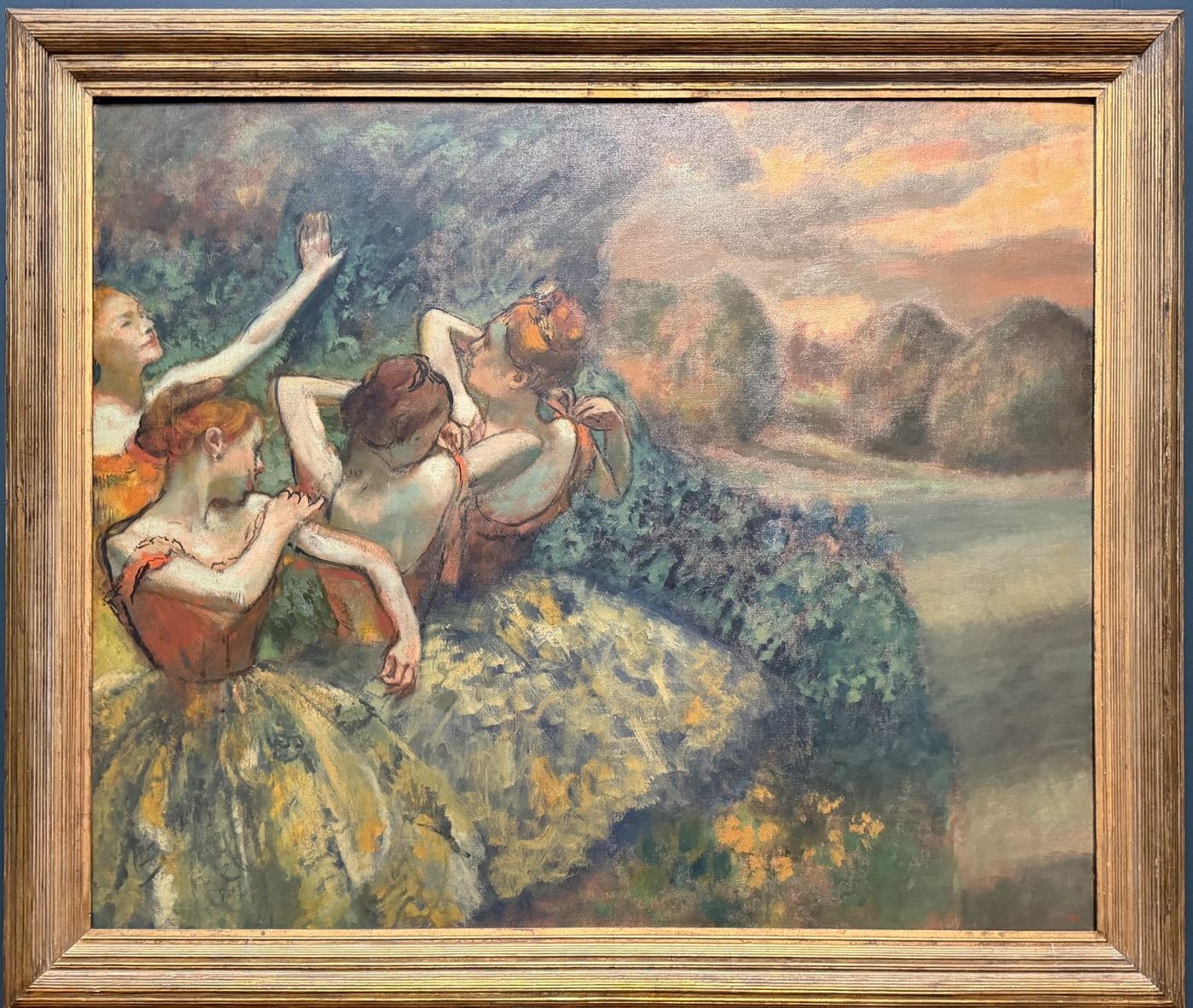
The wall cardFour Dancers, c. 1899
Chester Dale Collection 1963.10.122
Degas is famous for his depictions of ballerinas. This painting is one of his most perplexing examples. Four dancers appear together, adjusting their shoulder straps as if preparing to step onto the stage.
But is this a stage at all? Or is it an elaborate, dreamlike landscape with distant haystacks rising under a dramatically colored sky? Are these four separate women or a single dancer twirling through space and time? Art often blurs the lines between reality and fantasy. In this work, Degas invites us to decide which we are looking at.
The pictureFour dancers crowd the left half, cut by the left edge and each seen at a different turn. One flings an arm high with her face lifted; one in front looks down at her shoulder strap; one shows her bare back with both arms raised to her hair; and one at the right of the group, face in profile, ties a bow at her shoulder. All wear orange-red bodices over skirts of yellow, green, and blue patches that run together into one mass. A band of dark green strokes rises behind them like foliage. The right half opens onto a pale gray-blue floor or field, rounded hay-colored mounds the card calls haystacks, and a sky of salmon and orange over gray-blue. Yellow-orange dabs of flowers sit along the bottom.
Beyond the labelThe museum's catalogue text calls this one of the largest and most ambitious of Degas's late works, and notes that it exists in several variants. Two of the figures repeat poses of a single model who appears in a set of three photographic plates from about 1895 to 1898; Degas owned the plates and may have taken the pictures himself, and they solarized into colors that resemble, in reverse, the oranges and greens of this canvas. The same text points to Eadweard Muybridge's sequential photographs, published in 1887 as Animal Locomotion, as a possible model for this run of preparatory gestures. The picture was still in Degas's studio when he died and was sold in the 1918 studio sale; Chester Dale's purchase of it in 1931 made the front page of Art News. [X03-12, S0084]
In his wordsNo verified quote found for this work.
Look forThe figures are drawn before they are painted. Dark contour lines, thin and sometimes broken, run along the arms, the shoulder blades, and the tops of the bodices, and the color is filled in up to them or brushed across them. In the skirts the paint goes on as separate dabs of yellow, blue, and green that never blend, and the canvas weave shows through the thinner sky and the open space at right.
Photo IMG_7397; label IMG_7399
26
Edgar Degas
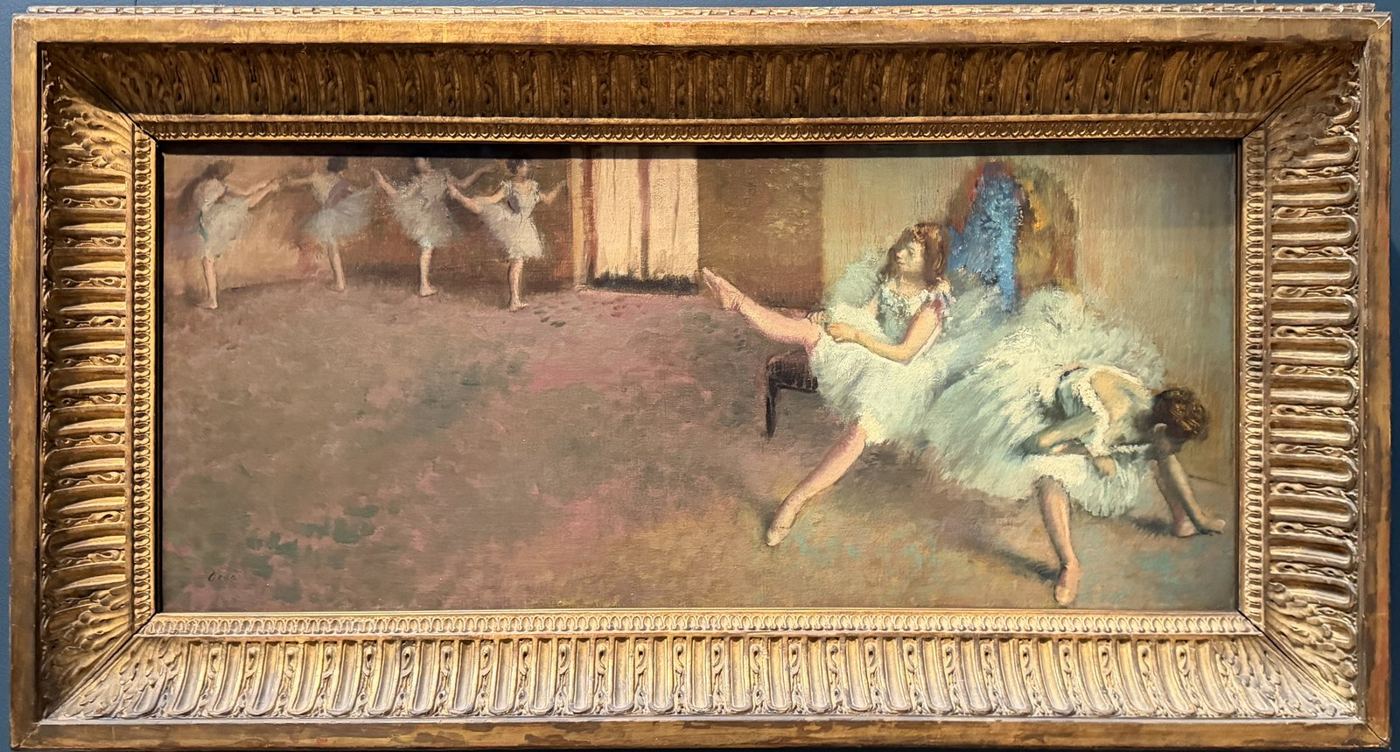
Before the Ballet
French, 1834 – 1917 1890/1892 oil on canvas Widener Collection
Label match: Paired by sequence: the label was photographed right after the work, and the edge of a label shows at the right of the work photo; the scene matches.
The wall cardBefore the Ballet, 1890/1892
Widener Collection 1942.9.19
The pictureAnother wide, low canvas, divided by a doorway hung with a pale pink curtain. At upper left four small dancers stand in a row at the barre, each with one leg raised along it. The right half belongs to two dancers close to us: one sits on a dark bench and stretches a leg far out to the left, holding it at the knee, and the other folds forward beside her to reach her own foot, her face hidden. Behind the seated dancer a rough patch of bright blue, with yellow beside it, stands against the wall. The floor between them, a wide empty field of pink, mauve, green, and ochre touches, takes up most of the picture. The signature is at lower left.
Beyond the labelThis canvas belonged to the dealer Paul Durand-Ruel's own private collection, and it was shown in London in 1905 at the Grafton Galleries exhibition of Boudin, Cézanne, Degas, Manet, Monet, Morisot, Pissarro, Renoir, and Sisley. In 1913 Peter A. B. Widener bought it for Lynnewood Hall, his house at Elkins Park, Pennsylvania, and it came to the National Gallery with the Widener gift in 1942. It shares the long, low frieze format that the museum, writing about The Dance Lesson two stops back, says Degas used for some forty ballet pictures; this one is a decade later. The museum's own description calls the arched patch of electric blue and mustard yellow behind the seated pair "difficult to interpret." [S0085, S0181]
In his wordsNo verified quote found for this work.
Look forGet close to the blue patch behind the seated dancer. It is the heaviest paint in the picture, put on with a loaded brush and left in raised ridges of impasto. The tutus around it are built up in short white strokes with some body, while the floor and the far wall are thin, flat touches. The paint gets thicker as the figures get closer to you.
Photo IMG_7400; label IMG_7401
27
Paul Gauguin
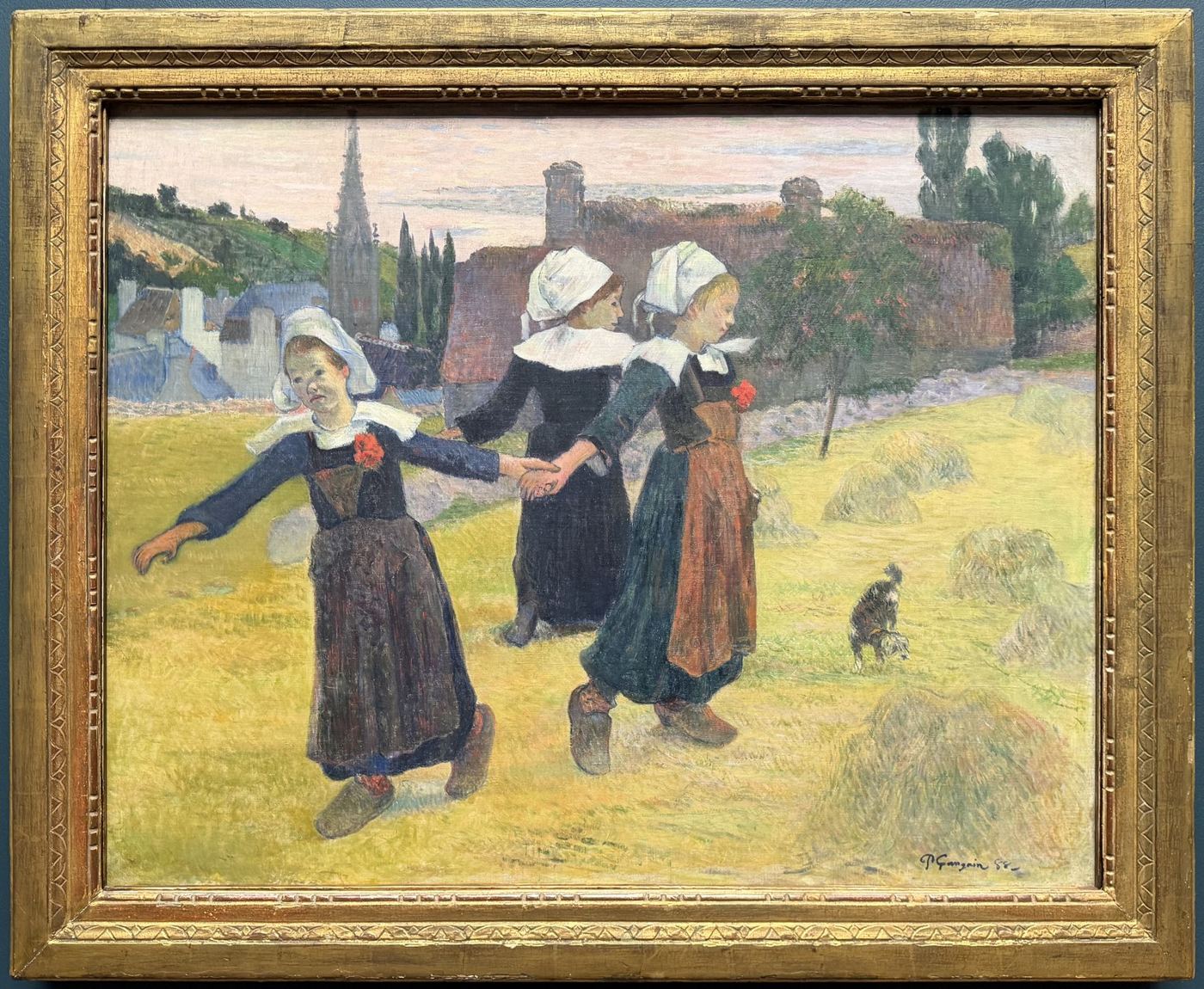
Breton Girls Dancing, Pont-Aven
French, 1848 – 1903 1888 oil on canvas Collection of Mr. and Mrs. Paul Mellon 1983.1.19
Label match: The same label is visible at the right edge of the work photo, so the pairing is certain.
The wall cardBreton Girls Dancing, Pont-Aven, 1888
The pictureThree girls in Breton dress hold hands in a ring dance across a mown field. Each wears a white coif and a broad white collar over a dark dress, with a red flower pinned at the chest and wooden clogs on her feet; the girl at right wears a rust-orange apron. The girl at left swings her free arm out, hand open and turned down, and looks off to our left with a set face. The field is yellow-green, with small piles of hay at right, and a little black and white dog noses the grass. Behind them stand reddish stone houses, a small tree with red fruit or blossom, dark columnar trees, a church spire, gray-blue roofs at left, and a green hill under a pale pink sky. Signed and dated at lower right, P Gauguin 88.
Beyond the labelTheo van Gogh's firm, Boussod, Valadon and Company, took this picture from Gauguin in November 1888, and a collector agreed to buy it on one condition: that Gauguin change the girl's hand that reaches to the edge of the frame. Theo sent the canvas to Gauguin, then working with Vincent in Arles, and Gauguin retouched the hand; Vincent wrote to Theo that he had altered it "very, very well." The sale fell through all the same, and Theo did not sell the picture until September 1889; that year it was also shown at the Café Volpini in Paris. In 1996 the museum in Rennes, Brittany, built a whole exhibition on Pont-Aven around this canvas. [S0189, X03-10]
In his wordsNo verified quote found for this work.
Look forThe field is laid in short, parallel strokes, most of them slanting the same way, so the grass has a regular, almost woven texture, unlike the broken dabs on the Degas canvases nearby. The figures carry dark outlines along the arms and skirts. Look at the clogs: each is a simple rounded shape modeled in two or three tones, with almost no detail.
Label match: Paired by sequence and content: the label was photographed right after the work, and the painting shows the halo, apples, and snake the card describes.
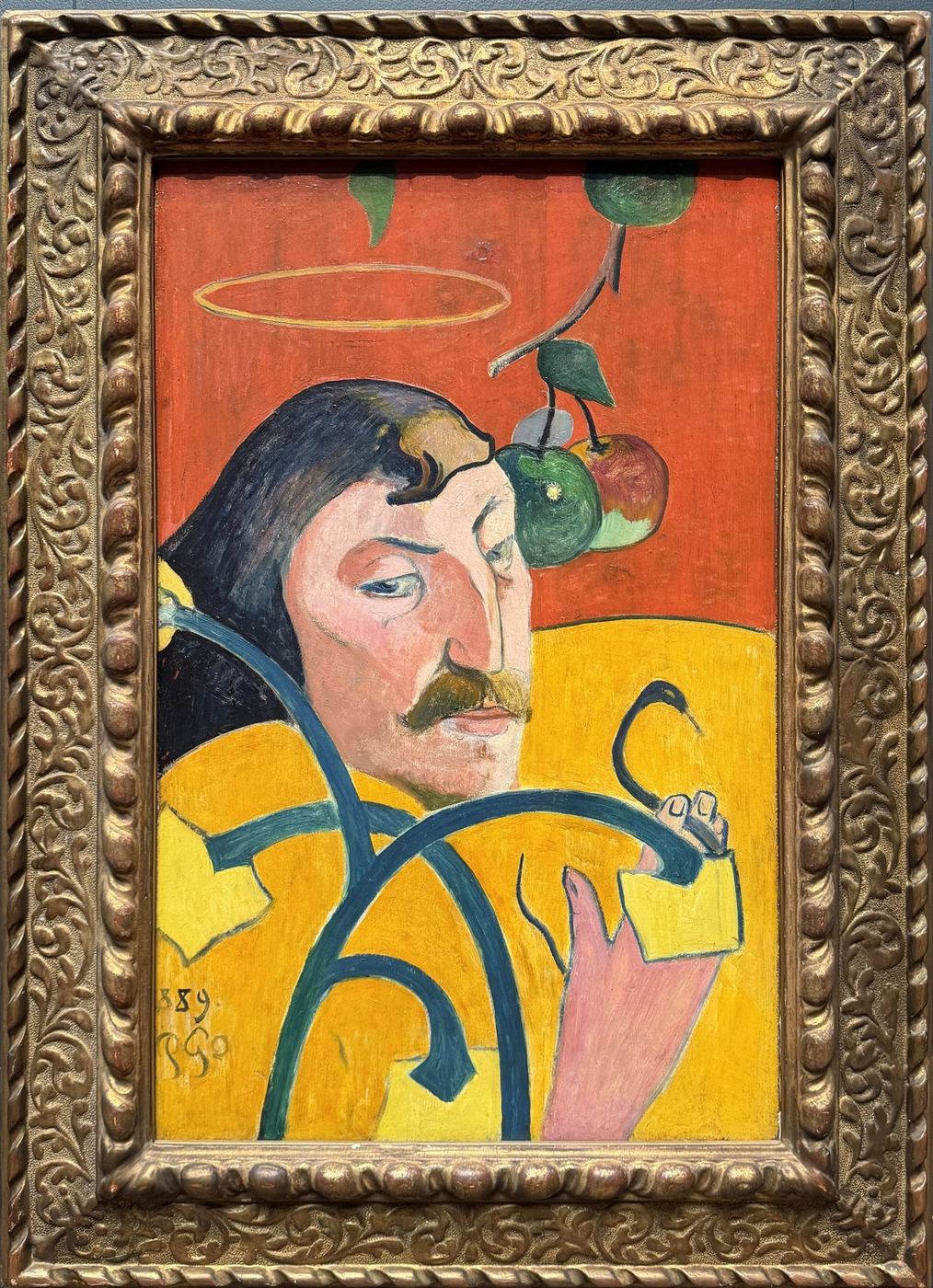
The wall cardSelf-Portrait, 1889
Are artists sinners or saints? Gauguin paints himself as both. The upper half of this self-portrait depicts him as a saint. With a halo above his head, he looks away from the apples, the forbidden fruit from the Tree of Knowledge. (In the biblical story, eating one of these apples was the original sin of humanity.) But in the lower half, Gauguin appears as a sinner. He holds the snake who tempted Adam and Eve to eat the forbidden fruit.
The modern artist, the painting suggests, rises above good and evil. Gauguin is pointing to deeper truths, free from what he considered society’s restrictive morality. He uses color and form to help us see the world in a new way.
The pictureA head and shoulders on a background split in two: flat red-orange above, flat yellow below, divided by a curving line. Gauguin's head turns to our right, eyes lowered, black hair swept over the brow, a heavy mustache. A thin yellow ellipse, a halo, floats above his head. From the top edge a branch hangs down with a green apple and a red and green apple beside his temple. Across the lower half sweep thick blue-green stalks in looping curves, with flat yellow leaf shapes edged in blue. At right a pink hand rises from a yellow cuff, holding a small dark snake whose head curls over the fingers. At lower left is the inscription 1889 and the monogram PGo.
Beyond the labelGauguin painted this on a cupboard door in the dining room of an inn at Le Pouldu, in Brittany, and left it with the innkeeper, Marie Henry, in lieu of rent. She kept it until June 1919, when she sold fourteen paintings for 35,000 francs, and that year it was number one in a Paris exhibition of Gauguin works that had not been seen before. The museum's catalogue text calls it one of his most important and radical paintings, and reads its touches of caricature as an ironic edge on his claim to artistic superiority. The same text ties his self-portraits of 1888 and 1889 to van Gogh, whose portrait series including La Mousmé, in this room, Gauguin knew through letters, and who had proposed that they exchange self-portraits. [S0109, X03-11]
In his words"the face of an outlaw . . . with an inner nobility and gentleness" (Gauguin, on a related self-portrait.) "a portrait of all wretched victims of society" (Gauguin, on a related self-portrait.)
Look forThis is oil on a wood panel, and it reads that way: the red-orange above is brushed in vertical strokes you can follow, and the surface stays smooth, with no canvas weave coming through. Every shape is a flat area of color closed by a dark outline, the way a cloisonné enamel is fenced with metal wire. The halo is a single loop of yellow paint, not modeled at all.
Photo IMG_7404; label IMG_7405
29
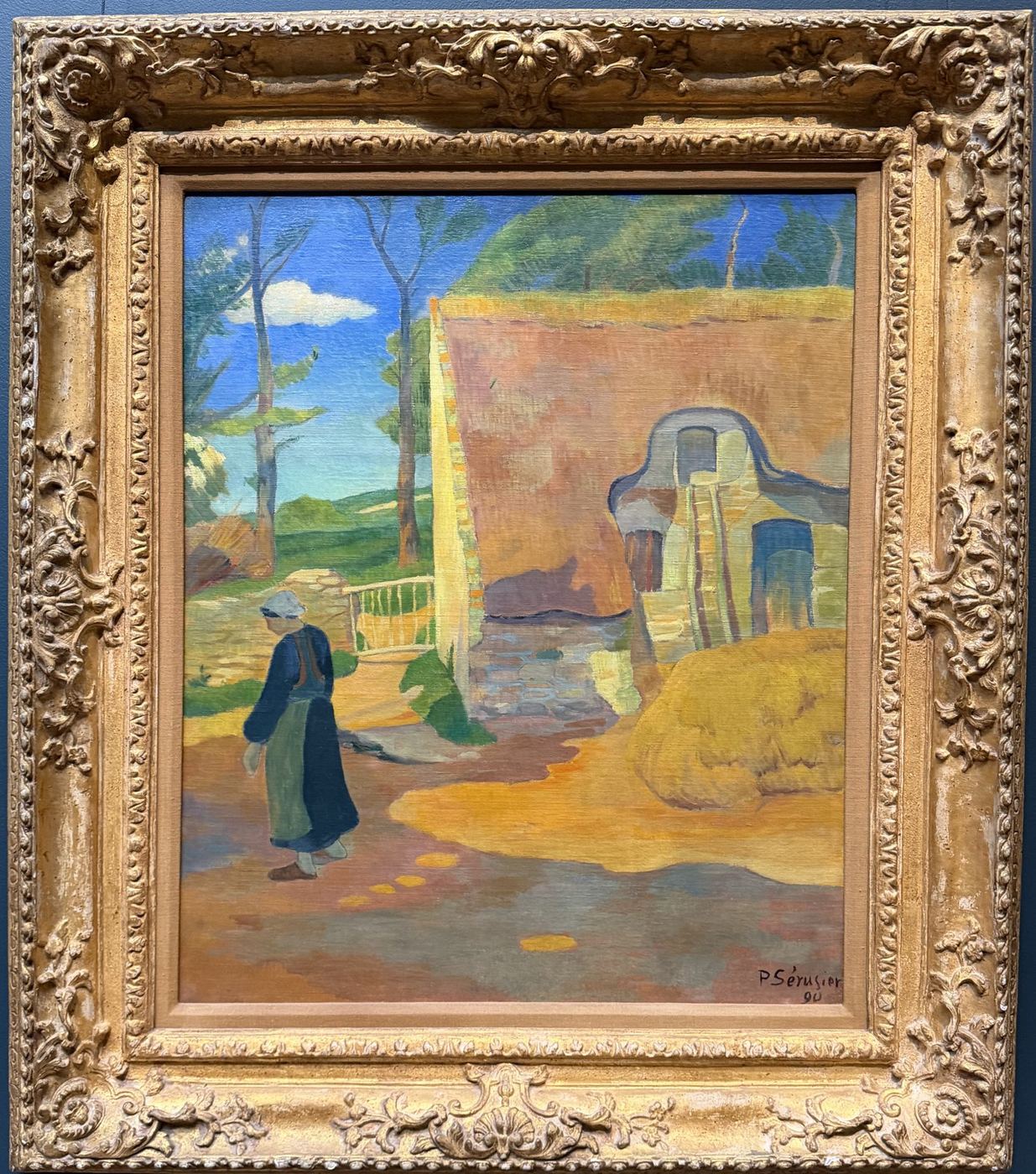
Paul Sérusier
Farmhouse at Le Pouldu
French, 1863 – 1927 1890 oil on canvas Gift of Alexander Mellon Laughlin and Judith Walker Laughlin 2000.95.1
Label match: Paired by sequence and content: the label was photographed right after the work, and the painting is signed P Sérusier 90.
The wall cardFarmhouse at Le Pouldu, 1890 Gift of Alexander Mellon Laughlin and Judith Walker Laughlin 2000.95.1
The pictureA tall canvas looking into a Breton farmyard. A massive building fills most of the right side: a broad, sloping pink and orange wall or roof with a bright yellow edge at the gable, and in front of it a smaller stone structure with a curved, scrolled gable, blue doorways, and a ladder-like run of stones. A great yellow haystack swells at lower right. At left a woman in a white coif, dark blue dress, and green apron walks toward the lower left along an orange path. Behind her are a white gate, a low stone wall, tall thin trees, green fields, and a bright blue sky with one white cloud. Round spots of yellow sunlight lie on the mauve shadow in the foreground. Signed P Sérusier, 90.
Beyond the labelIn 1925 the city museum in Ulm, Germany, acquired this picture; in 1933, after the Nazis took power, it was put on a list of works to be removed and hung in an exhibition at the museum meant to mock its director, Julius Baum, who was forced out because he was Jewish. It escaped the 1937 seizures that took more than 200 works from the Ulm museum, was back on view by 1950, and was sold at auction in 1955. In January 1956 it was bought by Josef and Hadassah Rosensaft, both Holocaust survivors. The museum's text names Cézanne, alongside Gauguin, behind the rows of short hatched strokes in the sky, trees, thatch, and hay. [S0110]
In his wordsNo verified quote found for this work.
Look forThe paint is thin and even, laid in flat areas with the brush moving in one direction, and the canvas weave shows across the sky and the big wall. Blue outlines run around the scrolled gable and the doorways. The spots of sunlight on the path are single touches of yellow, flat discs with no modeling, set on a shadow color that is mauve, not gray.
Photo IMG_7406; label IMG_7407
30
Paul Gauguin
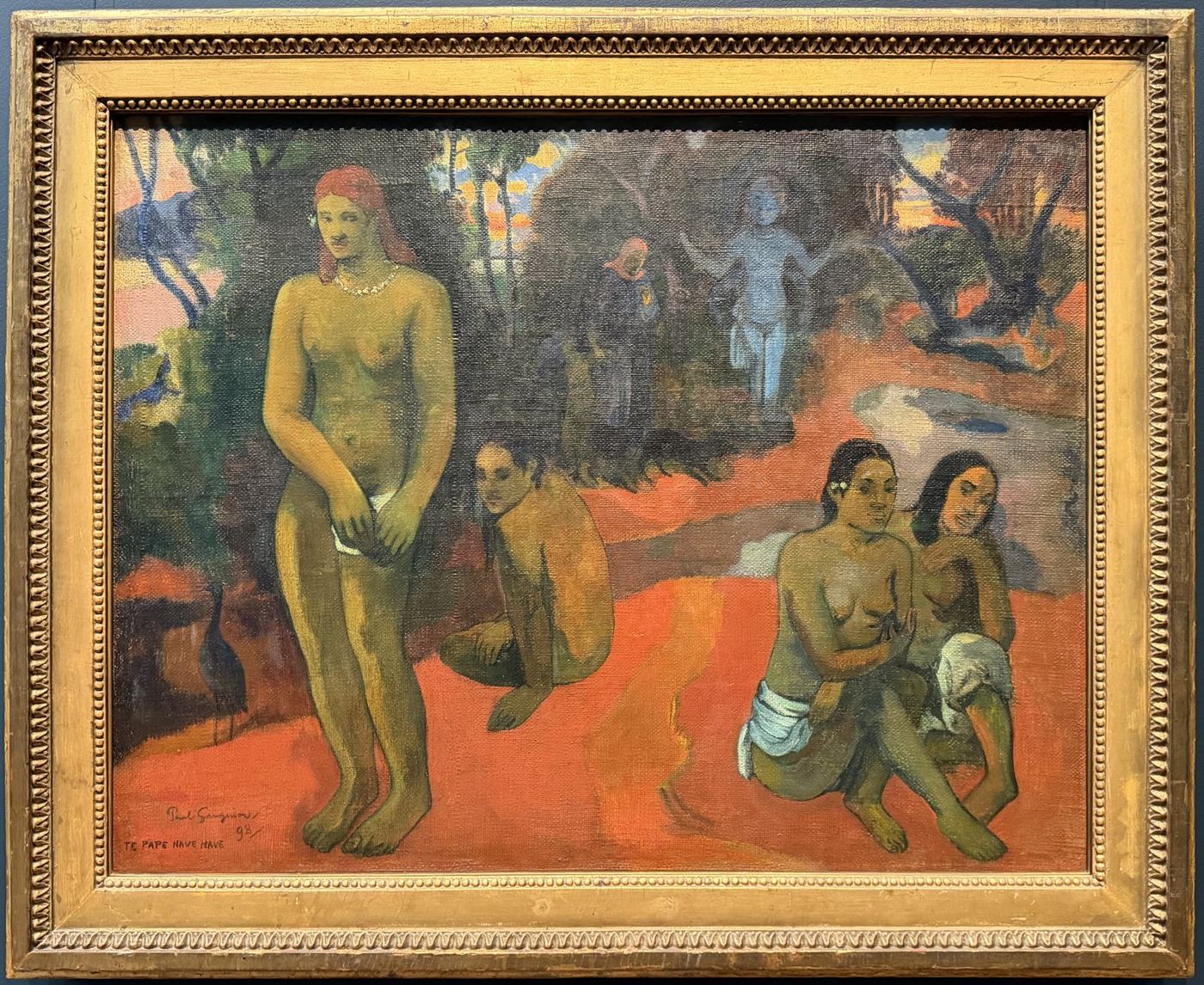
Te Pape Nave Nave (Delectable Waters)
French, 1848 – 1903 1898 oil on canvas Collection of Mr. and Mrs. Paul Mellon 1973.68.2
Label match: The same label is visible at the right edge of the work photo, and the canvas is inscribed TE PAPE NAVE NAVE, so the pairing is certain.
The wall cardTe Pape Nave Nave (Delectable Waters),
The pictureA horizontal canvas with red-orange earth running across the lower half. At the left a nude woman stands facing us, red-orange hair, a necklace of small pale beads, holding a white cloth before her with both hands. Beside her a second woman crouches, arms on her knees, looking down. At the right two women sit close together, one in a white wrap with a white flower in her hair, the other leaning at her shoulder and smiling. A streak of yellow and orange runs down through the red earth between the groups. Behind, under dark trees, stand a figure in a dark hooded robe with a red headcloth and a pale blue figure with arms spread, like a statue. A dark bird stands at the far left edge. Inscribed lower left: Paul Gauguin 98, and TE PAPE NAVE NAVE.
Beyond the labelGauguin painted this in Tahiti in 1898, and by the Wildenstein Plattner Institute's reading of his letters it went to Paris that year in a crate of the season's work, apparently together with his large painting Where Do We Come From? The scholar George Shackelford holds that it hung in Ambroise Vollard's Gauguin exhibition that winter, and that the critic Gustave Geffroy had it in mind when he wrote of a group of girls whose living beauty was fixed in the forms of statuary. The dealer Paul Rosenberg later logged it as La scène religieuse, the religious scene, and in 1931 it was one of twelve Gauguin canvases shown at the International Colonial Exhibition in Paris. [X03-14, S0108]
In his wordsNo verified quote found for this work.
Look forStand close to the upper left and the trees. The support is a coarse, open-weave canvas, and the paint is thin enough that the weave reads as a grid across the whole surface, the way a cast keeps the texture of its mold when it is left unchased. The figures are laid in with flat, muted color and a dark outline, with very little modeling in the bodies.
Photo IMG_7408; label IMG_7409
31
Paul Gauguin
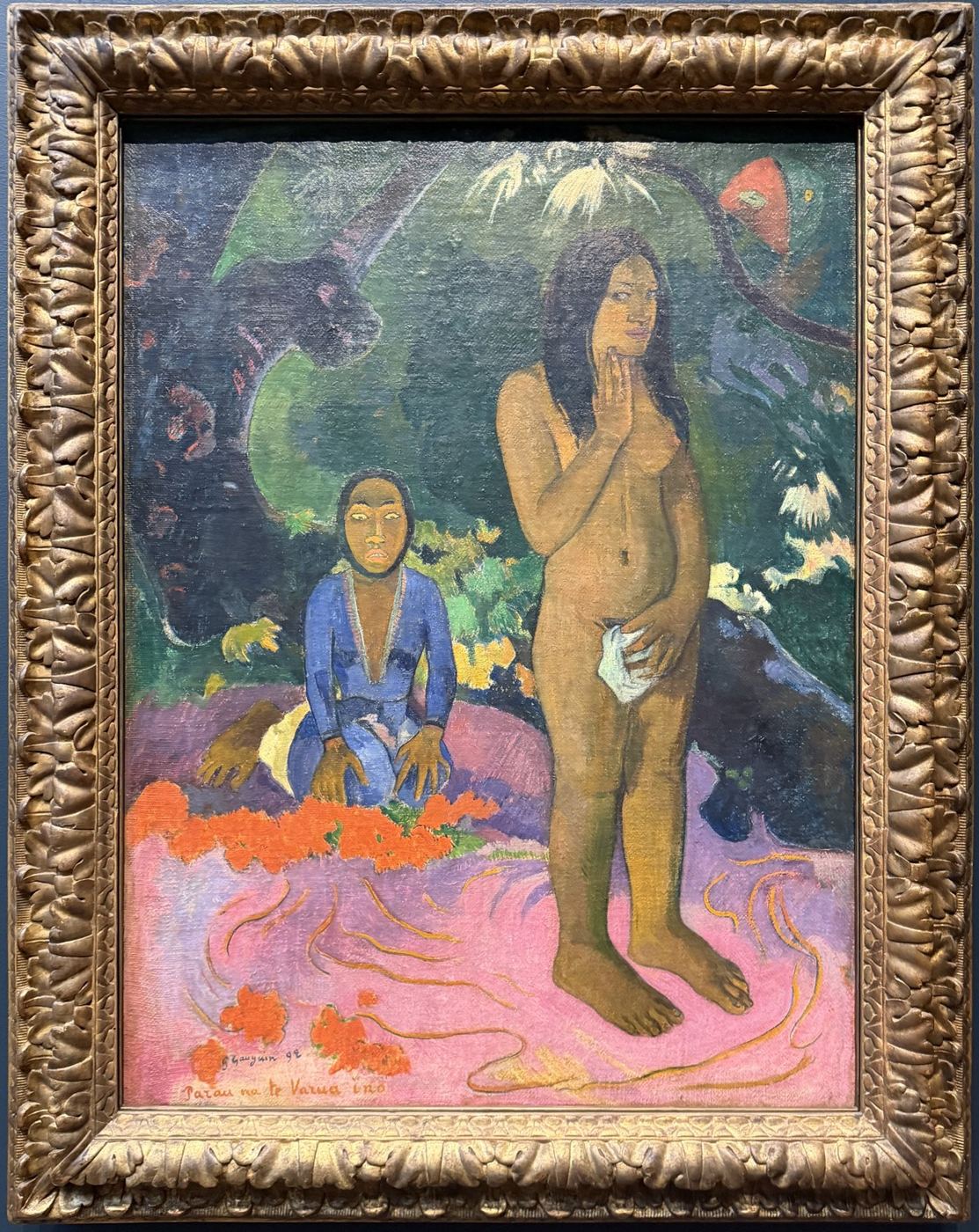
Parau na te Varua ino (Words of the Devil)
French, 1848 – 1903 1892 oil on canvas Gift of the W. Averell Harriman Foundation in memory of Marie N. Harriman 1972.9.12
Label match: Paired by sequence and content: the label was photographed right after the work (one photo between them is not in this set), and the canvas is inscribed Parau na te Varua ino.
The wall cardParau na te Varua ino (Words of the Devil), 1892 Gift of the W. Averell Harriman Foundation in memory of Marie N. Harriman 1972.9.12
The pictureA tall canvas. At right a young nude woman stands facing us, long black hair falling past her shoulders, one hand at her chin and the other holding a white cloth at her groin. She stands on a field of pink crossed by thin orange lines that curl like tendrils. At left a woman in a blue dress kneels with her hands on her knees, staring straight out with pale yellow eyes in a dark, mask-like face. A row of red-orange blossoms lies on the earth in front of her, and a brown hand reaches in from the left behind her. The background is a dark tangle of green and blue leaves with white fronds at the top, a dark purple form at upper left, and a red shape with an eye at upper right. Inscribed lower left: P Gauguin 92, Parau na te Varua ino.
Beyond the labelGauguin showed this in Paris in November 1893, at Durand-Ruel's exhibition of his recent work, and it went unsold when he put it in his own auction in February 1895. In 1906 the Prince de Wagram bought it from Ambroise Vollard as one of six Tahitian canvases, at 4,000 francs for this one, but it came back to Vollard, who sent it to London's 1910 exhibition Manet and the Post-Impressionists and then to the 1913 Armory Show in New York, Chicago, and Boston, as Spirit of Evil. An earlier National Gallery text notes that Gauguin took photographs of Renaissance paintings, the Parthenon, and the temple of Borobudur to Polynesia, and reads the sketchy hand at upper right as an emblem he used in self-portraits, which links it to the disembodied hand in his Self-Portrait three stops back. [S0192, X03-13]
In his wordsNo verified quote found for this work.
Look forThe canvas weave shows through everywhere, strongest at the top left, where the dark green is barely a stain. Against that thinness, the red-orange blossoms at the bottom are thick, dabbed paint that stands up from the surface. The curling orange lines on the pink are each drawn in one pass with a small loaded brush, closer to handwriting than to modeling.
Photo IMG_7410; label IMG_7412
32
Paul Gauguin
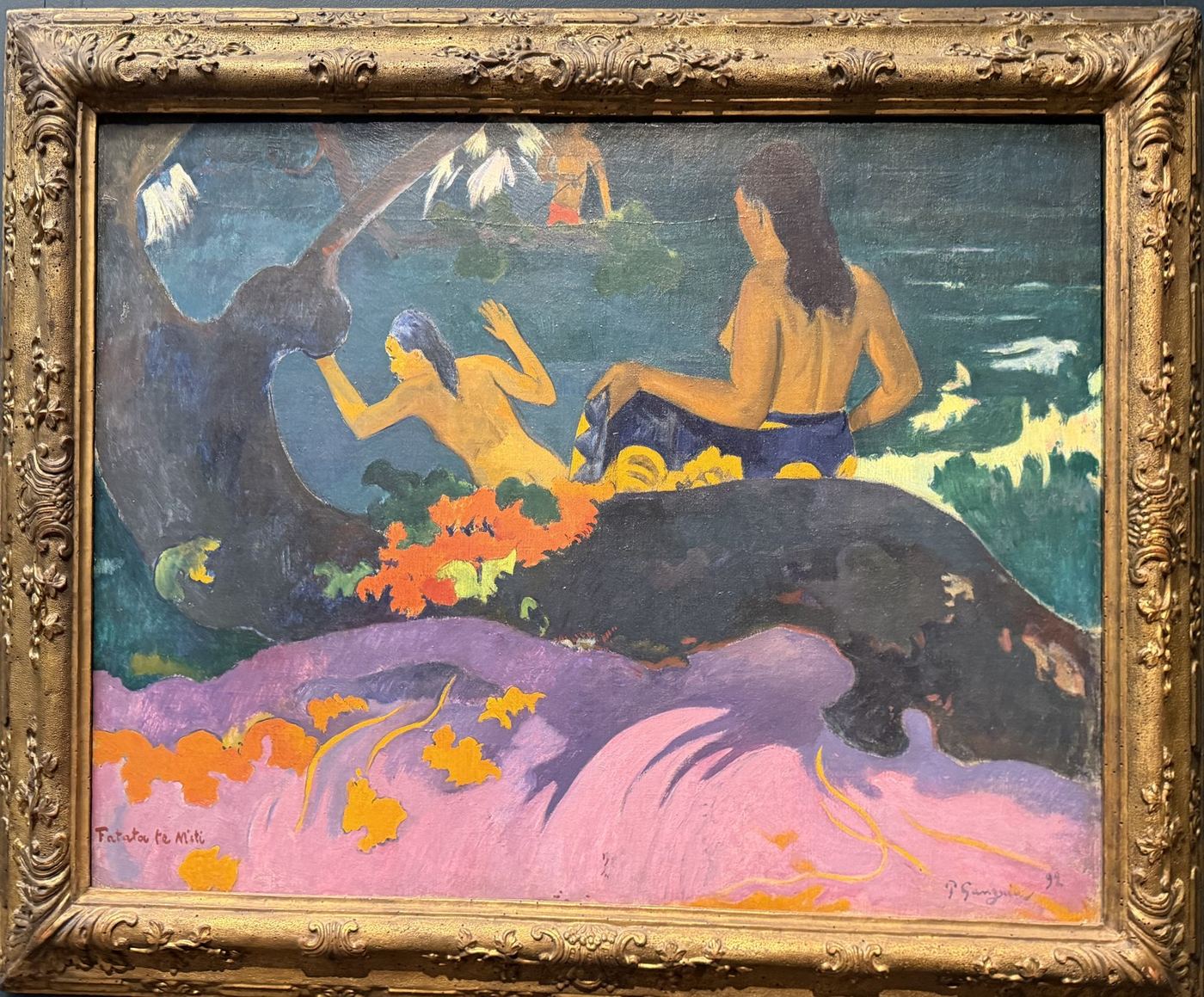
Fatata te Miti (By the Sea)
French, 1848–1903 1892 oil on canvas Chester Dale Collection 1963.10.149
Label match: Paired by sequence and content: the label was photographed right after the work, and the canvas is inscribed Fatata te Miti. The dash in the lifespan line prints tighter on this card than on the others.
The wall cardFatata te Miti (By the Sea), 1892
Across the winding trunk of a flowering tropical tree, we see two Tahitian women. They undress for a swim in the sea. Gauguin uses lush colors and a striking composition to convey the uninhibited joy of plunging naked into the waves.
The materialism and secularism of modern French culture disgusted Gauguin. Inspired by literature, the artist searched for a fantastical place where spiritually healthy people lived in harmony with nature. Believing that he had found that in Tahiti, he set about painting his idealized experience. Works like this one are more about the artist’s own thoughts and feelings than the real people surrounding him.
The pictureA dark tree trunk, thick and twisting, runs nearly the full width of the canvas, from the upper left down across the middle. Beyond it lies a teal sea with white surf breaking at the right. At center left a nude woman leans out past the trunk with both arms raised, about to go into the water. At center right a second woman, seen from behind with long dark hair, is taking off a blue cloth patterned in yellow. Orange-red blossoms and green leaves grow along the trunk. Far off, a small figure in a red loincloth stands in the water under white fronds. The foreground is a beach of lilac and pink, with flat orange leaf shapes and thin yellow-orange tendrils. Inscribed lower left Fatata te Miti; signed lower right P Gauguin 92.
Beyond the labelThis was in the same November 1893 Durand-Ruel exhibition as Words of the Devil, and like that picture it went unsold at Gauguin's auction in February 1895. His friend Daniel de Monfreid sold it in 1898 to Ernest Rouart, son of the collector Henri Rouart, who lent it to the 1906 Salon d'Automne in Paris. In 1928 it passed through the hands of Louis Horch, the financial backer of the first Roerich Museum in New York, to Chester Dale, whose papers first named the Roerich Museum as the seller and then crossed it out. [S0102]
In his wordsNo verified quote found for this work.
Look forThe beach is the most worked area. Its lilac and pink are laid in long, sweeping strokes that follow the shapes of the shadows, and the orange leaf shapes sit on top as flat cut-outs of color with crisp edges. Compare the trunk: a dull, nearly black mass brushed thinly enough that the canvas weave reads through it.
Photo IMG_7413; label IMG_7414
33
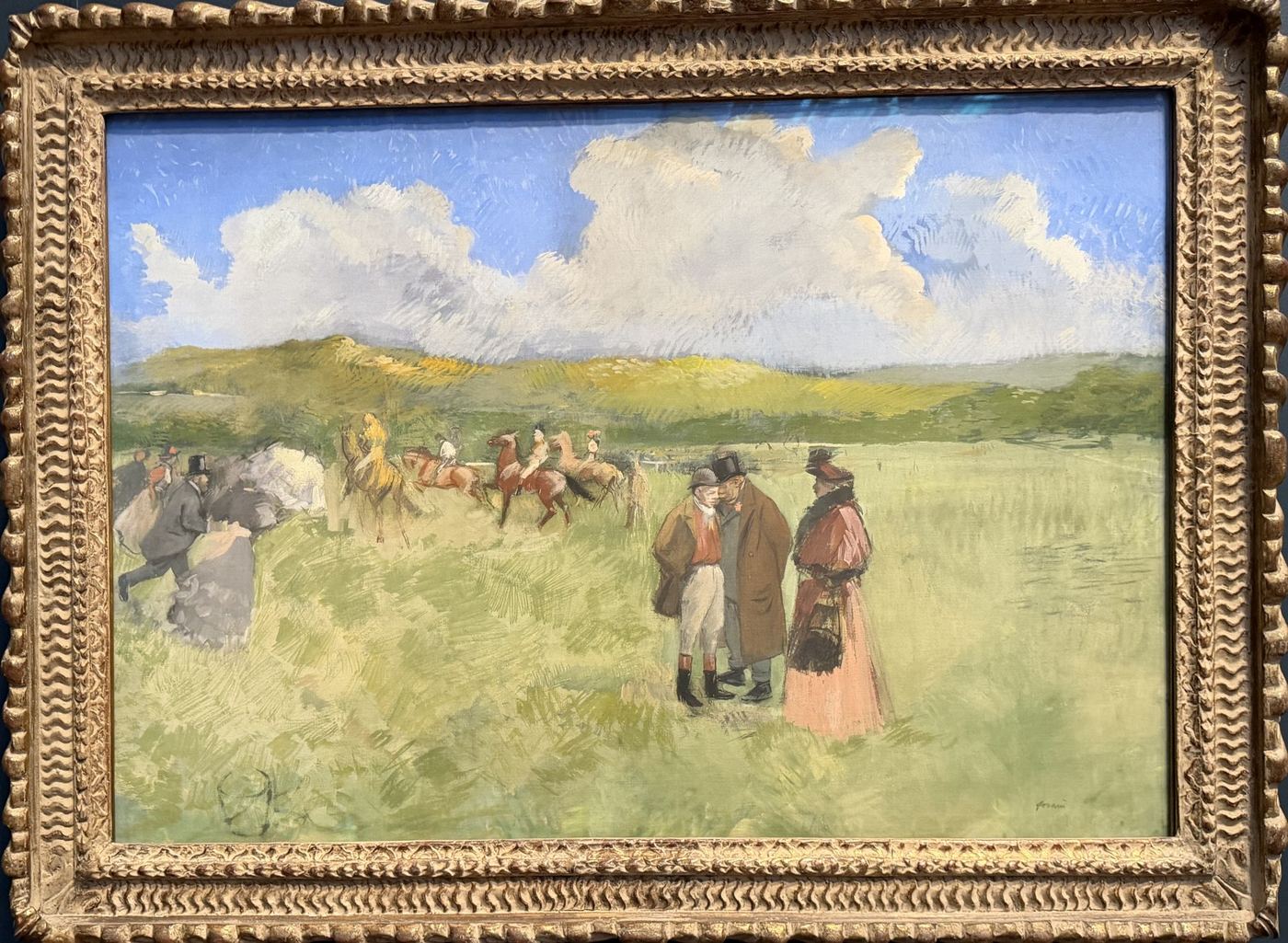
Jean-Louis Forain
The Race Track
French, 1852 – 1931 c. 1891 gouache on canvas Collection of Mr. and Mrs. Paul Mellon 1985.64.18
Label match: Paired by sequence and content: the label was photographed right after the work, and the scene shows riders, jockeys, and spectators on a race field.
The wall cardThe Race Track, c. 1891
The pictureA wide, open race field under a big sky. More than half the canvas is sky: bright blue with large white cumulus clouds touched with yellow and gray. Below, a band of green hills catches the sun, and a broad green field fills the rest. At the left, spectators in top hats and gray dresses hurry to the right in a blur. In the middle distance a string of jockeys in yellow, white, and pink silks ride chestnut horses. At right three figures stand together: a jockey in a red shirt, white breeches, and boots; a tall man in a top hat and long brown coat bending to talk to him; and a woman in a pink skirt and a dark fur-trimmed cape, holding a dark bag. Signed lower right, forain.
Beyond the labelForain studied in Paris with Chevreuse and Carpeaux, and briefly under Gérôme; he was a friend of Manet and of Degas, who invited him to show in some of the Impressionist exhibitions. From 1876 he worked as an illustrator, supplying drawings and captions for Le Figaro and the Courrier français, and after 1900 he turned to religious and legal subjects. The National Gallery holds some 480 of his works, including late court scenes such as Counsel and Accused and Men of Justice. [S0798, X03-19]
In his wordsNo verified quote found for this work.
Look forGouache is water-based, opaque, and dries matte, and Forain uses it here on canvas, not paper. The sky shows it best: the paint goes on in quick hatched strokes that cross each other without blending, and the field below repeats the same scrubbing touch in green. Near the lower left corner, a few dark drawn lines of a small shape are left uncovered by any paint.
Photo IMG_7415; label IMG_7416
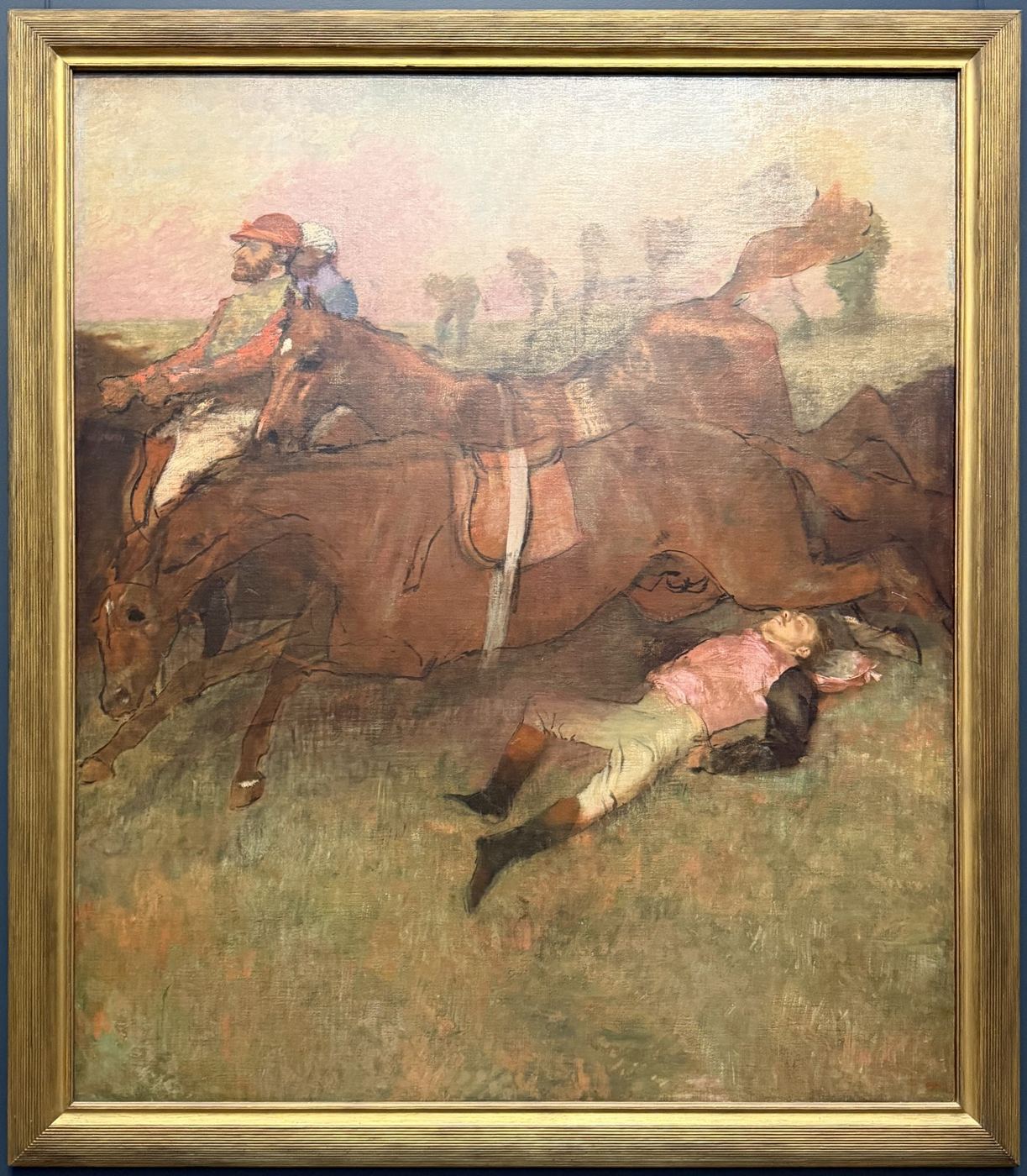
34
Edgar Degas
Scene from the Steeplechase: The Fallen Jockey
French, 1834 – 1917 1866, reworked 1880 – 1881 and c. 1897 oil on canvas Collection of Mr. and Mrs. Paul Mellon 1999.79.10
The wall cardScene from the Steeplechase: The Fallen Jockey, 1866, reworked 1880 – 1881 and c. 1897
It isn’t always easy to realize your vision. Degas often struggled with finishing his paintings, reworking them in his quest for perfection. This one proved especially challenging.
Degas originally painted this in 1866 but returned to it at least twice decades later. He made significant changes each time. Bits of the original blue sky peek through at the top of the canvas. And we can still see the rump and raised tail of a horse that has since disappeared. Rather than hiding the evidence, Degas leaves it exposed, allowing us to track the evolution of this painting.
The pictureA tall canvas of a steeplechase gone wrong. A riderless chestnut horse, saddle still on and a white strap under its belly, plunges across the picture toward the left, its body stretched nearly the full width. Ahead of it at the left, a second horse's head drops toward the ground. At upper left two jockeys ride past, one in a red cap and red and white silks, the other in a white cap and lavender jacket. Below the riderless horse a jockey lies flat on his back in the grass, in pink silk shirt, black sleeve, white breeches, and black boots, his eyes closed and his head tipped back. The lower third is open grass. At upper right a thin red-brown rump and raised tail float with no horse attached, and faint upright shapes stand along the horizon under a pink sky.
Beyond the labelDegas sent this to the Salon of 1866, a year after showing a medieval history picture there, and a reviewer wrote that, like the jockey, the painter was not yet entirely familiar with the horse. It stayed in his studio and was sold after his death in the 1918 studio sale, catalogued as the wounded jockey. In January 1921 it was bought at auction in New York for the American painter Gari Melchers; his wife Corinne's diary for that day reads, in part, "Buy the Degas at Plaza sale," at $3,500. It passed to her brother after her death and was sold to Paul and Bunny Mellon in 1960; the curator at Belmont, the Melchers house near Fredericksburg, Virginia, learned of the family's ownership only from the label at the National Gallery's Degas at the Races exhibition in 1998. [S0096, X03-15, X03-16]
In his words"I was totally ignorant of the mechanism that regulates a horse's movements." (Degas, recalled in 1897.)
Look forThe card asks you to read the revisions; here is how. Over the brown body of the riderless horse, the legs, belly, and saddle edges are redrawn in loose black lines that do not match the painted forms beneath, so you see two drawings at once. At upper right the abandoned horse is thin, scraped paint with the sky showing through it. The jockeys' silks, by contrast, are dense, granular touches sitting on top of everything.
Photo IMG_7417; label IMG_7418
35
Edgar Degas
The Riders
French, 1834 – 1917 c. 1885 oil on canvas Collection of Mr. and Mrs. Paul Mellon 2014.18.7
The wall cardThe Riders, c. 1885
The pictureJockeys walk their horses toward us across a green field, strung out in a loose line. The riders wear silks of yellow, white, blue, red, and black, with another half hidden behind them. The horses are chestnut and dark bay, several seen head-on, and one at center right stretches its neck straight up so that its head is a blurred mass. Long dark shadows fall toward us from the hooves, so the light comes from behind them. At far left a rider moves away; at right a crowd under pale umbrellas and a man in a top hat stand as dark silhouettes. Behind are trees and a long, pale green hill under a pale sky. Signed lower right, Degas.
Beyond the labelThis came out of Degas's studio through the dealer Ambroise Vollard, who reproduced it in his 1914 Album Degas; the Paris collector Jules Strauss bought it from Vollard in 1911 and wrote in his papers that it came directly from Degas. Strauss's great-granddaughter, Pauline Baer, shared that record with the museum in 2016. Paul Mellon bought it in 1967 and left it to the National Gallery with a life interest to his wife, Rachel (Bunny) Mellon, so it reached the Gallery only after her death in 2014. [S0095]
In his wordsNo verified quote found for this work.
Look forLook at the horses' legs. They are drawn first in dark lines and only partly filled, so the contour does the work and the field shows between the strokes. The horse lifting its head at center right is the least resolved, its head a few broad strokes with no features. The shadows below are transparent dark green pulled across the lighter grass.
Photo IMG_7419; label IMG_7420
36
Vincent van Gogh
Farmhouse in Provence
Dutch, 1853 – 1890 1888 oil on canvas Ailsa Mellon Bruce Collection 1970.17.34
The wall cardFarmhouse in Provence, 1888
The pictureA wheat field in full yellow fills the foreground. A dry-stone wall in lavender and blue curves in from the lower center and runs back to a gateway of two pinkish stone posts with a green gate between them. Beyond the wall stand a yellow farmhouse with orange-red tile roofs, rounded golden haystacks, and dark green and blue trees. A thin band of deep blue lies along the horizon. At the left a man in a blue jacket and dark cap walks away from us into the wheat. Red flowers on green stems crowd the foot of the wall, and a pale path runs off to the right. The sky is turquoise, laid with swirling strokes of white and pink.
Beyond the labelVan Gogh painted this in Arles in June 1888, working from a drawing of the same farmhouse; the editors of his letters count it among the two or three new painted studies he reported to Theo on 12 June. In about fifteen months in Arles, the museum says, he produced more than 200 paintings, about 100 drawings, and more than 200 letters. Less than four months after his death it was sold through Julien Tanguy in Paris to Willy Gretor, who gave it to the painter Maria Slavona. [X03-03, S0117]
In his words"I have two or three new drawings and also 2 or three new painted studies." (Letter to Theo van Gogh, 12 June 1888.)
Look forThe impasto here is real relief. The wheat is made of short, upright strokes of yellow, ochre, and green set side by side, each keeping the mark of the brush, and the red flowers are single raised blobs. The wall is built of small horizontal dabs of lilac, blue, and white, laid like the stones themselves. Look at it from the side and the surface throws shadows.
Van Gogh found inspiration for this portrait in the bold complementary colors and contrasting patterns of the Japanese woodblock prints he collected. He fantasized about Japan as a utopia of bright light and color different from the dark, crowded western capitals he lived in. In fact, the title of this portrait comes from a popular French novel about Japan. In the book, the “mousmé” is a young woman described as innocent and pure.
The pictureA girl sits in a curved wooden armchair, turned slightly, facing us with dark eyes. Her dark hair is pulled back into a bun with a red ribbon. She wears a jacket of red and blue vertical stripes closed with a row of orange buttons, with white collar and cuffs, over a deep blue skirt scattered with orange-red dots. One hand rests on the chair arm; the other holds a sprig of pink-white flowers with long, narrow green leaves in her lap. The chair's curved arms are drawn as bands of dark green and black. The background is a pale green-white, hatched in short crisscrossing strokes.
Beyond the labelVan Gogh spent a full week on this at the end of July 1888, telling Theo he had to save his mental strength to finish it, and in the same letter he listed its colors down to the sprig of oleander in her hand. In September Theo showed it to Camille Pissarro, and Vincent wrote back that he was pleased Pissarro had found something in it. In 1909 the German playwright Carl Sternheim bought it and soon traded it to Bernheim-Jeune in Paris for a landscape, as his wife Thea recorded in her diary. In 1929 it hung in the Museum of Modern Art's First Loan Exhibition in New York, and in 1931 a New York show catalogued it, wrongly, as a portrait of Mademoiselle Gachet. [X03-01, X03-02, S0115]
In his words"It took me my whole week, I wasn’t able to do anything else, having been not too well again." (Letter to Theo van Gogh, 29 July 1888.) "The portrait of a young girl is on a white background strongly tinted with Veronese green, the bodice is striped blood-red and purple. The skirt is royal blue with large orange-yellow stippling." (Letter to Theo van Gogh, 29 July 1888.) "It gives me great pleasure that Pissarro found something in the young girl." (Letter to Theo van Gogh, 8 September 1888.)
Look forEach zone gets its own stroke. The jacket's stripes are long vertical drags of thick paint following the body, the skirt's dots are separate raised touches set on a flat blue, and the background is short crossed strokes, almost like basketwork. The face and hands are thinner and smoother, with the features drawn in dark lines. The card's complementary colors are right there: orange on blue, red against green.
Photo IMG_7423; label IMG_7424
38
Vincent van Gogh
Roses
Dutch, 1853 – 1890 1890 oil on canvas Gift of Pamela Harriman in memory of W. Averell Harriman 1991.67.1
The wall cardRoses, 1890 Gift of Pamela Harriman in memory of W. Averell Harriman 1991.67.1
The pictureA large bouquet of roses in a tan vase sits on a green table, seen close and a little from above. The blossoms crowd the upper two-thirds of the canvas: dozens of full, ruffled roses in white and the palest pink, with buds on long stems and dark green leaves between them. A loose spray of roses lies on the table at the left, and two more lie at the foot of the vase. The wall behind is light green, crossed by long diagonal strokes of cream that sweep up from lower left to upper right. The tabletop is a flatter, deeper green, with a thin line marking its back edge.
Beyond the labelVan Gogh painted this in May 1890, in his last days at the asylum in Saint-Rémy, after a crisis he told Theo had disappeared like a thunderstorm. The paint was too thick to travel, so he left it behind when he set out on May 16, and a man at the asylum, probably the chief orderly Charles-Elzéard Trabuc, sent it on; it reached Auvers by June 24. The museum notes that the roses were pink when painted and have faded, weakening the contrast of complementary colors with the green that van Gogh intended. Within a year of his death his sister-in-law Jo van Gogh-Bonger sold it to the collector Paul Gallimard for 400 francs. [X03-05, S0199]
In his words"I’m working on a canvas of roses on bright green background" (Letter to Theo van Gogh, 11 May 1890.) "These canvases will take a good month to dry, but the man who works here will take care of sending them after my departure." (Letter to Theo van Gogh, 11 May 1890.)
Look forThe roses are modeled with paint, not with shading. Each bloom is a knot of thick, curling white and pink strokes, with a few thin lines of blue or red worked in to separate the petals, and the impasto stands up off the surface. The wall behind is thinner, laid in long strokes all running one way. At the edges, the canvas weave shows where the green barely covers.
Photo IMG_7425; label IMG_7426
39
Vincent van Gogh
Self-Portrait
Dutch, 1853 – 1890 1889 oil on canvas Collection of Mr. and Mrs. John Hay Whitney 1998.74.5
The wall cardSelf-Portrait, 1889
The pictureHead and shoulders, the face turned three-quarters to our left and the eyes turned back toward us. The face is yellow and pale green, with strokes of green in the shadows, under a shock of orange hair and above a cropped orange-red beard. He wears a blue smock buttoned high at the throat over a white shirt. At lower left he holds a palette with dabs of yellow, blue, green, and pink, and a bundle of brushes. The background is a deep blue and violet made of short strokes that flow around the head and shoulders like a current.
Beyond the labelVan Gogh painted this at Saint-Rémy in early September 1889, just after a severe attack; he told Theo he had begun one self-portrait the first day he got up, and the editors of his letters identify that canvas as this one. That year the Dutch writer Joseph Jacob Isaacson had praised him in print as "a single pioneer"; Vincent found the praise "extremely exaggerated" but planned to give him a self-portrait, and this painting later belonged to Isaacson. The museum counts 36 self-portraits by van Gogh and calls this one of his last. [X03-06, X03-07, S0198]
In his words"One I began the first day I got up, I was thin, pale as a devil. It’s dark violet blue and the head whiteish with yellow hair, thus a colour effect." (Letter to Theo van Gogh, September 1889.) "I’m planning to write to him again about his articles, and I’ll give him a portrait of myself as a souvenir." (Letter to Theo van Gogh, October 1889.)
Look forFollow the direction of the strokes. In the background they run in short, curving dashes that bend around the outline of the head; in the smock they run long and follow the folds; in the beard they are small and vertical. The paint is thick throughout, and the dabs of color on the painted palette are raised paint standing in for raised paint.
Photo IMG_7427; label IMG_7428
40
Vincent van Gogh
Green Wheat Fields, Auvers
Dutch, 1853 – 1890 1890 oil on canvas Collection of Mr. and Mrs. Paul Mellon 2013.122.1
The wall cardGreen Wheat Fields, Auvers, 1890
The pictureA field of young green wheat rises from the lower left toward a high horizon, and a pale path curves along the right edge. The wheat is a mass of blue-green, green, and yellow-green tossed in curling waves, with scattered small yellow flowers near the center and a few tall stalks standing up at the left. Above the horizon the sky is white and pale turquoise, filled with clouds drawn as loops and spirals outlined in lavender. There are no figures and no buildings: the whole canvas is field, path, and sky.
Beyond the labelThe editors of van Gogh's letters, listing the landscapes he painted at Saint-Rémy in May 1890, record the scholar Louis van Tilborgh's view that this field is probably from Auvers instead, which is where the museum places it. It was in Theo's estate, and by 1905 the Berlin dealer Paul Cassirer was showing it; in 1906 Curt Herrmann of Berlin bought it, and his son Fritz later took it to London. Paul Mellon bought it in 1955, and apart from one Gallery exhibition in 1966 it stayed in the Mellons' house in Virginia until it was given in 2013. [X03-08, S0196]
In his wordsNo verified quote found for this work.
Look forThe paint is thick enough to read as relief. Each curl of wheat is a single stroke of stiff paint, laid wet into wet so neighboring greens smear together at their edges. In the sky the strokes wind into spirals, and the white of the clouds is built up so thick that, at arm's length, it casts its own small shadows.
ReadingsA reading, not the museum's: in June 1890 van Gogh described to Gauguin a field of greens 'of the same value' that would vibrate like wheat in the breeze (see Girl in White, the next stop); this canvas, with no figure in it, comes close to that idea on its own.
The pictureA young woman stands in a field of tall green wheat, seen nearly to the knees and turned slightly to our left. She wears a long white dress with a high collar and a broad yellow straw hat trimmed with pale blue. Her face is ochre and green, framed by dark hair tied at the neck, and she looks off to the side, unsmiling. Her hands hang at her sides. The wheat behind her is a screen of vertical strokes in pale green, yellow, and cream. Orange-red poppies appear as round dots, and at lower left and right, blue-outlined angular shapes stand for flower stalks.
Beyond the labelVan Gogh painted this at Auvers in 1890, in the last weeks of his life, one of two portraits of a girl against a background of wheat. Andries Bonger's 1890 list of the works in Theo's hands recorded it as a size 12 figure canvas, but the museum now holds that it is on a size 15 marine canvas, a longer and narrower shape van Gogh chose for his own reasons. In 1908 the Zurich collector Richard Kisling bought it, and that year it was shown in Zurich, Paris, Frankfurt, Munich, and Dresden. [X03-09, S0116, S0196]
In his words"On it, on a very alive and yet tranquil background, I would like to paint portraits. It is greens of different quality, of the same value, in such a way as to form a green whole which would by its vibration make one think of the soft sound of the ears swaying in the breeze." (Draft letter to Paul Gauguin, June 1890.)
Look forThree textures, three handlings. The dress is built from short, stippled touches of white that leave a dotted, pebbled surface; the wheat is long vertical drags; and the poppies are single round knobs of orange paint that stand up from the canvas like rivet heads. A thin dark blue line runs down the figure's back and side, separating her from the field.
Photo IMG_7431; label IMG_7432
Room 4
Gallery M81: The Fictions and Fantasies of Orientalism
The panel names the movement and does not flatter it. These paintings, it says, show how French artists viewed the “orient,” “as they called regions France colonized in North Africa and to the east,” and they “often projected dreams of sensuality and violence onto their subjects.” Its verdict: “Those dehumanizing stereotypes reinforced a sense of difference that served French imperial aims.”
Ten pictures hang here, dated from about 1823 to 1898: three by Delacroix, two by Renoir, and one each by Lehmann, Bergöö, Benjamin Constant, Gérôme, and Regnault. The panel pairs two of them on purpose. Delacroix’s Arabs Skirmishing in the Mountains supplies the “vivid colors and expressive brushstrokes,” and Renoir’s Odalisque shows a younger painter taking them up, with “his girlfriend dressed in an ‘oriental’ costume.”
Watch the gap between the costume and the sitter. The two small Delacroix studies of an Indian from Calcutta are dated about 1823/1824, years before the 1832 Morocco trip the battle picture’s card mentions. And Karin Bergöö’s card tells you the academy students “often used costumes and props to cast him in exotic poses” -- then shows you what she did instead.
The wall panel, verbatim
The Fictions and Fantasies
of Orientalism
The paintings in this gallery belong to a movement called
orientalism. They show how French artists viewed the
“orient,” as they called regions France colonized in North
Africa and to the east. Painters such as Eugène Delacroix
drew from direct observation as well as their own frequently
superficial understandings of Arab and Islamic cultures. They
often projected dreams of sensuality and violence onto their
subjects. Those dehumanizing stereotypes reinforced a sense
of difference that served French imperial aims.
Both the subjects and style of French orientalism had a global
impact on art. Vivid colors and expressive brushstrokes,
seen here in Delacroix’s Arabs Skirmishing in the Mountains,
influenced younger generations of artists. For example, in
Odalisque Auguste Renoir used a bright palette and energetic
brush to depict his girlfriend dressed in an “oriental” costume.
42
Auguste Renoir
Young Spanish Woman with a Guitar
French, 1841 – 1919 1898 oil on canvas Ailsa Mellon Bruce Collection 1970.17.76
Label match: Pairing certain: the same label is visible at the right edge of the work photo.
The wall cardYoung Spanish Woman with a Guitar, 1898
The pictureA young woman in profile to the right, seen from the waist up, plays a guitar that crosses the canvas on a long diagonal from her lap to the upper right. Her eyes are lowered to the strings. She wears a black hat over a red-orange headscarf knotted at the back of her neck, a fine gold chain with a pendant, and a jacket worked in gold, blue, and rose that dissolves into flecks at the left edge. A pale yellow ribbon streams from the guitar’s head back toward her face. The guitar body is warm orange, the sound hole a dark oval ringed in gray. The background is a soft field of olive and yellow-green with a vertical band of rose at upper left. The signature and date are at lower right.
Beyond the labelIn the 1890s Renoir painted a series of young women playing the guitar, and this is the only one in which the sitter wears Spanish costume. The museum's curator Mary Morton says the woman was a model, neither Spanish nor a guitarist, dressed in a bolero jacket from Renoir's own costume collection, and she calls this almost an Orientalist picture: it plays on the French fantasy of Spain as a land of sun, music, and color, fed by Napoleon III's Spanish empress and by Manet's Spanish subjects of the 1860s. Renoir's dealer Durand-Ruel bought the canvas from him in January 1899 and showed it in Paris that year. Renoir painted a second version, and the two have been confused in print. [S0516, S0039]
In his wordsNo verified quote found for this work.
Look forLook at the background behind the guitar neck. It is scumbled: thin, dry green dragged over a warmer layer that shows through in the gaps, so the wall shimmers without describing anything. The yellow ribbon is one long loaded stroke pulled wet-into-wet through that green; its edges are soft where the two paints mixed on the canvas. The jacket is the thickest paint, small dabs of gold and blue standing up from the surface.
Label match: Pairing certain: the same label is visible at the right edge of the work photo.
The wall cardOdalisque, 1870
The pictureA woman lies full length across a wide canvas, head at the right on a white pillow, feet at the left in green slippers. She looks straight out at you, heavy-lidded, a red plume and gold ornaments in her dark hair, gold hoops at her ears, and a long strand of dark beads at her throat. She wears sheer, silvery-white sleeves, a gold and rose embroidered vest, a blue and orange striped sash, and loose trousers patterned in gold and red, gathered with gold bands below the knee. Her bare calves cross toward the lower left. Behind her: a carpet, a red and gold hanging, and a draped gray cloth. At upper left, a green glazed jug and a dish of oranges sit on a red-brown cushion. The signature, “A. Renoir,” with the date, is at lower left.
Beyond the labelThe model was Lise Tréhot, Renoir's favorite model from 1865, when they met, until 1872, and the setting is his Paris studio dressed with a costume he probably rented and some decorative objects, as curator Mary Morton puts it in the museum's audio. At the Salon of 1870 it hung as Woman of Algiers next to Renoir's much larger Bather with a Griffon Dog, also posed by Lise: critics Goujon, Duranty, and Mezin panned the Bather and the cartoonist Bertall called it pornographic, while this picture, painted as a tribute to Delacroix, won Renoir more praise. In the same audio the novelist Laila Lalami points out that France had already invaded and controlled Algeria when it was painted. In 1931 the painting was shown again in Paris, at the International Colonial Exhibition. [X04-02, S0037]
In his wordsNo verified quote found for this work.
Look forGet close to the white sleeves. They are thick impasto, pulled in long, crumpled strokes that follow the folds, so the silk reads as silk because the paint itself is ridged and catches the light. Compare her face and calves: smoother, more blended, with the strokes mostly gone. The patterned trousers are neither: small dabs of gold and red set on a dark layer, a pattern suggested, not drawn.
Photo IMG_7437; label IMG_7438
44
Henri Lehmann
Woman of the “Orient,”
French, born Germany, 1814 – 1882 1837 oil on canvas Chester Dale Fund 2019.15.1
Label match: Pairing by sequence: the label was photographed right after the painting, and its content matches (1837 is painted on the canvas at upper right). The comma after Orient sits inside the closing quotation mark, as on the card.
The wall cardWoman of the “Orient,” 1837
The pictureA young woman sits half-length on a terrace, body turned to the left, head turned back to look at you over her right shoulder. Her arms rest crossed on her lap. A cream and gold striped scarf is wound through her dark hair, with a braid falling down past her collarbone. Her white sleeveless top is pinned at the shoulder with a small round brooch, and a blue-gray skirt patterned with tan leaves pools around her. Behind her, a balustrade with pointed openings, then flat blue sea, then a sky that grades from deep blue at the top to pale peach at the horizon. A salmon-pink curtain hangs at the right edge, and a gray wall fills the upper right, where the signature and the date 1837 are painted.
Beyond the labelThe signature at upper right reads Heinrich Lehmann, 1837, Paris. He was born Heinrich Lehmann in Kiel, in the Duchy of Holstein, came to Paris in 1831 at seventeen to study with Ingres, and became a French citizen only in 1847. He painted this at twenty-three, the year before he went to Rome to keep working with Ingres, then director of the French Academy there. Four decades later Lehmann was teaching at the École des Beaux-Arts, and one of his students was Georges Seurat. [S0051, X04-09, X04-10]
In his wordsNo verified quote found for this work.
Look forThis is the opposite of the Renoirs. The surface is licked: the paint is blended until no stroke shows, and the edges of the arm, the face, and the balustrade are crisp. The sky is a long, even gradient laid so thin that the canvas weave catches the gallery light like grain. Modeling is in the shadows under the jaw and inside the elbow, built in smooth tonal steps rather than marks.
Photo IMG_7439; label IMG_7440
45
Karin Bergöö Larsson
Pierre Louis Alexandre
Swedish, 1859 – 1928 1879 – 1880 oil on canvas, mounted on board Gift of Funds from Laura and John Arnold, Virginia Cretella Mars, and Maria Elena Weissman 2024.6.1
Label match: Pairing certain: the same label is visible at the right edge of the work photo.
The wall cardPierre Louis Alexandre, 1879 – 1880 Gift of Funds from Laura and John Arnold, Virginia Cretella Mars, and Maria Elena Weissman 2024.6.1
Having escaped a French colony in Latin America, Pierre Alexandre fled to Sweden. He worked in the harbors and, when the docks froze over in the winter, modeled at the art academy. Alexandre may have been the only Black person many of the art students knew. They often used costumes and props to cast him in exotic poses.
But in this portrait, young Karin Bergöö, one of the few women students at the academy, captures Alexandre’s individuality. Because he is close to the picture plane, he feels physically present, even if his far-off gaze suggests his mind is elsewhere.
The pictureA man sits in profile to the right, seen from the knees up, close to the front of the picture. His hands are clasped around one raised knee. He wears a loose cream short-sleeved shirt, a yellow sash at the waist, and red and white striped shorts that end above the knee. His head is turned slightly toward you and lifted, the gaze going past you to the right, not meeting yours. His hair is short and his beard close-cropped. The background is a plain, pale sky blue. At lower left he sits on a red-orange cloth with a patch of blue-green beside it, both left loose. The signature, “Karin Bergöö,” is in dark paint at lower left.
Beyond the labelPierre Louis Alexandre came to Stockholm from Cayenne, in French Guiana, and worked the harbor on Södermalm; the researcher Mats Werner, whose father owned this painting, found him in the Academy's receipts as a model almost every winter from 1878 until 1903, when tuberculosis probably made posing too hard. Werner thinks he was sent to the Academy because Orientalist art had become fashionable, and a fellow student, Anna Holsteinson, painted him at the same sitting as this portrait. In Stockholm he was known by a nickname built on a racial label, and Bergöö herself always called this picture by it; on his receipts he signed Pierre, then P.L. Alexandre, the name the museum uses. He died in Stockholm in 1905; Bergöö went on to Paris, married the painter Carl Larsson in 1883, and put her brushes aside when their first child was born. [X04-04, S0057, X04-05]
In her wordsNo verified quote found for this work.
Look forThe finish is uneven on purpose, the way a study is. The face, hands, and forearm are modeled tightly with small, blended strokes. The shirt is broader, flat planes of cream with the folds marked in gray-green. Each red stripe on the shorts is a single loaded stroke over white, and the bottom left corner is rough patches of gray, blue, and red. The label says the canvas is mounted on board.
Photo IMG_7441; label IMG_7442
46
Eugène Delacroix
Arabs Skirmishing in the Mountains
French, 1798 – 1863 1863 oil on canvas Chester Dale Fund 1966.12.1
Label match: The label was photographed just before the work; the right edge of the same label is visible at the left edge of the work photo.
The wall cardArabs Skirmishing in the Mountains, 1863
Delacroix saw North Africa as a simpler, uncorrupted society compared to modern Europe. He believed North African men were braver and more manly, like the warriors of ancient Greece and Rome. Here, he brings his ideal to life using vibrant colors, energetic brushwork, and the dynamic composition of diagonals in the mountain landscape.
The artist had traveled to Morocco in 1832. But this dramatic battle scene, painted more than 30 years later, is pure fantasy. Although Delacroix admired Arab culture, paintings like this helped stereotype it as primitive, unchanging, and violent.
The pictureA mountain valley on a tall canvas. A castle with square towers sits on a hill at upper left under a blue sky with white cloud; a steep gray cliff rises at right. Gun smoke drifts across the middle of the valley. In the foreground a riderless brown horse with a black mane rears and twists, its saddle cloth red, beside a fallen man in blue and white lying face down, and a man in yellow crouching at left with a long gun. A second body lies on the slope behind them. At center, a horseman with a raised lance rides into the smoke. At right, a man in white kneels to fire, and others in red caps run uphill toward trees. More fighters crowd the bushes at left. The signature, “Eug. Delacroix 1863,” is at bottom center.
Beyond the labelThis was Delacroix's last important picture, painted four or five months before his death on August 13, 1863, when he was already in failing health; in his April receipt to his dealer he called it Combat of Arabs in the Mountains. Early writers retitled it The Collection of the Arab Tax, and it was exhibited under that name into the 1980s, although the museum's catalogue finds no sign in Delacroix's letters or journals that he ever saw such an event in 1832. The only known sketch is a pen drawing in the Louvre dated October 1862, for the fallen horse and rider in the foreground. Conservators describe the painting as unusually well preserved, with every glaze intact. [X04-01, S0041]
In his wordsNo verified quote found for this work.
Look forFollow the reds. Small touches of red on the saddle cloth, the caps, the sashes, and the coats are spread across the whole canvas, so your eye zigzags from the horse up the slope to the far fighters. The smoke is a scumble, dry white dragged over the green and brown so the hillside still shows through. The brush stays loose and visible everywhere; nothing is blended to a polish.
Photo IMG_7444; label IMG_7443
47
Jean Joseph Benjamin Constant
The Favorite of the Emir
French, 1845 – 1902 c. 1879 oil on canvas Courtesy of the United States Naval Academy Museum 2010.95.1
Label match: Pairing certain: the same label is visible at the right edge of the work photo, and the label photo shows the frame’s right edge at its left.
The wall cardThe Favorite of the Emir, c. 1879
The pictureA wide canvas. On a low couch at left, a red-haired woman lies back with her arm thrown over her head and her eyes closed, her body in a sheer blouse and a long orange skirt shot with gold. Behind her, a dark-skinned man in a white turban and white robe plays a long-necked stringed instrument. A second woman with black hair and a gold headband lies propped on her elbow at center, her head on her hand, looking straight at you, in a gold jacket. Rich carpets in black, gold, and red spill over the couch and floor. At right, an arcade of slim columns with climbing red vines opens onto a terrace, white buildings, a blue sea with small sails, and pale cliffs. A small figure in yellow stands between the far columns. The signature, “Benj-Constant,” is at lower left.
Beyond the labelBenjamin-Constant spent sixteen months in Morocco from 1871 in the party of Charles Tissot, France's envoy there, and came home with objects, sketches, and studies that fed his pictures for years. His first teacher in Toulouse, Jules Garipuy, had been a student of Delacroix, and the museum sees Delacroix in the palette and the paint surface, set against flat planes of bright color in the background. The museum reads the sleeping woman's pale skin and auburn hair as a European taken into a harem, a fantasy of the day, and the small standing figure at far right as a guard. The picture came from the Naval Academy Museum in Annapolis, which lent it to the Gallery from 1977 and gave it in 2010. [S0157]
In his wordsNo verified quote found for this work.
Look forThe textiles are where the paint gets thick. The brocade on the carpets and the skirt is not drawn thread by thread; it is dabs and flicks of gold and cream impasto laid over dark, so it glints like metal thread at a distance and comes apart up close. The sea and sky, by contrast, are smooth and flat. The floor tiles are ruled with thin lines into the gray.
Photo IMG_7445; label IMG_7446
48
Jean-Léon Gérôme
View of Medinet El-Fayoum
French, 1824 – 1904 c. 1868/1870 oil on wood Chester Dale Fund 2013.62.1
Label match: Pairing certain: the same label is visible at the right edge of the work photo.
The wall cardView of Medinet El-Fayoum, c. 1868/1870
The pictureA broad, sunlit town view in a small, wide picture. In the foreground, a low stone bridge with two arches runs across the bottom; a rider on a white horse and a group of figures in blue robes with two more riders are crossing it. At left, a stretch of still water reflects the sky, with a narrow footbridge and a figure on it farther back, and palms and green growth along the bank. At center stands a mosque with a tall minaret, a second minaret and a dome behind it, an arcaded building, and a large dark-green tree. Small crowds gather on the sandy ground. At right, a pale bush and broken earth, with tan hills beyond. The signature, “J.L. GEROME,” is at lower right on the stone.
Beyond the labelGérôme saw the Fayoum in early 1868, leading a party of artists and writers on a five-month journey through Egypt, Palestine, and Syria; his brother-in-law Albert Goupil came as photographer and took a picture he titled Medinet-el-Fayoum. Writing about a related Fayoum painting, the Clark Art Institute's catalogue explains that desert travel left Gérôme no chance to paint at full size, so he composed back in his studio from photographs, sketches, and his companions' written account. The National Gallery bought this panel in 2013, its first painting by Gérôme, whom it calls the most publicly honored and financially successful French artist of the later nineteenth century. [X04-06, S0056]
In his wordsNo verified quote found for this work.
Look forThe label says oil on wood, and the panel is why the surface is so even: no canvas weave at all, so the smallest brush can make the tiny figures, the horses’ legs, and the minaret’s balconies crisp. Strokes hardly show. The one loose passage is the pale bush at right, dabbed and dragged. Look at the scale of the people against the bridge; whole figures are a few strokes high.
Photo IMG_7447; label IMG_7448
49
Eugène Delacroix
Two Studies of an Indian from Calcutta, Seated and Standing
French, 1798 – 1863 c. 1823/1824 oil on canvas Collection of Mr. and Mrs. Paul Mellon 2006.128.19
Label match: IMG_7449 photographs two separate cards stacked on the wall; this is the upper card. Pairing by content: this canvas shows one seated and one standing figure (the lower card’s title is two standing figures), and IMG_7452 shows this work hung above the next stop with the upper card beside it.
The wall cardTwo Studies of an Indian from Calcutta, Seated and Standing, c. 1823/1824
The pictureTwo full-length studies of a man against a dark, nearly black background, on a gray floor. At left he stands facing you, leaning on a cane, wearing a red-orange round hat, a long white coat with a red-orange bib at the chest, a white sash with yellow cords, striped trousers, and red-trimmed slippers. At right he sits on a low, round stool with a pale cushion, one arm propped back, a tan shawl looped over his shoulders, the white coat spread across his knees. Both look out at you. The figures do not interact; there is no setting, only the two poses side by side.
Beyond the labelDelacroix kept this sketch until he died; it was sold with his estate in February 1864, shown that year in the memorial exhibition of his work, and still carries a red wax seal with his initials on the stretcher. It later belonged to the German novelist Erich Maria Remarque, who lent it to exhibitions and museums from 1938 to 1957, including a 1943 New York show of his collection, and a torn label with his name survives on the back. The museum's record gives the man no name, only the description in the title. [S0048, X04-11]
In his wordsNo verified quote found for this work.
Look forThis is an oil sketch, and the whites show it. The coats are thick, loaded strokes laid fast, impasto ridges that describe the folds directly, with the darks of the background brushed thinly up to them. The faces and hands are small and summary, barely more than a few warm tones. The red-orange accents are pure color, set down once and left.
Photo IMG_7450; label IMG_7449
50
Eugène Delacroix
Two Studies of a Standing Indian from Calcutta
French, 1798 – 1863 c. 1823/1824 oil on canvas Collection of Mr. and Mrs. Paul Mellon 2006.128.18
Label match: IMG_7449 photographs two separate cards stacked on the wall; this is the lower card. Pairing by content: both figures stand, and both cards are also visible at the right edge of this work photo, the lower one reading “Two Studies of a Sta... Calcutta.”
The wall cardTwo Studies of a Standing Indian from Calcutta, c. 1823/1824
The pictureTwo full-length standing studies of a man, side by side. At left he faces you, hands hidden in long sleeves, in a red-orange round hat, a long dark brown coat with a red bib, a tan shawl looped across his chest, a white sash, striped trousers, and red-trimmed slippers. At right he stands turned in profile to the right, hand on hip, the shawl bunched at his shoulder, his other hand resting on a dark block. The background is unfinished: gray and white scrubbed around the figures, warm brown bare elsewhere. Floating at upper right, on its own, is a single red-orange dab the shape of the hat brim.
Beyond the labelThis sketch and its neighbor were consecutive lots, 185 and 186, in Delacroix's estate sale of February 1864, and then went separate ways for about a century. Paul Mellon bought the other one in 1960 and this one in 1969, putting the pair back together, and they came to the Gallery with his bequest. In a 1968 exhibition in Montreal and Toronto this one hung as Étude Asiatique, Asian Study; neither that title nor the present one records the man's name. [S0038, S0048]
In his wordsNo verified quote found for this work.
Look forHere you can see the layers. The warm brown at right and between the figures is the ground, the toned first coat, left bare. Gray-white was scrubbed on only where the figures needed a light background. The gold edging on the coats is a thin line drawn with a fine brush, and the lone red blot at upper right reads as a color trial for the hat. This is an oil sketch caught mid-process.
Photo IMG_7451; label IMG_7449
51
Henri Regnault
A Chief of Abyssinia
French, 1843 – 1871 c. 1870 oil on canvas Corcoran Collection (Gift of Mr. R. M. Kauffmann, 1954) 2014.136.74
Label match: Pairing certain: the same label is visible at the right edge of the work photo. The accession number is printed on its own line under the credit, and the card ends with a black-boxed line, “nga.gov/Corcoran.”
The wall cardA Chief of Abyssinia, c. 1870 Corcoran Collection (Gift of Mr. R. M. Kauffmann, 1954) 2014.136.74 nga.gov/Corcoran
The pictureA head and shoulders, close up and seen from below. A man with a full, rounded mass of black hair and a short beard lifts his chin; his eyes turn to the right and up, past you. Light falls on his forehead, cheekbones, nose, and lower lip, and on the whites of his eyes. A red cloth is thrown over his shoulders and fills the bottom of the canvas, leaving his throat and part of his chest bare. The background is a warm yellow-ochre, darker toward the hair. The picture is small and the head nearly fills it.
Beyond the labelFrom late 1869 Regnault and the painter Georges Clairin kept a house and studio in Tangier, and his Salome made a sensation at the Salon of 1870, the same Salon where Renoir showed the Odalisque in this room. When the Franco-Prussian War broke out he went home to fight and was killed at the Battle of Buzenval in January 1871. Renoir, recalling the mid-1860s to his dealer Ambroise Vollard, described Regnault as already celebrated. This small head was in Washington by 1897, lent by a local banker to a Society of Washington Artists exhibition, and stayed in Washington-area hands, the Corcoran Gallery's from 1954, until it came here in 2014. [X04-08, X04-07, S0037, X04-03, S0151]
In his wordsNo verified quote found for this work.
Look forThe paint changes with the subject. The background is brushed in short, crossing strokes, with the canvas weave showing at upper right. The red cloth is a few broad, fast swipes, light over dark. The chest is scumbled ochre over a dark layer. The face is the most worked, built up from dark to light, with small, sharp highlights touched on last at the eyes and the lip.
Photo IMG_7453; label IMG_7454
Room 5
Gallery M82: Boudin, Morisot, and the Coast
No panel introduces this room, so the cards do the work. Fifteen pictures hang here, dated 1863 to 1890, most of them small. The oldest painters in the room open it: Eugène Boudin, born 1824, with three oil-on-wood panels of the beaches at Trouville, Deauville, and Berck, and Johan Barthold Jongkind, born 1819, with a canal towpath of 1864.
Then the room moves inland and into the 1870s: Alfred Sisley's flood at Port-Marly and his boulevard at Argenteuil, both 1872, Claude Monet's dahlia garden at Argenteuil of 1873, Paul Cézanne's house of the same year, Armand Guillaumin's Paris bridge, and Edgar Degas's racecourse, painted, like the Boudins, on wood.
Berthe Morisot has three pictures here: the harbor at Lorient and her sister at a window, both 1869, and her daughter with a parakeet of 1890. Renoir's woman with a cat and Carolus-Duran's red study of Lilia end the run on the figure. Walking through, watch how each painter handles white: a dress, a sail, a cloud, a bathing cabin.
52
Eugène Boudin
Jetty and Wharf at Trouville
French, 1824 – 1898 1863 oil on wood Collection of Mr. and Mrs. Paul Mellon 1983.1.9
Label match: One reader found no card for this work; the pairing with the card photographed right after it, and the title and date it gives, are the owner's reading.
The wall cardJetty and Wharf at Trouville, 1863
The pictureA wide, low panel, more than half of it sky. A gray-white overcast breaks into pale blue near the horizon, and a long plume of black smoke trails to the right from a steamer's funnel at center; a tricolor flies near the funnel and small flags at two mastheads. Across the bottom, a sandy-tan jetty deck runs the full width, a white railing angling in from the left. A crowd in crinolines, shawls, and top hats gathers along the rail and on a bench; touches of red and blue and a raised blue parasol pick them out at right. A gas lamp stands near center, two small dogs cross the deck, and at left a sailboat heels beside a second, lower pier.
Beyond the labelBoudin dated this panel 1863, the year the railway reached Trouville and put the coast within about six hours of Paris. The holiday crowd it brought became his living: in the 1860s he found a niche painting small beach scenes of well-to-do visitors at Trouville and Deauville, made a few hundred of them, and they came to define his reputation. The National Gallery in London calls these pictures distinctly modern in subject, and Boudin himself, in a letter of 1868, set his strollers on the jetty against the peasant subjects that Millet, Jacque, and Breton were painting. [X05-01, X05-16]
In his words"The peasants have their favourite painters: Millet, Jacque, Breton, and that’s fine…But don’t these bourgeois, who stroll on the jetty towards the sunset, have the right to be fixed on canvas, to be brought to the light? Between ourselves, they are often resting from hard toil, these men who emerge from their offices and their studies." (Letter, 1868.)
Look forBoudin builds the figures from single touches set on top of the tan deck: a stroke of blue for a crinoline, a dab of red for a shawl, a dark vertical for a man's coat. The smoke is laid over the finished sky, a dark gray dragged with a fairly dry brush so the pale paint breaks through at its ragged edges.
Label match: Upper of two cards in one photo; the same card shows at the right edge of the work photo, so the pairing is certain.
The wall cardHouse of Père Lacroix, 1873
The pictureA vertical canvas packed nearly edge to edge with green. Two houses stand in the middle band: at left a cream wall under a brown roof, at right a white gable under a bright red roof, half hidden by a dark, leafy tree. Tall, thin trunks rise behind them into a screen of yellow-green and blue-green foliage that fills the top. The lower third is a bank of shrubs and yellow flowers above a strip of still, dark water edged by a low pale wall. At the top left corner, a small patch of blue sky and an orange shape show above the trees. The signature, P. Cézanne, with the date 73, is brushed in dark paint at lower left.
Beyond the labelCézanne painted this at Auvers, near Paris, where he moved in 1873, close to Camille Pissarro's home; the two often worked side by side in 1873 and 1874. To brighten his dark palette, Pissarro told him, "Never paint except with the three primary colors," and the Gallery reads the bright hues and quick strokes here as Pissarro's influence. The museum also notes that the careful signature and date are unusual for Cézanne, perhaps meant for a buyer or an exhibition: Auvers was home to Dr. Gachet, a collector Cézanne may have hoped would buy, and at Pissarro's urging three of his works went into the first Impressionist show. Pissarro later said that at Pontoise Cézanne "came under my influence and I his." [S0086, X05-05]
In his wordsNo verified quote found for this work.
Look forThe foliage is built from short, flat strokes laid in small parallel patches, each patch angled its own way and set beside the next rather than blended into it. The red roof is a single plane of nearly unbroken color. At upper left, where the paint thins, the weave of the canvas shows through.
Photo IMG_7460; label IMG_7461
54
Eugène Boudin
Bathing Time at Deauville
French, 1824 – 1898 1865 oil on wood Collection of Mr. and Mrs. Paul Mellon 1983.1.8
Label match: Lower of two cards in one photo, taken before the work; paired by sequence and content: a small beach scene with bathing cabins, and the card hangs below the Cézanne card beside the neighboring work.
The wall cardBathing Time at Deauville, 1865
The pictureAnother low, wide panel, again with sky taking more than half: a heavy blue-gray cloud bank with lighter streaks. On the sand below, a crowd sits on wooden chairs in front of three white bathing cabins with peaked roofs; one woman wears a mustard-yellow dress, another a red jacket, and a pale blue parasol rises among them. A small spotted dog stands at their feet. To the right, a man holds a brown horse at the edge of a wet, reflecting strip of beach, and three tall poles with flags at their tips stand farther off. Small figures, one in red, stand at the waterline, a couple watches from the right, and two sails lean on the horizon.
Beyond the labelDeauville was a brand-new resort when Boudin painted this: the Duc de Morny had turned it into one, next door to Trouville, with a railway from Paris, a racecourse, a small casino, and more than forty villas within three years, and he died in 1865, the year on this panel. In those same mid-1860s, the Gallery's own Courbet text records, Courbet was on this coast painting alongside Boudin, Whistler, and Monet, and swimming every day. The panel has come back to Washington more than once: the Gallery showed it in Manet and Modern Paris in 1982, and it hung at the Phillips Collection in Impressionists by the Sea in 2007. [X05-16, S0460, S0079]
In his words"I shall do something else, but I shall always be a painter of beach scenes." (Boudin, as quoted by the National Gallery, London.)
Look forThe sky is gray scumbled over a paler layer in loose, crisscrossing strokes, and the lighter paint showing through gives it weight and movement. Against that, the cabins are flat blocks of cream, with seams and a few marks on one face drawn in thin dark lines with the brush tip. The figures are small flat patches of yellow, red, and black, each set down once.
Photo IMG_7462; label IMG_7461
55
Johan Barthold Jongkind
The Towpath
Dutch, 1819 – 1891 1864 oil on canvas Collection of Mr. and Mrs. Paul Mellon 2006.128.22
The wall cardThe Towpath, 1864
The pictureA flat, open landscape under a bright, high sky full of white and cream cumulus. A pale dirt path runs straight from the bottom edge into the distance, and on it a rider on a white horse heads away from us. To the left, a canal of still blue-green water runs beside the path, lined by a row of tall, thin poplars whose tops lean together; trunks and foliage repeat in the water. Small figures crouch on the far bank. On the right, a grassy verge leads to a cluster of pale, blocky buildings, one a tall square block with dark window openings, and a single white animal grazes nearby. A factory chimney stands far off at left. The signature, Jongkind 1864, is at lower right.
Beyond the labelJongkind was Dutch, lived partly in Holland and partly in France, and was a friend of Boudin's who influenced the young Monet, as the National Gallery in London puts it; he often made drawings and watercolor sketches on the spot and worked up his oils from them in the studio. The towpath was a motif he had already etched: the Gallery owns his 1862 print The Towpath, one of a set of six etched views of Holland. This canvas later belonged to a Robert Esnault-Pelterie, whose name and dates, 1881 to 1957, match those of the French aircraft designer and spaceflight theorist. [S0797, X05-06, S0087, X05-18]
In his wordsNo verified quote found for this work.
Look forThe clouds carry the thickest paint here, creamy white and yellow laid on with a loaded brush so the ridges catch the gallery light. Below, the poplars' reflections are vertical strokes pulled straight down through the horizontal strokes of the canal, the two directions crossing. The path is a lighter layer with darker strokes dragged along its length for the ruts.
Photo IMG_7463; label IMG_7464
56
Alfred Sisley
Flood at Port-Marly
French, 1839 – 1899 1872 oil on canvas Collection of Mr. and Mrs. Paul Mellon 1985.64.38
The wall cardFlood at Port-Marly, 1872
In December 1872, Sisley traveled to Port-Marly, a village in the western suburbs of Paris. There he produced four paintings showing the flooding of the Seine River. At first glance, this scene looks peaceful. The waters are calm, reflecting the overcast sky. A pair of women seem to be chatting in front of the entrance to a wine merchant’s shop.
On closer inspection, we see small boats crossing flooded streets and trees emerging directly from the water. It is a surprisingly mundane portrayal of a climate disaster.
The pictureA riverside street under water. At left, a tall cream building with a slate-gray roof, dormer windows, and chimneys carries painted lettering high on its face, A St Nicolas, and more lettering along its ochre ground floor. Two women stand in front of the doorway at the water's edge, and beside the building a flat-bottomed boat, a standing boatman poling it, crosses what was the street, with more figures at its bow. The flood stretches right and back, flat and pale, reflecting the overcast sky. Bare trees and a tall pole stand straight out of the water at right, a covered shed sits out in the flood, and a low line of hills closes the horizon. The signature, Sisley 72, is at lower left.
Beyond the labelSisley and Monet had met as students in Charles Gleyre's studio, and at the end of 1872 both painted the Seine in flood, but differently: Monet chose flooded trees in an almost natural setting at Argenteuil, while Sisley kept to the streets and buildings of Port-Marly, which a Thyssen Museum essay, citing this canvas, credits with the steadier feel of his pictures. The river rose again in March 1876, after Sisley had settled in the town at the end of 1874, and he painted the flood a second time, seven more canvases, two of them now in the Musée d'Orsay and Rouen. In those later pictures the facade of the same A St Nicolas tavern returns, its bands of color and dark openings reflected in the water. [X05-04]
In his wordsNo verified quote found for this work.
Look forThe flood is built from the building above it: the ochre of the ground floor and the dark of the doorway repeat in the water as short vertical strokes, crossed by a few pale horizontals that keep the surface reading as water. The sky is many small strokes of cream, gray, and violet laid in different directions. The lettering on the wall is drawn freehand with the brush, uneven and broken.
Photo IMG_7465; label IMG_7466
57
Alfred Sisley
Boulevard Héloïse, Argenteuil
French, 1839 – 1899 1872 oil on canvas Ailsa Mellon Bruce Collection 1970.17.82
The wall cardBoulevard Héloïse, Argenteuil, 1872
The pictureA wide street running back at a sharp angle into a hazy distance. The left side is a row of pale houses, roofs and chimneys stepping back, with a garden wall and bare trees in front. At right, a double row of tall bare trees lines a broad footpath where a single dark figure walks toward us. The roadway between is a wide band of pale tan, scored with ruts. Left of center, figures in blue and in a black top hat walk beside a cart pulled by a white horse and a brown one, a man in blue striding alongside. A carriage approaches farther down. The sky is a nearly blank, pale cream. The signature, Sisley 72, is at lower left.
Beyond the labelSisley was the first friend to join Monet at Argenteuil, and in February 1872 the two stood on this street together and painted it; Monet's version, from the middle of the road, is now at Yale. The boulevard was named for Héloïse, the twelfth-century prioress of the town's nunnery after her scandal with her tutor Abélard, and it had been made by filling in an old arm of the Seine. Paul Hayes Tucker's catalogue for the Gallery's 2000 Argenteuil exhibition notes that Sisley left out the new gas lamps on the left side of the street, dodging one by standing farther down and simply deleting the other. For most of the twentieth century the picture traveled under wrong names, a street at Sèvres, a road at Louveciennes, a road to Saint-Germain, and the Gallery's own 1985 catalogue still called it Street at Sèvres. [X05-03, X05-04, S0158]
In his wordsNo verified quote found for this work.
Look forThe bare trees at right are dry-brush work: gray-violet paint dragged lightly down over the pale sky, so the texture of the canvas catches it and the branches read as a haze, not as lines. The sky itself is thin and nearly flat. The ruts are a few long, darker strokes laid along the road's perspective, which carries the eye straight back.
Photo IMG_7467; label IMG_7468
58
Eugène Boudin
Women on the Beach at Berck
French, 1824 – 1898 1881 oil on wood Ailsa Mellon Bruce Collection 1970.17.15
The wall cardWomen on the Beach at Berck, 1881
The pictureA small panel: a flat beach under a clear, pale blue sky that takes the top half. In the center, seven women and girls stand and sit on the sand in white head scarves, brown dresses, and shawls, with three bright red skirts, two of them spread on the sand where the wearers kneel. Two standing figures carry flat baskets at their hips, and more baskets lie at their feet. At right a woman in a dark dress sits apart. Behind them, at left, a dark boat hull rests on the beach, and at right small figures walk at the waterline with long poles or nets over their shoulders. Faint footprints mark the foreground. Signed and dated 81 at lower left, with a second word beneath.
Beyond the labelThe word under Boudin's signature reads Berck, a fishing village on the Channel that he first visited in 1874 and returned to regularly for some twenty years, painting more than 120 pictures there, by a London dealer's count. His subjects at Berck, by that same account, were either fashionable Parisian visitors or the local fisherwomen gathered on the beach. The panel's first recorded owner was Adolphe Tavernier, the critic to whom Sisley explained in 1892 why he always started a picture with the sky; Tavernier's collection was sold in 1903. [S0078, X05-17, X05-04]
In his wordsNo verified quote found for this work.
Look forThe reds are the thickest paint on the panel, a bright red laid in a few loaded strokes that stand up from the thin, smooth sand around them. The sand is pale ochre brushed in long horizontal strokes, and the footprints are small dark dashes set on top. The sky is a near-flat blue, darker at the top, with little brushwork showing.
ReadingsA reading, not the museum's: the plain head scarves and the baskets suggest working women of the village rather than holidaymakers, which would make this a counterweight to the resort crowds of 1863 and 1865 on the same wall.
The pictureA racecourse on an overcast day, most of the panel gray and white sky. Across the left half, a cluster of jockeys sits on dark brown horses, seen from behind and the side, their silks picked out in small bright notes: black and white, salmon under a red cap, pale blue, green, and yellow. A man in a top hat rides among them. At right, a single jockey in white moves across the green toward the group, and in the distance a pale horse gallops past white rail posts. On the horizon a town spreads along the edge of the field: rooftops, a tall Gothic church with several spires, and factory chimneys trailing smoke. Degas signs at lower right.
Beyond the labelDegas sold this small panel straight to the dealer Durand-Ruel in April 1872, and a year later it went to Jean-Baptiste Faure, a baritone of the Paris Opéra and a collector who owned 67 canvases by Manet. The Gallery records Faure as an earlier owner of several works now in Washington, among them Manet's The Railway and The Dead Toreador and Degas's Woman Ironing. By 1889 the panel was in New York, sold at auction as Before the Races, and in 1894 Peter A. B. Widener of Elkins Park, Pennsylvania, bought it; it came to the Gallery with his family's collection in 1942. [S0073, X05-15, X05-20]
In his wordsNo verified quote found for this work.
Look forLook at the sky: long horizontal strokes of gray and white run the width of the panel, thin enough that the surface beneath shows as fine parallel streaks. The silks are the opposite, tiny crisp touches of unmixed color set on last, sharper than anything around them. The horses' legs and the foreground grass are left loose and smeared.
The pictureA Paris quay on a bright day. At left a broad stone embankment runs in from the corner, a couple under a parasol strolling on it and trees above them at the edge. A wooden gangway slopes from the quay down to the river, where a small green boat lies. Moored along the near bank is a long, low boathouse with white slatted sides and a flat roof, and in front of it a raft of yellow timber where a man in a white shirt carries a plank. Two dark posts rise behind. Beyond, a stone bridge with low arches crosses the river, flags flying above it and domed buildings behind. At right, tall houses in yellow, cream, and pink stand above trees on the far bank. Signed at lower left.
Beyond the labelGuillaumin painted around a day job: he left his uncle's shop for a post with the Paris-Orléans railway, then joined the city of Paris's Department of Bridges and Roads and was soon working nights. He had met Cézanne and Pissarro at the Académie Suisse, showed three landscapes in the first Impressionist exhibition of 1874, and only in 1891, when he won 100,000 francs in a lottery, could he paint full time. The bridge he painted here was nearly new: the first Pont Louis-Philippe, a suspension bridge begun in 1833 to celebrate the king's accession and renamed Pont de la Réforme after the revolution of 1848, was replaced by the present arched bridge between 1860 and 1862. [X05-09, X05-08, X05-19]
In his wordsNo verified quote found for this work.
Look forThe paint is opaque and loaded throughout, laid in short, blocky strokes side by side: the reflections in the river are built from the same dabs as the buildings they mirror. The white boathouse slats are thick single strokes with ridged edges. Even the sky is worked in dense, overlapping strokes of cream, blue, and lilac rather than thinned to a wash.
Photo IMG_7473; label IMG_7474
61
Claude Monet
The Artist’s Garden in Argenteuil (A Corner of the Garden with Dahlias)
French, 1840 – 1926 1873 oil on canvas Gift of Janice H. Levin, in Honor of the 50th Anniversary of the National Gallery of Art
Label match: The same label is visible on the wall to the right of the frame in the work photo; the title is printed on two lines.
The wall cardThe Artist’s Garden in Argenteuil (A Corner of the Garden with Dahlias), 1873 Gift of Janice H. Levin, in Honor of the 50th Anniversary of the National Gallery of Art 1991.27.1
The pictureA garden in full bloom in front of a house. The left half is a dense mass of dahlias: hundreds of dabs of red, scarlet, pink, yellow, orange, and white over dark green leaves, rising nearly to the house's eaves. A red-brown path curves in at lower left. Behind, a white house with blue-gray shutters, a dark roof, and two chimneys sits among trees. At right a fence runs back past a pale bed of flowers, with blue blooms at the lower right edge, and two small figures stand by the fence, one in dark clothes. A tall green tree fills the right side. The sky is broken white and blue cloud. The signature, Claude Monet 73, is at lower left.
Beyond the labelMonet's first house in Argenteuil came with a garden of about 2,000 square meters, and in the summer of 1873 he painted it again and again, this canvas among the most animated, by Paul Hayes Tucker's account. Renoir painted Monet at his easel in the same spot that summer, and Tucker suggests he may show him painting this very picture; Renoir's version, now in Hartford, takes in the crowded houses next door that Monet's tall tree hides, so Monet's garden looks more secluded than it was. Tucker even doubts the dahlias were Monet's own, since they appear in no other view of his garden, and suggests he borrowed them from the neighbors across the fence. Durand-Ruel bought the canvas from Monet in December 1873, and in 1924 it hung, titled The House in the Flowers, in a Paris Monet exhibition held for the benefit of victims of what the catalogue called the catastrophe in Japan. [X05-03, S0167]
In his wordsNo verified quote found for this work.
Look forEach flower is a single loaded dab, many of them twisted as the brush lifted so they leave a raised ridge, set on top of a darker green layer. The reds go on last and sit highest. The sky is broken into short commas of white, blue, and gray worked wet into wet, so neighboring strokes pull into one another at their edges.
Photo IMG_7475; label IMG_7476
62
Berthe Morisot
The Harbor at Lorient
French, 1841 – 1895 1869 oil on canvas Ailsa Mellon Bruce Collection
The wall cardThe Harbor at Lorient, 1869 Ailsa Mellon Bruce Collection 1970.17.48
The pictureA harbor, the water taking most of the canvas. The near quay wall runs diagonally from the bottom center toward the right, and on it sits a young woman in a white dress and dark hat, a pale pink parasol open over her shoulder; she looks down. Across the water, a quay at left is lined with trees and white houses under a church tower. Moored boats and a tall-masted ship sit in the middle distance, the channel narrowing toward the horizon. The water mirrors the pale sky in lilac, blue, and cream, with darker reflections of the hulls. The signature is painted small on the face of the quay wall.
Beyond the labelThe woman on the wall is Berthe's sister Edma, who had trained beside her, studying with Corot from 1860, and had two paintings accepted at the Salon in 1864. In March 1869 Edma married Adolphe Pontillon, a naval officer and an old friend of Manet's, and moved with him to Lorient in Brittany, where Berthe visited that summer; Edma's career as a painter effectively ended with the marriage. Berthe gave this canvas to Manet the same year, and in 1874 it was shown, titled simply Marine, in the first Impressionist exhibition. [X05-12, S0072, X05-21]
In her wordsNo verified quote found for this work.
Look forMuch of the water is barely covered: thin, pale layers of blue, pink, and lilac, with the canvas texture showing through, and the reflections set down as a few horizontal strokes. The dress is the opposite, white laid on loosely and more thickly in short, slashing strokes. The sky shows the weave too, at upper left.
Photo IMG_7477; label IMG_7478
63
Berthe Morisot
The Artist’s Sister at a Window
French, 1841 – 1895 1869 oil on canvas Ailsa Mellon Bruce Collection
The wall cardThe Artist’s Sister at a Window, 1869 Ailsa Mellon Bruce Collection 1970.17.47
The pictureA young woman in a long white dress sits in a pink armchair, in profile, turned toward an open window, looking down at a fan she holds open in both hands. The dress pours from her lap to the floor and fills the lower center. The armchair is patterned with faint flowers. Behind her, a tall French window stands open, a sheer white curtain hanging, and a dark wooden pier divides the view. Through it, at upper left, a balcony with dark green ironwork and a pink flower, and across the street a cream facade with green awnings and small figures at the windows. The wall at right is gray-blue above a piece of wooden furniture. The floor is reddish brown.
Beyond the labelThis is Edma again, painted the year of her marriage, and the picture went to the Salon of 1870 together with The Mother and Sister of the Artist, which hangs in Gallery M86. For that second picture the Gallery records an episode from Morisot's letters: anxious about the Salon, she asked Manet's advice, and on the last day for submissions he came to the house and extensively repainted her mother's figure himself. This canvas stayed in the family: Berthe gave it to Edma, it passed to Edma's daughter, and it later belonged to Ernest Rouart, husband of Berthe's daughter Julie, whose portrait with a parakeet hangs in this room. [S0068, S0245]
In her wordsNo verified quote found for this work.
Look forThe white dress is laid in with long, loose strokes of cream, pale gray, blue, and pink, heaviest toward the hem, where the brush drags and breaks. The floor and wall around it are painted flatter and thinner, so the dress stands forward as paint as well as subject.
Label match: A label at the right edge of the work photo is mostly cut off; the full card was photographed separately.
The wall cardThe Artist’s Daughter with a Parakeet, 1890 Chester Dale Collection 1963.10.50
The pictureA half-length portrait of a girl seated facing us, her head tilted slightly, looking out toward us. She wears a loose coral-pink dress with full sleeves, a pink bow at the side of her hair, and her hands rest in her lap. Her light brown hair carries green shadows. At left, behind her, a green parakeet with a red face perches in a cage drawn with a few thin lines, and a pale green bow sits on top of the cage. Below it, a small blue-and-white pot or flower sits on a dark surface. The background is a sweep of blue, violet, and gray. The signature is at lower right.
Beyond the labelThe sitter is Morisot's only child, Julie Manet, and the picture stayed with her for decades. Morisot died of pneumonia in 1895, when Julie was sixteen, and in March 1896 this portrait hung in the memorial exhibition at Durand-Ruel's gallery that Julie helped organize with Degas, Renoir, and Monet, with a catalogue preface by the poet Stéphane Mallarmé. Julie's journal records Degas quarreling with the others over the hanging, since he meant the show more for Berthe's friends than for the public; Monet and Renoir won. [S0161, X05-13, X05-14]
In her wordsNo verified quote found for this work.
Look forLook at the dress: long diagonal strokes of coral, rose, white, and a little yellow laid side by side and never smoothed, the canvas showing between them in the lower half. The face gets small, careful touches; everything else is left at the speed of a sketch. The cage is a handful of thin vertical lines over the background color.
Photo IMG_7481; label IMG_7482
65
Auguste Renoir
Woman with a Cat
French, 1841 – 1919 c. 1875 oil on canvas Gift of Mr. and Mrs. Benjamin E. Levy
The wall cardWoman with a Cat, c. 1875 Gift of Mr. and Mrs. Benjamin E. Levy 1950.12.1
The pictureA young woman, seen from the waist up, holds a striped tabby cat against her chest and looks down at it, her cheek nearly touching its head. Her reddish-blond hair is piled high. She wears a white short-sleeved blouse, and a ring shows on the hand that cradles the cat. The cat's eyes are half closed and one paw hangs over her arm. Behind her, a plum-colored chair back at left, a cushion of red, blue, and white flowers at right, and a teal-green wall, with a strip of patterned fabric and a blue vertical band at the left edge.
Beyond the labelThe first recorded owner was Ernest Hoschedé, who with his wife Alice was among the earliest collectors of Impressionist painting. Hoschedé went bankrupt, and in June 1878 his collection, this canvas included, was auctioned for a fraction of its value, a blow to the Impressionists and to Monet most of all; Alice later married Monet. In 1900 the picture was back in public view at the Paris World's Fair. [S0162, X05-02, X05-10]
In his wordsNo verified quote found for this work.
Look forThe cat's fur is drawn with the brush: short dark strokes laid in the direction the fur grows, over a warm brown underlayer. Her face and arms, inches away, are blended and softly modeled, with no single stroke standing out. The blouse sits between the two, thin white over a cooler layer, with the canvas weave showing.
Photo IMG_7483; label IMG_7484
66
Carolus-Duran
Study of Lilia
French, 1837 – 1917 1887 oil on canvas New Century Fund, Gift of Edwin L. Cox – Ed Cox Foundation
Label match: Paired by sequence: the card was photographed right after the painting; the medium matches, and the title does not describe the image.
The wall cardStudy of Lilia, 1887 New Century Fund, Gift of Edwin L. Cox – Ed Cox Foundation 1999.45.1
The pictureA study of a woman seen from behind, head and shoulders only. Her light brown hair is gathered up into a loose, curling knot with a darker bun at the crown, where a pale streak, possibly a pin, catches the light. Her ear and the nape of her neck are bare. She wears a red dress with puffed shoulders and a broad collar, its edge marked by a single dark line across her back. The background is red as well, darker and duller, scrubbed in around her. There is no face, no setting, and no prop: only hair, skin, and two reds.
Beyond the labelCarolus-Duran, born Charles-Émile-Auguste Durand, made his fortune in the 1870s with large society portraits, and the Clark Art Institute, cataloguing a similar small head of 1876, describes such quick studies as his break from the constraints of studio portraiture. The Clark notes the rich red background he often favored for portrait studies and names this Washington study as an example. He taught the same directness: in his Paris studio, which John Singer Sargent entered in 1874, students learned to paint au premier coup, at the first touch, with a loaded brush, an approach shaped by his enthusiasm for Velázquez. The date 1887 is written on the back; the museum records nothing about Lilia beyond her name. [X05-02, X05-07, S0168]
In his wordsNo verified quote found for this work.
Look forThe background and the dress are nearly the same red, separated by value and by the direction of the stroke: the background scrubbed thin with the canvas weave showing, the dress laid in broader, wetter strokes. The hair carries the thickest paint, worked in curling dabs, while the nape is a smooth, blended passage. The collar's edge is one dark line, drawn with the brush in a single pull.
Photo IMG_7485; label IMG_7486
Room 6
Gallery M80: Painting with Monet
The museum calls this gallery Painting with Monet, and its panel sets the task: to watch how his brushwork "evolved over time." Nine Monets hang here, dated 1880 to 1908: the 1880 flowers and the riverbank at Vétheuil, a pair of Rouen Cathedral façades, the Seine at Giverny, three views of Waterloo Bridge in London, and a Venetian palace.
The panel traces the arc from "short, broken brushstrokes of pure color" in the 1870s and 1880s, to the 1890s habit of painting the same subject "many times under different lighting and weather conditions," and on to late brushwork that is "broader and freer." The Rouen pair and the three bridges are that habit on the wall: one motif, different light, side by side.
The room also holds a different Paris: five Toulouse-Lautrecs from 1891 to 1896, four of them painted on cardboard, Steinlen's laundresses in the street, and Vuillard's five-panel screen of a city square. Gauguin's Eve, a glazed ceramic figure, stands in a case.
The wall panel, verbatim
Painting with Monet
Claude Monet (1840 – 1926) was a French painter and one of
the founders of the impressionist movement. He became
famous for his ability to capture the changing effects of light,
atmosphere, and color in nature. Instead of focusing on small
details, Monet tried to paint the feeling and appearance of
a moment.
Monet’s brushwork was an important part of his art and
evolved over time. In his early paintings, his brushstrokes
were more careful and controlled, showing the influence of
traditional landscape painting. During the 1870s and 1880s,
his style became looser and more experimental. He used
short, broken brushstrokes of pure color placed next to each
other, allowing the viewer’s eye to blend the colors from a
distance. In the 1890s, Monet developed this method further
by painting the same subjects — such as Rouen Cathedral,
haystacks, and poplar trees — many times under different
lighting and weather conditions.
Notice Monet’s changing style as you explore the paintings
in this gallery. In his later years, Monet’s brushwork became
broader and freer. Shapes became less clear, while color and
texture became more important.
67
Edouard Vuillard
Place Vintimille
French, 1868 – 1940 1911 five-panel screen, distemper on paper laid down on canvas Gift of Enid A. Haupt 1998.47.1–5
Label match: Label photographed just before the screen; content matches (five-panel screen), and the same label is visible on the wall at the screen's left.
The wall cardPlace Vintimille, 1911 five-panel screen, distemper on paper laid down on canvas
On this decorative screen, Edouard Vuillard painted the Place Vintimille (now the Place Adolphe-Max), as seen from his fifth-floor apartment. Vuillard was an avid photographer, and he took snapshots from his window to use as reference for these panels.
The sweeping curve of the sidewalk, which unifies the five panels, is dotted with small scenes of everyday life. Vuillard captures the bustling activity of a bright spring day in the city. While this subject is typically Parisian, the work reflects Vuillard’s fascination with Japanese art. Its seemingly casual arrangement of forms and cropped composition recalls Japanese woodblock prints.
The pictureFive tall panels in narrow gilt frames stand hinged on a plinth, angled like a folding screen. The view looks down from high above onto a city square. At far left, a brick-red apartment front and a street with horse cabs and carriages drop to cobbles laid in pale dashes. The other four panels open onto a fenced garden thick with yellow-green trees, one hung with pink blossom, and a statue on a pedestal in the fourth panel. People sit on benches and walk the paths. A wide sidewalk in pale buff sweeps in a curve along the bottom of all five panels, with a street lamp, a cart, a figure beside a large round basket, a loaded barrow, a small dog, and a young tree in a round iron grate. A signature sits at lower right of the last panel.
Beyond the labelVuillard painted this screen for Marguerite Chapin, an American living in Paris whom he met through Pierre Bonnard in March 1910, and who later became the Princess of Bassiano. She first commissioned a large panel, The Library, now in the Musée d'Orsay, for her new apartment; once it was installed in the spring of 1911 she ordered this screen, and by early June it was mounted on a wood support backed with wallpaper, ready for her rooms. Vuillard had lived above the square since 1908, at 26 rue de Calais; this was the last of only three decorative screens he made. By then he preferred distemper, a glue-based paint, to oil, and the Gallery's text points to how he set its matte color against bare patches of the support. [S0017]
In his wordsNo verified quote found for this work.
Look forDistemper dries matte and chalky, with none of oil's gloss. Look at the sidewalk: the strokes are short, flat, and opaque, laid side by side over a buff ground that shows between them, and they do not blend into one another. The surface reads more like a stage flat than an easel picture, which suits a piece of furniture made to stand in a room.
Label match: Label photographed right after the painting; the canvas is signed and dated "Claude Monet 1880" at lower right, matching the card.
The wall cardJerusalem Artichoke Flowers, 1880
The pictureA tall bunch of yellow flowers with dark centers bursts from a pale, cylindrical vase set on a round table. The stems fan up and out through the top third of the canvas, and blue-green leaves hang long and heavy around the vase's mouth. Around the vase's foot lies a ring of dark, knobby rounds in purple, green, and rust on a red-brown tabletop, whose edge curves off at left into blue-gray shadow. The background is not a described wall but a field of pink, orange, lavender, and gray flecks. The signature and date, "Claude Monet 1880," are painted in red at right, just above the table.
Beyond the labelMonet sold this canvas in November 1880 to a Paris collector named Cahuzac, who lent it to the seventh Impressionist exhibition in 1882 under the title Fleurs de topinambour, Jerusalem artichoke flowers. It later belonged to Georges de Bellio, a Romanian-born homeopathic physician whom the Musée Marmottan remembers as the man who bought Impression, Sunrise, and whose free care for the painters and their families earned him the name doctor to the Impressionists. For more than forty years the Gallery itself published the picture as Vase of Chrysanthemums, from its 1942 catalogue of the Chester Dale collection through its 1985 catalogue; the present title matches the name it carried in 1882. [S0003, X06-02, X06-11, X06-01]
In his wordsNo verified quote found for this work.
Look forCompare three kinds of stroke. The background is short vertical dabs of pink and lavender over a pale gray, thin enough near the top that the canvas weave shows through. The leaves are long, loaded sweeps that bend as they go. The petals are the thickest paint here, impasto flicked on in a few strokes each, standing up off the surface so the yellow catches the gallery light.
Photo IMG_7491; label IMG_7492
69
Henri de Toulouse-Lautrec
Lady with a Dog
French, 1864 – 1901 1891 oil on cardboard Gift of the W. Averell Harriman Foundation in memory of Marie N. Harriman 1972.9.22
Label match: Label photographed right after the painting; the subject matches (seated woman holding a small black dog).
The wall cardLady with a Dog, 1891 Gift of the W. Averell Harriman Foundation in memory of Marie N. Harriman 1972.9.22
The pictureA young woman sits in a folding deck chair in a garden, turned nearly to face us, with a level, unsmiling look. Her hair is pinned up in a loose knot. She wears a white blouse with lavender dots, an olive belt, and a skirt striped dark green and gray, and she holds a small black-and-tan dog upright in her lap with both hands; the dog looks off to the right. The chair's sling is a flat tan plane edged in blue, its frame yellow. Behind her runs a tall fence of wooden palings drawn in long vertical streaks of mauve, green, and brown, with a tree trunk at upper left and a strip of grass at right. A small monogram appears at lower right.
Beyond the labelThe Gallery's record does not name the sitter. Around 1890 and 1891 Toulouse-Lautrec painted a run of half-length outdoor portraits of women he knew -- friends, shop assistants, and paid models -- in oil thinned with turpentine on cardboard, in a Montmartre garden that London's National Gallery identifies as probably that of his neighbor, the retired photographer Père Forest, and some of those studies later became figures in his dance-hall scenes. This picture reached America early: it hung in the Metropolitan Museum's 1921 loan exhibition of Impressionist and Post-Impressionist painting, and in June 1936 Marie Harriman's gallery on East 57th Street in New York bought it. After her death in 1970, her husband, W. Averell Harriman, gave it to the Gallery in 1972 with twenty-one other works from her gallery. [S0139, X06-23, X06-24, X06-05]
In his wordsNo verified quote found for this work.
Look forThe chair's sling is bare cardboard. Toulouse-Lautrec held that tan board in reserve and drew its edges and seams with a few blue lines, so the support itself becomes the chair's canvas. Elsewhere the paint is thinned until it drags dry and matte, more drawing than painting: the fence is hatched in long single strokes, with board showing between them.
ReadingsA reading, not the museum's: the paling fence and folding deck chair put this sitter in the same kind of garden setting as Toulouse-Lautrec's other outdoor portraits of 1891.
Label match: Label photographed right after the painting; the canvas is signed "Steinlen" at lower left and shows laundresses carrying bundles on a night street, matching the card.
The wall cardThe Laundresses, 1899
The pictureA dark city street after nightfall, seen at walking height. Cobbles fill the lower third. At left a group of women bends forward under huge bundles of laundry: one with a pale sack on her shoulder, one in a white blouse and gray apron with a dark bundle on her hip, and one in black with a red scarf, bent nearly double under a black load on her back. A fourth, in a white shirt, walks off to the right. Behind them a shopfront glows yellow and green with hanging lamps, and its light runs along the tops of the bundles. At upper right, pale buildings and a red façade frame a crowded street where a man carries a load. The signature, "Steinlen," is at lower left.
Beyond the labelSteinlen, born in Lausanne, came to Paris in 1882 and settled into Montmartre, where he became the main artist for the magazine Gil Blas illustré, designing many of its covers between 1891 and 1900; American illustrators collected those covers, and the Delaware Art Museum credits him with a major influence on John Sloan and William Glackens. Laundresses carrying their work through the street were a subject in his prints as well: the Phillips Collection here in Washington owns his 1898 etching and aquatint Blanchisseuses reportant l'ouvrage. This painting's earliest recorded showing was in New York in 1931, in an exhibition titled Degas and his Tradition. [S0031, X06-20, X06-21]
In his wordsNo verified quote found for this work.
Look forThe paint is thin and dark, brown-black brushed over the canvas so the weave shows through the bundles and the sky. The lights are few and placed last: a lick of pale yellow along the top of each bundle, a white blouse, the lamp glow in the window. The cobbles are single brushed rectangles, one stroke per stone, darker at the joints.
Label match: Label photographed right after the painting; the same card is partly visible at the right edge of the work photo.
The wall cardQuadrille at the Moulin Rouge, 1892
The pictureA dance floor seen from just behind the crowd. The foreground is the back of a woman in a long tan coat with a fur collar and a hat piled with purple and pink plumes; beside her, at the left edge, a man in a top hat is cut off by the frame. Past them, at center right, a dancer in a teal dress stands with hands on hips, skirt hitched to show white petticoats and black stockings, one foot lifted. She looks down and to the side, unsmiling. Behind her a second dancer in pink and brown is caught mid-kick. A balcony with a decorated railing runs across the top right, above green foliage at upper left. The floor is green, streaked vertically.
Beyond the labelThe Moulin Rouge, opened by Charles Zidler and Joseph Oller in late 1889, was where La Goulue turned the cancan into a risqué dance of high kicks, and Toulouse-Lautrec's poster for it, pasted across Paris in three thousand copies one evening in December 1891, made him famous the year before this picture. The Gallery records no signature on it, only his red studio stamp. In 1898 it went to London for the first exhibition of the International Society of Sculptors, Painters and Gravers, a new society of independent artists whose first president was Whistler and whose second was Rodin. [S0140, X06-08, X06-22]
In his wordsNo verified quote found for this work.
Look forMost of the woman's coat is the cardboard itself. Toulouse-Lautrec held the tan board in reserve and drew the coat on top of it in a few lines of blue, white, and violet: the belt, a seam, the hanging glove. Up close you can find exactly where the paint stops and the board starts. The floor is thin green pulled down the board in long vertical strokes, dry enough to skip and break.
Photo IMG_7497; label IMG_7498
72
Henri de Toulouse-Lautrec
Marcelle Lender Dancing the Bolero in “Chilpéric”
French, 1864–1901 1895–1896 oil on canvas Collection of Mr. and Mrs. John Hay Whitney 1990.127.1
Label match: The title runs two lines on the card, and the comma printed inside the closing quotation mark is the title-date separator, kept on the card and dropped from the title; the transcription readers differed only on that comma and on the spacing of the date.
The wall cardMarcelle Lender Dancing the Bolero in “Chilpéric,” 1895–1896
The pictureA big, nearly square canvas of a stage. At center a red-haired dancer with pink flowers in her hair and a jeweled choker spins in a green skirt over a froth of pink petticoat, one black-stockinged leg kicking out toward us. At right a man in Spanish costume, red-brown jacket and knee breeches with white stockings, steps toward her; his face is shaded dark. Behind him stand two women in blue-violet tights, hands on hips. At left a seated court watches: a laughing man with a red beard and a crown, a figure on a raised seat, a clown in a white ruff and tall black hat, women in green gowns, and a hunched old man in green with spectacles. A red curtain hangs at upper left; pale arches and hanging lamps fill the back. The floor is a wide olive-brown plane.
Beyond the labelToulouse-Lautrec saw Hervé's operetta Chilpéric more than twenty times during its run at the Théâtre des Variétés, from February to May 1895, arriving just in time for Marcelle Lender's bolero in the second act; the Gallery counts six lithographs and two paintings from that fixation, and calls this canvas one of the largest and most elaborate he ever made. It suggests that Don Nervoso, the man at right with the best view of her back, may stand in for the artist. Lender did not return the feeling, and the Gallery prints her reply two ways, "What a horrible man!" on its object page and "The frightful man!" on its 2005 exhibition page, both ending with her offering to give the picture away. It stayed with his estate and then with his childhood friend Maurice Joyant until John Hay Whitney bought it in 1950. [S0018, X06-08, X06-06]
In his words"I come strictly in order to see Lender's back. Look carefully; you will seldom see anything as wonderful. Lender's back is sumptuous." (A remark attributed to him, as the National Gallery prints it.)
Look forThis one is on canvas, and the canvas shows. The floor is a thin scumble of olive and brown scrubbed on with a dry brush, so the weave reads through it across the bottom third. The petticoat is quick, broken pink strokes over a darker underlayer, and the kicking leg is a single dark shape laid in one pass. The figures are held by dark contour lines drawn over the color.
Photo IMG_7499; label IMG_7500
73
Henri de Toulouse-Lautrec
Maxime Dethomas
French, 1864–1901 1896 oil on cardboard Chester Dale Collection 1963.10.219
The wall cardMaxime Dethomas, 1896
The pictureA heavy man in a top hat sits in profile, facing left, at a round marble table. He wears a black overcoat, a white collar and black tie, and white gloves; one gloved hand rests on the knob of a cane. An empty glass stands on the table before him. His face is pale and still, the eye fixed ahead. At upper left, beyond him, a group of women in pink costumes moves past: a blonde in a black eye mask with a hand on her hip, another blonde in profile, and a third figure in a pink hooded cloak. At right is the curved back of a cane chair, and behind him gray-brown columns and a red door. Signed and dated at upper right.
Beyond the labelMaxime Dethomas was a painter and printmaker, later a leading designer of sets and costumes for the Paris Opera, and one of Toulouse-Lautrec's closest friends. He stood six foot six, Lautrec nicknamed him roughly Big Tree, and the writer Paul Leclercq said Lautrec was fascinated by his "ability to preserve an impassive appearance even in a place of amusement." The portrait was in the 1914 Toulouse-Lautrec retrospective at the Manzi-Joyant gallery in Paris, and in 1995 it was one of the paintings examined, with Lady with a Dog in this room, in a published study of artists' materials by amino-acid analysis, a chemical test for proteins such as glue or egg in paint. [S0030, X06-25, X06-01]
In his wordsNo verified quote found for this work.
Look forLook at the coat. It is not painted as a mass but hatched: short diagonal strokes of black laid over blue, close but not touching, with the brown cardboard showing between them. It handles like a crayon drawing made with a brush. The gloves and the face are the only places where the paint is opaque and built up, so they come forward.
ReadingsA reading, not the museum's: the friend's famous impassivity is the subject -- a still, gloved figure set against the masked women moving behind him.
Photo IMG_7501; label IMG_7502
74
Henri de Toulouse-Lautrec
Rue des Moulins, 1894
French, 1864–1901 1894 oil on cardboard on wood Chester Dale Collection 1963.10.69
Label match: The year 1894 is part of the printed title and is then repeated as the date line, so the card reads "Rue des Moulins, 1894, 1894."
The wall cardRue des Moulins, 1894, 1894
The pictureTwo women stand in profile, facing left, one behind the other, cut off by the frame just below the knee. The nearer is older, her blond hair pinned up; she holds a pink chemise gathered at her waist with both hands, and below it she is bare to the tops of black stockings. The second, with bright red hair, wears a short white cape gathered at the chest and is bare from the waist to her stockings. At right a third woman in a long dark green coat is seen from behind, only sketched. The room behind them is streaked red and orange, with a pale doorway or mirror and a hanging lamp at top center. The floor is red.
Beyond the labelThe rue des Moulins was the street of a brothel Toulouse-Lautrec frequented, and the picture is often called The Medical Inspection: the women are lifting their shifts for the examination they were obliged to undergo regularly. The Gallery's 2005 exhibition on Lautrec and Montmartre put such pictures in its section on the maisons closes, the French euphemism for brothels, and described their subjects as nameless women shown without glamour or sensationalism. It was bought from the artist by Paul Gallimard, a collector of Monet, Manet, and Renoir whose son Gaston founded the Gallimard publishing house. [S0142, X06-26, X06-08, X06-04]
In his wordsNo verified quote found for this work.
Look forThe brown board is the middle tone of the whole picture. Flesh is built up from it with pale yellow, white, and pink, hatched across the thighs so the board shows in the gaps. The third figure stops at the drawing stage: green and blue lines over bare board, with no fill at all, a useful look at how the other two began.
Photo IMG_7503; label IMG_7504
75
Claude Monet
Rouen Cathedral, West Façade, Sunlight
French, 1840–1926 1894 oil on canvas Chester Dale Collection 1963.10.179
Label match: Pairing inferred: the two Rouen canvases hang as a pair with a label on each side; this is the warmer canvas, with blue sky and golden stone, matching Sunlight. The card's two paragraphs describe both paintings.
The wall cardRouen Cathedral, West Façade, Sunlight,
Your experience of these paintings changes depending on where you stand. From afar, the architecture of Rouen Cathedral seems sturdy and imposing. The thick texture of Monet’s paint heightens the effect. But as you move closer, the cathedral seems to dissolve into fragments of color. The illusion of its solidity comes apart.
Monet painted a series of more than 30 views of Rouen Cathedral in Normandy between 1892 and 1893. He moved from one canvas to another to capture the distinctive effects of light and atmosphere throughout the day. He finished the canvases in his studio in nearby Giverny in 1894.
The pictureThe west front of Rouen Cathedral fills the canvas nearly edge to edge, seen close and from slightly below, cut off at the top and sides. The stone is cream, butter yellow, and pale ochre in full light, with blue sky showing in narrow slots between the towers and pinnacles. The central portal rises as a tall pointed arch, with a round window inside it reduced to a blurred disk. The lower doorways sink into warm peach and orange shadow. At lower left stand a few tiny dark figures. The signature is at lower right.
Beyond the labelMonet painted the cathedral from rooms he rented facing it, working at the window on many canvases at once. When Durand-Ruel showed twenty of the series in 1895, Georges Clemenceau answered with an article titled "The Revolution of the Cathedrals," arguing that "As long as the sun shines upon it, Rouen Cathedral will have as many forms of existence as man can make divisions of time." This canvas has a tangled record in print: it was shown in New York in 1917 and Brooklyn in 1922 as a "Symphony in Gray," and the Gallery's 1985 catalogue printed its picture with the entry for the façade beside it, and that one's picture with this entry. [X06-10, X06-12, S0132]
In his words"I am working like a slave—nine canvases today. You can’t imagine how tired I am, but Rouen is wonderful" (Letter to Alice Hoschedé, March 18, 1892.)
Look forThe paint is a crust. Monet laid stroke over dried stroke until the surface built up into a rough relief, then dry-brushed new color across the top so it caught only on the ridges and left earlier colors showing in the hollows. At arm's length it reads like weathered stone, or a modeled surface with a patina rubbed back. Step away, as the card suggests, and it closes into architecture.
Photo IMG_7506; label IMG_7505
76
Claude Monet
Rouen Cathedral, West Façade
French, 1840–1926 1894 oil on canvas Chester Dale Collection 1963.10.49
Label match: Pairing inferred: label photographed right after this work, and by content this is the paler, cooler canvas, matching West Façade; it is signed and dated "Claude Monet 94" at lower left.
The wall cardRouen Cathedral, West Façade, 1894
The pictureThe same west front, at the same close range and from nearly the same position, in a cooler light. Here the stone is lavender, pale blue, and peach, and the sky at top is a pale yellowish white, not blue. The round window becomes a dark blue-gray disk inside the central arch, the strongest dark on the canvas. Gold catches on the left tower and the pinnacles, and the three doorways at the base glow faint orange-pink. The whole surface sits close in value, so the forms hang in a haze. Signed and dated "Claude Monet 94" at lower left.
Beyond the labelMonet rented rooms across from the cathedral in late January or early February 1892, stayed until spring, came back the next winter, and made more than thirty views in all, most of them as close and cropped as this one. This canvas was among the twenty he showed together at Durand-Ruel's in 1895; the Gallery reads the series as giving up the building's solidity for light, color, and mood, and calls these series pictures a break with Impressionism because they were reworked at length in the studio. It went from Monet to James F. Sutton, a founder of New York's American Art Association auction house, and the Gallery lists it in an 1896 New York show of Monet's cathedrals. [S0002, X06-03]
In his words"To me the motif itself is an insignificant factor," (As quoted by the National Gallery of Art.) "What I want to reproduce is what exists between the motif and me." (As quoted by the National Gallery of Art.)
Look forThe crust is here too, but finer and more even, and because the colors sit close in value, the relief does more of the work than contrast does. Compare the Sunlight canvas beside it, where the strokes are broader and the lights thicker. The card says Monet moved among canvases through the day and finished them in the studio; this layering is the visible record of those returns.
Photo IMG_7507; label IMG_7508
77
Claude Monet
The Seine at Giverny
French, 1840–1926 1897 oil on canvas Chester Dale Collection 1963.10.180
Label match: The label is visible at the right edge of the work photo, with the same title line.
The wall cardThe Seine at Giverny, 1897
The pictureA still river with wooded banks. A pale sky of cream and pink fills the top half. A low line of trees runs in from the left, and a larger rounded mass of trees rises at center right, its crown reaching above the middle of the canvas. Every tree drops a full reflection into the water below, so the lower half nearly mirrors the upper. The trees are blue, violet, sage, and yellow, all softened by the pink of the air, and nothing has a hard edge. Signed at lower left.
Beyond the labelIn 1896 and 1897 Monet was at work on the series called Mornings on the Seine, rising at about 3:30 and taking a small boat, his floating studio, to a set spot on the river near Giverny to paint before sunrise; the Kreeger Museum, here in Washington, owns one of those canvases. He had built his first studio boat in the 1870s, following Charles-François Daubigny, who painted the Seine from a converted barge. The Gallery's record does not say whether this 1897 canvas belongs to that series; it went from Monet to the New York collector James F. Sutton, like two others in this room. [X06-19, X06-18, S0010]
In his wordsNo verified quote found for this work.
Look forWatch the direction of the strokes. The sky goes on in long diagonals from upper left; the trees are short curved commas in several colors, laid wet into wet so they melt at the edges; the reflections switch to horizontal strokes. The colors stay close in value throughout, so the picture holds together by hue and stroke, not by light and dark.
ReadingsA reading, not the museum's: the close values and near-mirror reflections here are the qualities the Kreeger describes in its Mornings canvas, so the picture is worth hearing beside that series even though its membership is unconfirmed.
The pictureA riverbank in flower. The lower half is a dense thicket of wildflowers and grasses, white daisies and yellow blooms over deep green, spilling toward us right to the bottom edge. Behind it the river crosses the canvas as a broad band of blue, scattered with white light and the dark verticals of reflected trees. On the far bank, tall poplars stand in dark clusters along a low green line of land. The sky is blue, broken by white and cream cloud. The signature and date are in red at lower right.
Beyond the labelMoney troubles took Monet to Vétheuil in 1878, into a shared household with the family of his bankrupt patron Ernest Hoschedé: Alice Hoschedé and her six children lived there with Monet, his wife Camille, and their two children. Camille died in 1879, the year before this picture, and Alice raised the Monet children with her own; she came from a family that manufactured clocks and decorative bronzes, and married Monet in 1892. This canvas, the Rouen façade, and the Seine at Giverny in this room all went from Monet to James F. Sutton, a founder of New York's American Art Association auction house; Chester Dale bought this one and the Giverny river at the 1933 auction of Sutton's collection, and the façade reached him two years later through another buyer. [X06-07, X06-18, S0124, S0010, S0002, X06-03]
In his wordsNo verified quote found for this work.
Look forEach flower is one or two flicks of thick white or yellow, set down last on top of the green and left alone. The water is short horizontal strokes of blue and white, broken color that the eye mixes at a distance, as the room panel describes. The sky is small, separate dabs. Three zones, three different strokes.
The pictureThe front of a Venetian palace fills the upper two-thirds of the canvas, seen straight on and cropped at the top and both sides. A row of tall pointed windows runs across the upper floor, glowing rose and violet inside their frames. At water level two arched openings stand above a dark green gondola, and thin blue mooring poles rise from the water in front. The water fills the lower third with flecks of green, lavender, pink, and white. Stone and water alike share one pale blue-green haze. Signed and dated "Claude Monet 1908" at lower left.
Beyond the labelMonet made his only trip to Venice in October 1908, at sixty-eight, as a guest of the patron Mary Hunter; he and Alice stayed first in the Palazzo Barbaro, which she was renting, and the palace façades he painted, the Palazzo da Mula twice, stand across the Grand Canal from it. He kept a strict timetable there, moving every two hours to the next motif and taking up whichever unfinished canvas matched what he saw that day. Alice died in 1911 before they could return, and Monet finished the Venice pictures in his studio at Giverny; twenty-nine were shown at Bernheim-Jeune in Paris in May 1912, his last exhibition of new work. [X06-18, X06-17]
In his wordsNo verified quote found for this work.
Look forThe façade has the same crusted, granular surface as the Rouen canvases in this room, built up in layers until the paint has a texture like stone. The water is different: flat horizontal dabs, each a single touch of one color, separate and unblended. Look where the poles meet the water: their reflections are a few vertical drags pulled down through the dabs.
Photo IMG_7513; label IMG_7514
80
Claude Monet
Waterloo Bridge, London, at Dusk
French, 1840 – 1926 1904 oil on canvas Collection of Mr. and Mrs. Paul Mellon 1983.1.27
Label match: Three Waterloo Bridge canvases hang in a row; the label at the right of this work photo reads "at Dusk, 1904" and "1983.1.27," so the pairing is confirmed by content, not only by sequence.
The wall cardWaterloo Bridge, London, at Dusk, 1904
The pictureA bridge crosses the canvas just above the middle, its arches barely darker than the river and air around them. Above it, tall chimneys and buildings stand in fog as faint vertical smudges. Along the deck of the bridge run small touches of red and orange. The river below is the same blue-green and lavender as the sky, with only a few horizontal strokes to mark its surface. Almost the whole canvas sits within a narrow band of cool color. Signed at lower right.
Beyond the labelMonet spent about six months in London over three trips between 1899 and 1901, painting Waterloo Bridge from the Savoy Hotel, and at the end judged none of the canvases ready; he took them all back to France and reworked them for three more years, comparing them with each other, until Durand-Ruel pressed him into the first Thames exhibition in 1904. This canvas and the Sunset beside it stayed with Monet until December 1920, when the dealers Durand-Ruel and Bernheim-Jeune bought them from him. Its title is not fixed: a 1996 Monet exhibition in Vienna called it Waterloo Bridge, Daybreak. [X06-14, X06-15, S0009]
In his words"Only I need more canvases: there’s no other way to get anything done, than to have different ones going for all kinds of weather, all kinds of harmonies, that’s the real way to do it" (Letter to Alice Monet, London, March 18, 1900.)
Look forThis is the thinnest of the three bridges. The paint is laid smooth and close in value, with little texture, so the arches come out by temperature, a slightly warmer lavender against blue-green, more than by dark against light. The lights are the only raised paint: tiny dots of red and orange, put down last.
Label match: The label at the right of this work photo reads "Waterloo Bridge, Gray Day, 1903" and "1963.10.183," matching the card; the canvas is signed and dated "Claude Monet 1903" at lower left.
The wall cardWaterloo Bridge, Gray Day, 1903
The pictureWaterloo Bridge crosses the canvas just below the middle, its arches dark blue-gray against brighter water. Traffic packs the roadway as a row of orange and red flecks. At right, white and pink clouds of smoke or steam billow over and through the last arches. Behind the bridge, factory chimneys and a squat tower rise into a pinkish haze, and a vessel sits on the far water at left. On the river, boats are dark blue shapes: one under the second arch with two figures, one at the left edge, and a long barge at bottom center. Signed and dated "Claude Monet 1903" at lower left.
Beyond the labelThis is the only one of the three bridges that carries a date, 1903, which falls in the years Monet spent reworking the London canvases in France after his last stay in 1901. Paul Durand-Ruel kept it in his private collection and sold it in 1904 to Franklin F. Nicola of Pittsburgh, so it crossed the Atlantic the year of the first Thames exhibition; it was shown at the Carnegie Institute in Pittsburgh in 1908 and 1910. [S0011, S0009, S0016, X06-14]
In his words"Early this morning there was an extraordinary fog, completely yellow; I think I did not too bad an impression of it; it’s always beautiful, in fact, but so very variable that I’ve had to start a lot of canvases of Waterloo Bridge and the Houses of Parliament" (Letter to Alice Monet, London, February 26, 1900.)
Look forThe smoke is the thickest paint on the canvas, white and pink impasto swirled on in curling strokes that stand up from the surface, while the sky around it is scumbled thin. The water is broken color again: short horizontal strokes of green, rose, and gray-blue. Each boat is a few dark blue strokes, quick and unrevised.
Photo IMG_7517; label IMG_7518
82
Claude Monet
Waterloo Bridge, London, at Sunset
French, 1840 – 1926 1904 oil on canvas Collection of Mr. and Mrs. Paul Mellon 1983.1.28
Label match: The label at the right of this work photo reads "Waterloo Bridge, London, at ..." and "Collection of Mr. and Mrs. Paul Mellon," consistent with the Sunset card and not with the Dusk card already paired to the first canvas.
The wall cardWaterloo Bridge, London, at Sunset, 1904
The pictureThe bridge again, now wrapped in pale gray and lavender fog. Its parapet and piers catch light in strokes of orange, yellow, and pink, so the span reads as a warm shape floating in cool air. Under it the arches are soft blue-gray hollows. Above, faint chimneys stand in the haze at upper left, nearly gone. The river below is pale lavender, with pink reflections under the lit piers. Signed at lower right.
Beyond the labelWhat Monet called fog is now understood as the smoke and smog of an industrial city, a point the Kunstmuseum Winterthur makes about its own Waterloo Bridge, and his letters show him depending on it. Like the Dusk canvas, this one stayed with Monet until 1920; Paul Mellon and his wife bought the two from the New York dealer Sam Salz on the same day, November 2, 1960, and gave them to the Gallery together. Its title has shifted too: the 1996 Vienna exhibition called it Waterloo Bridge, Pink Effect. [X06-16, S0016, S0009]
In his words"when I got up I was terrified to see that there was no fog, not even a wisp of mist: I was prostrate, and could just see all my paintings done for, but gradually the fires were lit and the smoke and haze came back." (Letter to Alice Monet, London, March 4, 1900.)
Look forThe orange and yellow are laid last, in short strokes over a dry lavender and gray underlayer, and they sit on top of it without mixing. That is why the warm light reads as light: the strokes stay clean. Compare the Dusk canvas in the same row: the same arches, carried in a different color.
Photo IMG_7519; label IMG_7520
83
PAUL GAUGUIN
Eve
French, 1848–1903 1890 glazed ceramic Ailsa Mellon Bruce Fund 1970.30.1
Label match: Sculpture in a vitrine on a pedestal; the label is the engraved plaque on the pedestal front, in the same photo, read from the full-resolution crop.
The wall cardglazed ceramic, 1890
The pictureA standing nude woman in glazed ceramic, on a round base, inside a glass case. She stands straight, feet together and flat, arms down; her left hand turns open and out at her side. Long hair falls over her shoulders and down her back. Her face is broad and calm, the eyes lowered. A tall, rough support, in the same glaze, rises behind her right side from the base to the shoulder. The glaze is a dark brown-black, glossy where it pools, and it breaks to a pale buff on the high points: the hair, the shoulders, the belly, and the pubic area. The navel is a deep round hole. The base is incised with looping, wave-like lines.
Beyond the labelLong taken for a Tahitian work, this figure has been identified since the 1940s as an Eve made in Paris in late 1890, just before Gauguin left for the South Pacific, probably the red-clay figure his early biographer Jean de Rotonchamp saw on a modeling stand in Emile Schuffenecker's studio that November. Gauguin showed it in Brussels in February 1891 with the avant-garde group Les XX, catalogued as a glazed statue in stoneware and with its right arm missing: the critic A. J. Wauters sent readers to "examine Gauguin's one-armed statuette," and Gustave Lagye granted it "real qualities of style and facture" but said he would wait until Gauguin recovered from "this so-called symbolic nightmare." The Gallery's examination found a low-fire earthenware, coiled up from the base, hollowed, and worked with spatulas and a pointed tool, with a glazed, empty socket at the right shoulder that seems shaped for an arm never attached. Eve was among the Gauguin sculptures cast in lost-wax bronze by the Valsuani foundry around 1959 with the owners' authorization; bronzes from an edition of ten have sold at auction, and none is known to be in a public collection. [X06-09, S0103]
In his wordsNo verified quote found for this work.
Look forRead the surface as you would a patina. The glaze sits thick and dark in the hollows and runs thin or breaks away over the high points, so the pale clay body shows on the hair, shoulders, and belly, the same logic as a patina rubbed back on a bronze. The lines in the base are cut through the glaze into the pale body beneath.
Photo IMG_7521
Room 7
Gallery M86: Intimate Impressionism
The museum's panel sets out what this room is for. Impressionism usually means "breezy landscapes and city views painted outdoors"; this gallery "focuses on domestic interiors and the world of women." Sixteen pictures hang here: nine by Mary Cassatt, three by Edgar Degas, and one each by Berthe Morisot, Marie Bracquemond, Claude Monet, and Edouard Vuillard.
The panel gives the reason. Social conventions kept privileged women artists out of "the streets and suburbs of Paris," so Cassatt and Morisot painted family and friends at home, and their work there "matched and sometimes outpaced the most daring work of male artists." The cards bear out the family circle: Cassatt's three-year-old nephew, Morisot's mother and sister, Degas's cousin and sister-in-law in New Orleans.
The panel adds that Cassatt and Degas "worked together and challenged each other." Test it on the fans: Cassatt's at stops 89 and 90, and Degas's at stop 96.
The wall panel, verbatim
Intimate Impressionism
We associate impressionism with breezy landscapes and
city views painted outdoors. But this gallery focuses on
domestic interiors and the world of women. Here you will
see mothers and sisters, wives and daughters, housemaids
and laundresses.
Social conventions discouraged privileged women artists
from venturing into the streets and suburbs of Paris to find
modern subjects. Mary Cassatt and Berthe Morisot turned
to family members and friends within the home. Their
experimentation and innovation in these intimate settings
matched and sometimes outpaced the most daring work of
male artists. Cassatt and Edgar Degas, in particular, worked
together and challenged each other.
84
Mary Cassatt
Eddy Cassatt (Edward Buchanan Cassatt)
American, 1844 – 1926 1875 oil on canvas Gift from the Family of Col. Edward Buchanan Cassatt 2015.41.1
Label match: paired by sequence and content: the label was photographed right after the painting, and the boy in a red velvet suit with a dog matches its text; the title prints on two lines, and a small brass plaque on the frame is not legible in the photo.
The wall cardEddy Cassatt (Edward Buchanan Cassatt), 1875
Cassatt regularly asked family members to pose for her. The earliest example is her portrait of her nephew, Eddy, who was only three at the time of this painting, though he appears older. She depicted him in a red, lace-trimmed velvet suit that looks more like a costume than contemporary dress. There is a formality to the painting, but the mood is tempered by Eddy’s awkward posture and forlorn expression.
The pictureA small boy stands full length on a red patterned carpet in front of a dark green-brown curtain that falls in loose vertical folds. He wears a deep red velvet jacket and knee breeches with a white lace collar, lace cuffs, and lace frills at the knee, a bright vermilion sash knotted at the hip, red stockings, and black shoes, and a broad plumed hat over long light-brown hair. He holds a thin black riding whip across his body in both hands, one end just above the head of a shaggy brown terrier sitting at his side. His face is pale and his dark eyes are wide. In the lower left corner a three-line inscription in pale paint appears to read "Eddy from Aunt Mary."
Beyond the labelThe boy's father was the artist's brother Alexander Cassatt, later president of the Pennsylvania Railroad, and the picture was a family present: the inscription at lower left reads "Eddy from Aunt Mary." It went on public view in 1895 at Cassatt's exhibition at Durand-Ruel's New York gallery, her first solo show in the United States, under the plain French title Enfant au Chien, child with dog. It then passed from Eddy's father to Eddy's daughter and on to her daughter, and stayed in the family until the 2015 gift. The museum records only three exhibitions for it before then: New York in 1895, Philadelphia in 1960, and Portland, Maine, in 1979. [S0265, S0274, X07-07]
In her wordsNo verified quote found for this work.
Look forLook at the lace against the velvet. The red suit is laid in broad, dark, fairly smooth strokes, and the lace collar, cuffs, and knee frills go on over it in separate thick dabs of white flecked with pink, a light impasto that stands slightly proud of the red. The curtain behind is thinner, dragged in long vertical strokes, and the carpet is loose scribbled dabs. The finish is tightest in the face and loosest underfoot.
Photo IMG_7523; label IMG_7524
85
Marie Bracquemond
Marguerite
French, 1840 – 1916 c. 1874 oil on canvas Chester Dale Fund 2026.9.1
Label match: paired by sequence: the label was photographed right after the painting of a young woman in white lying under blossoming trees; nothing on the label describes the image.
The wall cardMarguerite, c. 1874
The pictureA young woman lies full length on a grassy bank, propped on her elbows, her hands clasped under her chin and her eyes lowered. She wears a long white dress trimmed in blue at the collar, cuffs, and hem, a white headcloth banded in blue, and a small brown pouch on a cord at her waist; dark slippers show at the far end of the skirt. Above her, fruit trees in white and pink blossom arch across the top of the canvas, one trunk rising in the middle distance, with more flowering trees behind under a grey-blue sky. Daisies dot the grass. At the lower left the bank drops to a dark strip of water with a pale flower in it.
Beyond the labelBracquemond sent this picture to the official Salon of 1874, the same year her husband, the printmaker Félix Bracquemond, showed with the first Impressionist exhibition. The reviewer for the journal Paris à l'eau-forte, in April 1874, saw in it a white figure lying under flowering trees dazzling with light. The title may point to the daisies around her, marguerite being French for daisy, or to Marguerite, the doomed heroine of Faust: the National Gallery's 2024 exhibition label leaves it open between the daisies and Gounod's opera, and the French culture ministry's account ties the subject to Goethe's Faust. The painting stayed with her descendants until a Paris auction in 2021, and the National Gallery bought it in 2026. [S0267, S0795, S0794]
In her words"La sévérité de Monsieur Ingres me glaçait… parce qu’il doutait du courage et de la persévérance des femmes dans le domaine de la peinture… il ne leur confiait que des peintures de fleurs, de fruits, des natures mortes, portraits ou scènes de genre" (Recalling Ingres's studio.) In English, as translated by the source: "The severity of Monsieur Ingres frightened me… because he doubted the courage and perseverance of a woman in the field of painting… He would assign to them only the painting of flowers, of fruits, of still lifes, portraits and genre scenes."
Look forLook at the white dress from a step back, then close. A fine network of cracks, the craquelure, runs across it, far more visible there than in the grass, because the cracks catch shadow against the white. The blossoms are built from small raised dabs of white and pink, an impasto set over a softer, thinner green and grey, so the trees stand up from the sky as texture.
This young woman sits at her dressing table arranging her hair. She is looking at herself in a mirror just outside the frame. Cassatt is referencing a popular tradition in European painting: male artists depicting women dressing or undressing. These works show erotic fantasies of women in private spaces. By contrast, Cassatt’s sitter is enjoying a peaceful moment of self-regard. Her ruddy complexion, large teeth, and recessed chin do not match beauty ideals of the time.
The carefully drawn pose and richly painted white shirt are set against fantastic pink, red, and mauve wallpaper. They signal the care Cassatt took with this portrait, among the most accomplished in her career.
The pictureA girl in a loose white shirt sits half-turned to our right, one arm raised with the hand behind her head and the other hand gripping a long brown braid at her shoulder. Her head tips back in three-quarter view, lips parted, a small blue earring at her ear. Behind her stands a washstand of turned, bamboo-like wood with a white top: a white basin and pitcher at the right, and a glass carafe, a tumbler, and a small white box at the left. The wall is papered in a loose pattern of red, pink, and mauve leaves. The white shirt fills the whole lower half of the canvas, its folds gathered at the neckline.
Beyond the labelCassatt showed this at the eighth and last Impressionist exhibition, in 1886, under the modest title Etude, a study. Afterward Degas took it in exchange for one of his pastels of a woman bathing, from the suite of nudes critics had attacked at that same exhibition; the Metropolitan Museum, which owns the pastel, records the swap. The canvas stayed with Degas and was sold from his studio after his death, in March 1918, to the New York collector Louisine Havemeyer. According to the National Gallery's Degas/Cassatt study, Degas acquired nearly a hundred works by Cassatt, most of them prints, more than by any other artist of his time. [S0273, X07-01, S0726]
In her words"The Degas sale will be a sensation. I am glad that in the collection of pictures by other painters he owned I will figure honorably, in fact they thought the two, a painting, and a pastel were his at first." (Letter to Louisine Havemeyer, before the 1918 Degas sale.)
Look forLook at the shirt. It is painted wet into wet: thick strokes of white pulled through still-wet blue, so the shadows are streaks of blue dragged along inside the white rather than shading laid underneath. Many strokes run the length of a fold in one pass. Compare the wallpaper, thin and quick, and the face and raised arm, where the touch tightens and the flesh is modeled in small strokes.
The pictureA young woman with reddish hair pinned up sits on a park bench, her body turned toward us, her head tilted down to one side and her eyes lowered. One hand is raised against her cheek and ear, the elbow propped on the bench back. The other hand holds a single red zinnia on a green stem up near her collar. She wears a white blouse under a lilac dress patterned in strokes of blue, with blue piping looping across the bodice and a dark blue belt. The bench back is a dark blue-green band running across the canvas behind her. Beyond is a lawn and a row of thin tree trunks in grey-green light. The signature is at lower right.
Beyond the labelDurand-Ruel bought this canvas from Cassatt and showed it in her 1893 exhibition at the firm's Paris gallery as Rêverie, revery, a title the museum still keeps in parentheses. The firm showed it again in New York in 1895, 1920, and 1926, and sold it to Chester Dale in 1926. The flower has drifted with the labels: the Brooklyn Museum hung it in 1932 as Woman with Red Carnation, and St. Louis showed it the next year as Woman with Carnation. [S0284]
In her wordsNo verified quote found for this work.
Look forLook at the bench back. It is a flat, nearly unbroken band of dark blue-green with hard edges, set against the lighter, brushier lawn, and it cuts the picture in two behind her shoulders. The dress is the opposite: short dashes of blue laid over lilac, with the stroke direction following the fall of the cloth. The zinnia is the only strong red, a few raised touches of thick paint.
ReadingsA reading, not the museum's: the flat, hard-edged band of the bench back is close to what the National Gallery's Degas/Cassatt study says Cassatt took from Japanese woodblock prints after seeing an exhibition of them in Paris in April 1890, flat planes of color and crisp outlines, which she put into her color prints of the same years.
The pictureThree figures share a small boat, seen from inside it and close up. A man in a dark navy jacket and cap rows with his back to us, filling the right side; his outstretched arm and the yellow oar run in a long diagonal to the left edge. Facing him in the stern sits a woman in a white hat with yellow trim and a dress patterned in pink and blue, holding a small child in pink on her lap, its legs dangling, its face turned toward the rower. The boat's interior is yellow-green with a white rim. A pale green sail cuts in from the upper left. The water is deep blue and rises almost to the top, where a thin strip of green shore with white houses closes the view.
Beyond the labelCassatt kept this picture until at least 1918. It was the first number in her 1895 New York exhibition, a 1914 letter from her to Durand-Ruel is the museum's evidence that she still owned it, and in 1917 and 1918 she lent it to a touring show, Six American Women Painters, where it hung in Pittsburgh, Cleveland, Cincinnati, Kansas City, and St. Louis as Party in a Boat. Only then did it pass to Durand-Ruel in New York, which sold it to Chester Dale in 1929. The museum ties its harder, more decorative color to the summers she began spending at Antibes on the Mediterranean after 1893, and calls it one of her most ambitious paintings. [S0274]
In her wordsNo verified quote found for this work.
Look forLook at how flat the large areas are. The rower's back is a near-unbroken mass of dark navy with little modeling, and the boat's yellow-green ribs and seat are laid as flat slabs with drawn edges. The water is the opposite: horizontal strokes of blue and violet worked in many passes. The faces and the woman's dress carry most of the small brushwork, and the interlocking shapes of boat, oar, and sail do the composing.
Photo IMG_7532; label IMG_7533
89
Mary Cassatt
Woman with a Fan
American, 1844 – 1926 c. 1878/1879 oil on canvas Chester Dale Collection 1963.10.95
The wall cardWoman with a Fan, c. 1878/1879
The pictureA young woman with reddish-brown hair piled on her head sits facing us, her eyes cast down and to our right. She wears a pale yellow-green dress flecked with red and blue, a white bow at the throat, and red at the cuffs; across her lap she holds a large open brown fan, her hands clasped below it. Behind her at the left, what reads as a mirror shows the back of a head and shoulders with the same hair and the same dress, set against a dark blue-violet field. At the right, beside a gilt upright, a round white object is patterned in red and blue. The signature is at the left, by the reflected shoulder.
Beyond the labelThis may be the Étude de femme avec éventail, study of a woman with a fan, listed in the fourth Impressionist exhibition of 1879; that show was Cassatt's debut with the group, two years after Degas invited her to join, and she sent about a dozen works, some in colored frames. Durand-Ruel bought it directly from her and showed it again and again, from her Paris exhibition of 1893 to the firm's New York sale of 1926, where Chester Dale acquired it. Washington saw it early: it hung at the Corcoran Gallery in 1911 and again in the winter of 1914 to 1915. [S0282, S0726]
In her wordsNo verified quote found for this work.
Look forLook at the background at top left. The blue-violet paint is thin enough that the canvas weave shows through it, while the dress below is built up in thick, broken, multicolored strokes. The fan is the smoothest passage: long radiating strokes of brown and ocher following the ribs, with lighter strokes along the folds. The reflected figure is painted as loosely as the sitter, with no change in focus between them.
Photo IMG_7534; label IMG_7535
90
Mary Cassatt
The Loge
American, 1844 – 1926 c. 1878 – 1880 oil on canvas Chester Dale Collection 1963.10.96
The wall cardThe Loge, c. 1878 – 1880
The pictureTwo young women sit side by side in a theater box, seen close. The one on the right faces us, her eyes down and to our left; she wears a pale pink off-the-shoulder gown, a black ribbon at her throat, and long white gloves, and holds a small bouquet of cream roses with one red flower. The one on the left, pressed against her shoulder, raises a large open fan painted with flowers that hides the lower half of her face; only her eyes and brow show. Behind them curve the tiers of the auditorium: a gilded balcony front, a row of spectators in red and white, and at upper right a burst of white light. The signature is at lower right.
Beyond the labelCassatt kept this theater picture until April 1896, when Durand-Ruel bought it from her. The earliest showing the museum records is in Washington, at the Corcoran Gallery's 1903 annual of the Society of Washington Artists. It then went to Europe: by 1912 it belonged to the Budapest collector Marczell von Nemes, who showed it with his collection in Düsseldorf that year and sold it at auction in Paris in 1913. In the same years she painted it, Cassatt was working beside Degas at the copperplate, and one of her etchings for his planned print journal, Le Jour et la nuit, was another woman in an opera box. [S0275, S0726]
In her wordsNo verified quote found for this work.
Look forLook at the gloves and the fan. The gloves are long strokes of white and pale blue that follow the arm, thick enough to catch the gallery light. The fan is painted almost as a separate picture, loose dabs of pink, green, and yellow over a pale base, with its brown sticks showing at the center. Behind, the balcony and audience are dabbed in quickly in a thin, scumbled layer that lets the color beneath break through.
Photo IMG_7536; label IMG_7537
91
Edouard Vuillard
Théodore Duret
French, 1868 – 1940 1912 oil on cardboard on wood Chester Dale Collection 1963.10.70
The wall cardThéodore Duret, 1912
The pictureAn old man with a white beard and a bald head sits at a desk heaped with papers, a tabby cat held against him in one arm, his other hand resting on the desk. He wears a dark brown suit and a black bow tie and looks off to our right. The desk in the foreground is a slope of open portfolios and loose sheets in pink, cream, and pale yellow, with a glass paperweight on a brass stand at the right. Behind him, stacks of papers and books rise on a second table. The wall is bright red, hung with gilt-framed pictures, and through a doorway at right a second red room holds more pictures, among them a full-length man in black. A white paneled door stands open at the far left. Signed and dated lower left.
Beyond the labelThe full-length man in black through the doorway is Whistler's portrait of Duret himself, painted in London in 1883 and 1884 and repainted at least ten times, which Duret sold to the Metropolitan Museum in New York the year after Vuillard painted this, in 1913. Duret, a critic and collector, had been painted by Manet in 1868, and it was Manet who introduced him to Whistler in 1880; he wrote a monograph and several articles on Whistler. After Duret's death the Vuillard went through his estate sale in 1928 and was bought for the national fine arts museum in Algiers, which soon returned it to the dealer. [X07-02, S0263]
In his wordsNo verified quote found for this work.
Look forLook at the papers in the foreground. The support is cardboard mounted on wood, and the paint sits on it dry and matte, without the sheen of oil on canvas; tilt your head to check. The strokes are short and stiff, dragged so the paint breaks over the surface, and the pinks and creams are laid side by side rather than blended. The man's head gets the same touch as the papers.
Photo IMG_7538; label IMG_7539
92
Claude Monet
Interior, after Dinner
French, 1840 – 1926 1868/1869 oil on canvas Collection of Mr. and Mrs. Paul Mellon 1983.1.26
The wall cardInterior, after Dinner, 1868/1869
The pictureA dim room lit by a single hanging oil lamp, its pale shade and brass reservoir set at upper left against near-black. Below it a round table catches the light in a yellow oval, holding three cups on saucers and a glass. At the table a woman in dark clothes bends over sewing in her hands. A second woman, seen from behind in a grey-blue jacket, sits in a wooden chair facing into the room. At the right a bearded man in a black suit leans on the mantelpiece above a glowing fire; two blue-and-white jars stand on the mantel, and the mirror above holds dim reflections of heads and the jars. An empty chair stands in the foreground. The signature is at lower left.
Beyond the labelMonet painted this during the winter of 1868 to 1869 at Étretat on the Normandy coast, where he was living with Camille Doncieux, whom he married the following year, and their infant son, Jean. Camille is identified as the woman in grey; the man standing at the fireplace may be his friend Frédéric Bazille, and the third figure is unknown. A companion canvas, The Dinner, now in the Bührle Collection in Zurich, shows the same evening earlier on, and the two are the only night interiors in Monet's work; the historian Hollis Clayson calls this one an exemplary naturalist nighttime interior for its lamplight and firelight. It was shown in 1880 as la salle à manger, the dining room, and in Berlin in 1928 as Familie Sisley, the Sisley family. [X07-09, X07-10, S0254]
In his words"And then in the evening, dear fellow, I come home to my little cottage to find a good fire and a dear little family" (Letter to Frédéric Bazille.)
Look forLook at the lamp and the tabletop. The tabletop is a flat oval of yellow ocher, with the cups set on it in a few touches each and their shadows as single dark strokes. The lamp's shade and brass fittings are thicker, ridged paint, small impasto highlights standing up from the thin, nearly black background around them. The fire at right is the other thick passage: dabs of orange and red over dark.
The pictureTwo women sit side by side on a sofa upholstered in a pale floral pattern. The younger, at left, in a white dress with a blue bow in her long reddish-brown hair, sits upright with something blue in her fingers and looks out, her face turned slightly to our left. The older woman at right, in black with a white ruffle at the neck and white cuffs, reads from a green book held open in both hands. At the far left a small round mahogany table holds a glass of purple flowers and a sheet of paper. Above them on a grey wall hangs a large gilt-framed mirror reflecting a window with a pale curtain. The black dress fills the lower right.
Beyond the labelThe picture began when Morisot's sister Edma came to stay with the family in the winter of 1869 to 1870 to await the birth of her first child; the loose white morning robe discreetly disguises the pregnancy. Anxious about the Salon, Morisot asked Manet's advice, and on the last day for submissions he came to the house and, by her own account in her letters, repainted the mother's figure himself. The museum points out the two hands: Manet's quick shorthand in the mother's features and black dress, Morisot's nervous refinement in Edma's face, the flowered upholstery, and the mirror. The canvas went to the Salon of 1870 anyway, and it descended to Edma and then her daughter before a Paris dealer sold it to Chester Dale in 1930. [S0245, X07-03]
In her words"Once started, nothing could stop him; from the skirt he went to the bust, from the bust to the head, from the head to the background. He cracked a thousand jokes, laughed like a madman, handed me the palette, took it back; finally, by five o'clock in the afternoon we had made the prettiest caricature that was ever seen." (Letter to Edma Pontillon, 1870.) "My only hope is that I shall be rejected." (Letter to Edma Pontillon, 1870.)
Look forLook at the two dresses against each other. The white dress is worked in loose, loaded strokes of white, cream, and grey, with the pleats and lace edges flicked in. The black dress is broader and flatter, a few big sweeps of black with the folds picked out in dark grey. In the mirror above, the reflected window is a few vertical strokes of white over grey, barely drawn.
Photo IMG_7542; label IMG_7543
94
Mary Cassatt
Child in a Straw Hat
American, 1844 – 1926 c. 1886 oil on canvas Collection of Mr. and Mrs. Paul Mellon 1983.1.17
The wall cardChild in a Straw Hat, c. 1886
The pictureA little girl stands facing us, cut off below the waist, her hands clasped in front of her. She wears a wide-brimmed straw hat banded with a blue-and-white ribbon, a grey-lavender pinafore over a white short-sleeved blouse, and her blond hair hangs to her shoulders. Her cheeks are flushed, her lower lip is pushed out, and her eyes look up and to our right. The background is an even grey-green with nothing in it. The signature is at lower right beside her hands.
Beyond the labelThe museum places this among the many pictures Cassatt made of little girls who seem to be playing dress-up, with a difference: this child, made to stand still, looks pensive, frustrated, and bored rather than pleased with the game. The paint went on quickly and directly, a way of working the museum calls alla prima, which gives the picture its look of spontaneity. Its first recorded owner was the Paris dealer Ambroise Vollard; it came down through his heirs, and the museum's provenance note points to the wartime movement of Vollard's collection before a Zurich dealer sold the picture to Paul Mellon in 1965. [S0266]
In her wordsNo verified quote found for this work.
Look forLook at the white sleeves against the pinafore. The sleeves are thick, loaded strokes of white touched with blue, a real impasto that stands off the canvas, while the pinafore is thin lavender with the weave showing through. The straw brim is laid in long strokes that follow its curve, its top edge picked out in a lighter yellow. The background is a thin, even layer, brushed but empty.
Photo IMG_7544; label IMG_7545
95
Mary Cassatt
Woman with a Sunflower
American, 1844 – 1926 c. 1905 oil on canvas Chester Dale Collection 1963.10.98
The wall cardWoman with a Sunflower, c. 1905
The pictureA woman with piled auburn hair sits in a green painted armchair with a small naked child on her lap. She holds up a gilt-framed hand mirror, the child's hands reaching for it, and the child's face looks back at us from the glass. Her other hand steadies the child's shoulder. She wears a loose yellow-and-white robe over a pale green skirt, open at the neck, with a large sunflower pinned at her breast. At upper left a larger mirror on the wall shows the woman in profile and the child with the hand mirror. The rest of the wall is a flat brown. The signature is at lower right.
Beyond the labelIts first owner was Roger Marx in Paris; at his sale in 1914 Durand-Ruel bought it for Louisine Havemeyer, the New York collector and one of the more prominent backers of the American suffrage movement. The next year it hung, as Mother and Baby Reflected in Mirror, in Havemeyer's 1915 loan exhibition of old and modern masters at Knoedler's in New York, a show staged to raise money for the suffrage campaign. On the museum's audio guide, the curatorial fellow Nikki Georgopulos argues that by about 1905 the sunflower had become the primary symbol of the American suffrage movement, and that Cassatt cloaked radical beliefs in a subject thought acceptable for a woman artist. [S0283, X07-08, X07-14]
In her wordsNo verified quote found for this work.
Look forLook at the robe. The yellow and white are laid in long, loaded strokes that follow the fall of the cloth, wet into wet, so the two colors smear into each other at their edges. The sunflower is the thickest paint in the picture, petals as separate raised strokes around a flat brown center. The child's skin is worked in smaller, crossing strokes of pink and cream, and the chair is flat green with drawn edges.
The pictureThe whole canvas glows red-orange. A woman in a red dress, white at the neckline, sits in profile facing right, her hair gathered up, holding a large round fan of dark brown on a stick across her lap. At the left a dark upholstered sofa back curves up behind her. At upper center a gilt frame or sconce is mostly cut off by the top edge. At the right a dark statuette on a gilt base stands on a pedestal beside a pale lace shape, and below sits a box or stool covered in a mottled pattern with a red band. Her face is dim, in half-shadow. The signature is at lower right in red.
Beyond the labelDegas sent this portrait to the Salon of 1870 under the discreet title Portrait de Mme C., and probably showed it again at the second Impressionist exhibition in 1876 as Portrait, le soir, portrait, evening. He painted the same sitter in 1869 at her piano, a larger canvas now in the Bührle Collection in Zurich. Despite two public showings the picture stayed with him: it was sold from his studio after his death, in May 1918, and later belonged for a time to a Manchester cotton dealer, Herbert Coleman. [S0255, X07-12, X07-13]
In his wordsNo verified quote found for this work.
Look forLook at the red wall behind her head. It is thin paint rubbed and scrubbed over the canvas, a scumble that lets the weave and a lighter layer show through, with brushmarks running in every direction. The figure is barely firmer than the wall; her edges soften into it. The most specific paint is at the right: the gilt base and the lace, picked out in small, lighter touches.
Photo IMG_7548; label IMG_7549
97
Mary Cassatt
Portrait of an Elderly Lady
American, 1844 – 1926 c. 1887 oil on canvas Chester Dale Collection 1963.10.7
The wall cardPortrait of an Elderly Lady, c. 1887
The pictureA white-haired woman, seen to the waist, sits in an armchair and faces us with a slight smile. She wears black, with a black bonnet set back on her head and trimmed with a large pink flower, and a grey-green bow at one side of her collar. One arm rests along the chair arm, which is draped with a white cloth patterned in red and green, and a brown glove covers the hand that hangs over it. Her other gloved hand rests at the lower left. The background is a light grey-beige brushed in broad, uneven patches. The black dress has touches of red down the front.
Beyond the labelThe sitter is unidentified. The painting surfaced at a Paris auction in March 1927, the year after Cassatt died, in the sale of a Mademoiselle X, catalogued as a study of an elderly woman in a hat with a pink flower. Mademoiselle X was probably Mathilde Valet, Cassatt's housekeeper, maid, and companion: Durand-Ruel's copy of the sale catalogue has "Mathilde" written in by hand, and the Cassatt scholar Adelyn Breeskin told the museum that Cassatt had left her studio to Valet. In 1964 the museum wrote to Cassatt's niece to ask who the old lady was; she confirmed the bond with Valet but could not identify the sitter. [S0272]
In her wordsNo verified quote found for this work.
Look forLook at the background and the drape. The grey behind her is thin and scrubbed, with bare canvas showing at the left edge and broad, unblended strokes elsewhere. The white drape on the chair arm is the opposite: thick, fast strokes with red and green pulled through wet white. The black dress is a few flat masses with the red marks set on top, so the finish changes from one area to the next.
Photo IMG_7550; label IMG_7551
98
Edgar Degas
Mademoiselle Malot
French, 1834 – 1917 c. 1877 oil on canvas Chester Dale Collection 1963.10.18
The wall cardMademoiselle Malot, c. 1877
The pictureA young woman with dark hair parted in the center and pulled back sits facing slightly left, wrapped in a heavy dark brown cloak that fills the lower two-thirds of the canvas. Her face is pale and her gaze goes past us to our left. One bare hand emerges at the left, holding something small at the cloak's edge; the other, in a yellow glove, lies across her lap. Behind her, against dark green, a mass of white and yellow chrysanthemums rises at upper left, with a warmer red-brown patch at upper right and a patterned chair back at her shoulders. The signature is at lower right in red.
Beyond the labelWho Mademoiselle Malot was is uncertain. The Barber Institute in Birmingham, England, which owns a pastel of a Mademoiselle Malo, says its sitter is believed to have been a dancer at the Paris Opéra, that an oil sketch probably of the same woman is in Detroit, and that this Washington canvas is the larger portrait for which its pastel may be a study. The painting stayed in Degas's studio until his estate sale in 1918, and when it was shown in Paris in 1930 it went simply as Jeune femme assise, young woman seated. The National Gallery's conservator Ann Hoenigswald and curator Kimberly Jones discuss it, with a detail, in their 2017 study of how Degas judged when a picture was finished. [X07-05, S0256, S0726]
In his wordsNo verified quote found for this work.
Look forLook at the cloak. It is thin, dark paint laid in broad strokes, the canvas weave visible through it and few folds drawn inside it, so it reads as one dark shape. The chrysanthemums above are the opposite: separate thick strokes of white and yellow, each bloom built from short radiating marks. The face sits between the two, smoothly modeled, and carries the most deliberate drawing in the painting.
Degas painted this moving portrait of his first cousin and sister-in-law, Estelle de Gas, in New Orleans, where she lived. Estelle was nearly blind, and Degas, whose own vision was deteriorating, was deeply affected by her condition.
The portrait may suggest dimming vision. The light is diffuse, the details blurred. And the palette of grays, pinks, and whites is almost monochromatic (one color). But the painting does not allow us to enter fully into Estelle’s experience. Positioned off center, she faces to the side. Her eyes seem unfocused, and her expression betrays nothing of what she is thinking or feeling. Isolated and withdrawn, she is unknowable.
The pictureA young woman sits on a long white sofa that runs across the canvas, her dress spreading in a wide grey skirt that fills the lower half. The bodice is white, loosely spotted with dark grey, with a black sash at the waist; the skirt is grey with the same spots. Her hands rest together in her lap. She is placed left of center and turns her face to our left, her dark hair pulled back. The wall behind her is an even pale pink across the top half of the canvas. The sofa's white upholstery and cushions run out to the right edge. The signature is at lower right in red.
Beyond the labelDegas spent five months, October 1872 to March 1873, with his mother's family in New Orleans, where Estelle Musson had married his brother René in 1869. He had known her since the Civil War, when, already a war widow, she fled occupied New Orleans for France with her baby, her ailing mother, and her sister, and stayed until 1865. Her eye disease was diagnosed in 1866; she had lost the sight of her left eye by 1868 and kept some vision in the right only until 1875. In 1878 René left her for another woman, and Degas was so disturbed that he broke with his brother until 1893. [X07-04, S0253]
In his words"My poor Estelle, René's wife, is blind as you know. She bears it in an incomparable manner; she needs scarcely any help about the house. She remembers the rooms and the position of the furniture and hardly ever bumps into anything. And there is no hope!" (Letter to Désiré Dihau, November 11, 1872.)
Look forLook at the skirt. The grey is thin and dragged, with dark lines drawn on top to mark the folds and the spots dabbed on last. The pink wall is so thin that the canvas weave shows across the whole top half. The face is the most worked area, built up in small, close strokes, and even there the edges stay soft.
Photo IMG_7554; label IMG_7555
Room 8
Gallery M87: Pissarro, Sisley, and the Landscape
Six of the ten pictures in this room are landscapes and river views from 1872 to 1875, with Camille Pissarro and Alfred Sisley at the center: three Pissarros dated 1872 and 1873, and two Sisleys dated 1873 and 1875. Two titles name the same village, Louveciennes, and both show an orchard in bloom, Pissarro's in 1872 and Sisley's a year later. Compare how each one handles blossom against sky.
The Seine runs through two more: Claude Monet's ships at Rouen, 1872/1873, and Henry Ossawa Tanner's Paris at dusk, about thirty years later. Tanner's card notes that he was born in Philadelphia and moved to France in 1891 "to escape the racism he experienced as a Black artist in the United States."
Three pictures turn toward a person: Berthe Morisot's young woman in an apron, 1886, Edouard Manet's George Moore in a garden, about 1879, and Théo van Rysselberghe's Denise Maréchal, about 1894, the one Belgian painter here and the one picture made entirely of dots.
100
Alfred Sisley
Pommiers en fleurs — Louveciennes
French, 1839 – 1899 1873 oil on canvas Private Collection
The wall cardPommiers en fleurs — Louveciennes, 1873
The pictureAn open field under a high, pale sky that takes up more than half the canvas. Two tall trees with pale trunks stand at the left edge, their thin upper branches still nearly bare against the blue. Behind them a band of orchard trees runs across the middle distance, some in pink blossom, some in pale green and white, one at right in sparse pink flowers on bare twigs. The ground in front is a broad stretch of tilled, salmon-colored earth, and a row of low, leafy green plants crosses the bottom edge. Small figures work among the trees: a woman in a red top at center with two children, and others bent over at right. The sky is streaked with thin white cloud. Signed and dated lower right, "Sisley 73."
Beyond the labelSisley lived in Louveciennes from late 1871 until early 1875, and this is one of three landscapes he painted there in the spring of 1873 with small children in the fields outside the village. The village had been hit hard by the Franco-Prussian War: in the winter of 1870 to 1871 more than three thousand Prussian troops were billeted there, and countless trees were cut down along the road and on the farms around it. The Christie's catalogue reads the young saplings at center, beside the mature trees at left, as the replanting after the war, and the well-dressed woman and children strolling at center, against the bent peasants working at either side, as Parisian weekenders arriving in a market-garden village. On at least one of these outings Renoir set up his easel beside Sisley and painted a very similar view. [X08-01]
In his words"The sky cannot be a mere background. On the contrary, it not only helps to add depth through its planes (for the sky has planes just as the ground does); it also gives movement through its shape, and by its arrangement in relation to the effect or composition of the picture... I always start a painting with the sky" (Sisley to the critic Adolphe Tavernier, 1892.)
Look forLook at the sky. Sisley lays it in with short diagonal strokes of white and pale blue, with touches of pink, and lets them cross in a loose hatching that never settles into a smooth gradient. The tilled earth is the opposite: flatter, broader strokes of pink and ochre worked wet into wet. The two trunks at left are single loaded strokes, and the twigs above them are drawn with the tip of a small brush.
Photo IMG_7557; label IMG_7558
101
Alfred Sisley
Meadow
French, 1839 – 1899 1875 oil on canvas Ailsa Mellon Bruce Collection
Label match: Paired by sequence and content: the label was photographed just before the painting, and the painting shows a meadow with a fence under a cloudy sky.
The wall cardMeadow, 1875 Ailsa Mellon Bruce Collection 1970.17.83
The pictureA summer meadow seen from inside the tall grass. The lower third is a field of pale green and straw-colored grass, flecked with white, pink, and a few red flowers. Across the middle a rough fence of split stakes and crooked rails runs from the center to the right edge. Near the fence two small figures stand in the grass, one upright in a straw hat, a smaller one crouching in front of it in pale blue. Beyond, the land rises in rolling green and tan hills dotted with round trees, with a small red-roofed building on the ridge. A large dark green tree anchors the right side. Above, white clouds float in a bright blue sky that fills more than half the picture. Signed lower right.
Beyond the labelIts earliest recorded owner was the Comte Armand Doria, a Paris collector who died in 1896; his collection went to auction in May 1899, the year Sisley died. From at least 1933 the picture was in Buenos Aires, in the collection of Senator Antonio Santamarina, who lent it that year to an exhibition of French painting at Argentina's national fine arts museum. It stayed in Argentina until 1957, when it came north through the New York dealer Wildenstein, and in a 1966 Sisley show in New York it hung under its French title, La Prairie. [S0281]
In his wordsNo verified quote found for this work.
Look forThe clouds are the thickest paint on the canvas: creamy white impasto with a little pink, laid on with a loaded brush and left with its ridges, so they catch the gallery light. The blue around them is thinner and goes on in short strokes that butt up against the cloud edges. In the meadow the grass is a mass of short vertical and diagonal flicks, and the flowers are single dabs set on top while it was still wet.
Label match: Label pairing rests on one reading: one transcription pass paired label IMG_7562 with this painting and read its title and date; the other pass returned nothing for it.
The wall cardIn the Dining Room, 1886 Chester Dale Collection 1963.10.185
The pictureA young woman in a long white apron stands in the middle of a dining room, facing us, her hands together at her waist as if holding something small. She wears a dark blue bodice with puffed sleeves and a row of buttons, and a dark skirt shows below the apron. Behind her at left are a tall glass-fronted cupboard, a wooden sideboard draped with a white cloth, a blue-and-white object on the wall, and a round, light-catching shape hanging in front of it. At right a tall window glows green and pink, and a dark wooden chair and a round table with a pitcher and an orange-colored dish stand in front of it. On the floor at lower right a small white animal, a dog by its shape, is a few loose strokes. Signed lower left, "Berthe Morisot."
Beyond the labelMorisot showed this canvas at the eighth and last Impressionist exhibition, in 1886, under the title Petite servante, the little servant. Her studio was always inside her home: in the house she and her husband, Eugène Manet, moved into in 1883, she painted in a large central salon with a ceiling-high, south-facing window, and the dining room and bedrooms were on a second level beside it. In 1948 her daughter, by then Madame Ernest Rouart, wrote a letter on the picture's early history that the Gallery keeps in its files. [S0290, S0289, X08-18]
In her wordsNo verified quote found for this work.
Look forMorisot leaves the edges open. Look at the apron: long, loose, vertical strokes of white over gray and blue, with gaps where the layer beneath and even the bare priming show through. The cupboard at left is a few broad diagonal swipes of brown and ochre. The face is the tightest passage, small and carefully placed, and everything loosens as it moves away from it, down to the dog, which is barely more than a handful of white touches.
Photo IMG_7561; label IMG_7562
103
Théo van Rysselberghe
Denise Maréchal
Belgian, 1862 – 1926 c. 1894 oil on wood Chester Dale Fund
The wall cardDenise Maréchal, c. 1894 Chester Dale Fund 2019.118.1
The pictureA head-and-shoulders portrait of a young girl in strict left profile. Long reddish-blond hair falls in loose curls over her shoulders and down her back. She wears a dark green coat, nearly black, with a white ruffled collar at the throat. Her face is pale, with pink at the cheek and lips, and her eye looks straight ahead. The background is a field of blue, violet, and red-orange dots, and behind her head a vertical band of green and gold, a curtain or hanging, runs down from the top edge. The whole surface, face included, is built from small, separate touches of color, with no blended areas anywhere. It is a small picture, set in a plain, wide, light wooden frame.
Beyond the labelThe sitter is the painter's niece, Denise Maréchal, born in 1883, the daughter of his wife Maria Monnom's sister Irma. Her grandmother, Sylvie Monnom-Descamps, headed the Brussels publishing house that printed the avant-garde journal L'Art moderne and the posters and catalogues of Les XX, the exhibiting society Van Rysselberghe helped found in 1883; he gave this panel to her, and his dedication to Madame Monnom is still on the back. The Metropolitan Museum owns an earlier, much larger portrait of the same girl, painted in 1889 and one of his first pointillist portraits, made after he saw Seurat's Sunday on La Grande Jatte at the 1886 Impressionist exhibition in Paris. The dates of the two have been confused: a 1927 retrospective showed this panel dated 1889, and a 1932 account gave both 1889 and 1894. [S0302, X08-02]
In his wordsNo verified quote found for this work.
Look forThis is pointillism on a wood panel, and the panel matters: the smooth, rigid support lets each touch sit up as a separate bead of paint. Watch how the touches change shape with the form. In the background they are round dots; in the hair they stretch into commas that follow each curl; in the coat they lengthen into short dashes. Seen at an angle to the light, the beads have real relief, a raised, granular surface like a fine stippled patina.
Photo IMG_7563; label IMG_7564
104
Edouard Manet
George Moore in the Artist’s Garden
French, 1832 – 1883 c. 1879 oil on canvas Collection of Mr. and Mrs. Paul Mellon
The wall cardGeorge Moore in the Artist’s Garden, c. 1879 Collection of Mr. and Mrs. Paul Mellon 2006.128.24
The pictureA young man with a shock of red-blond hair and a red beard sits on a green slatted garden chair, facing us, knees apart, hands clasped low in front of him. He wears a dark navy jacket over a white shirt with an open collar, a small red flower in the lapel, and light gray trousers that end in black shoes. He sits on a pale, sunlit path or terrace. Behind him is a low gray-green wall, and above it a screen of foliage broken up by patches of white light and a few green posts. His face is a few strokes: pale skin, blue eyes, an orange-red beard. Large areas of the background and the path are thin and loosely brushed.
Beyond the labelManet painted and drew the Irish critic and novelist George Moore more than once around 1879; the pastel portrait at the Metropolitan Museum, done in a single sitting, was mocked when it was shown in 1880 as 'the drowned man fished out of the water.' Moore later recalled that he was a fresh-complexioned, fair-haired young man, 'the type most suitable to Manet's palette,' and that Manet asked him at once to sit. This canvas was still in Manet's studio when he died in 1883 -- it carries his red studio stamp -- and it later belonged to the German Jewish painter Max Liebermann, who in May 1933, months after the Nazis took power, sent it with thirteen other pictures to the Kunsthaus Zürich for safekeeping. His daughter's family took it with them to New York when they left Europe in 1938. [S0296, X08-12, X08-15]
In his words"Is it my fault that Moore has that look of a broken egg yolk, or if the sides of his face are not aligned? The plague of our times is the need for symmetry. There is no symmetry in nature. One eye never matches the other; it's always different. We all have more or less crooked noses, our mouths are always irregular." (Manet, on Moore's complaints about his pastel portrait, about 1880.)
Look forLook at how thin it is. In the foliage, the wall, and the path, Manet sets down one loaded stroke and moves on, often leaving the weave of the canvas visible between strokes. The navy jacket is a single dense, flat mass with almost no modeling. The trousers are long, dragged strokes of gray, and the chair is drawn in a handful of dark green lines laid over them. It reads as a sketch done alla prima, in one sitting.
Photo IMG_7565; label IMG_7566
105
Camille Pissarro
Landscape, Ile-de-France
French, born St. Thomas, Virgin Islands, 1830 – 1903 1873 oil on canvas Collection of Mr. and Mrs. Paul Mellon
The wall cardLandscape, Ile-de-France, 1873 Collection of Mr. and Mrs. Paul Mellon 2014.18.40
The pictureA flat, open harvest field under a huge sky; the horizon sits a little below the middle, so the sky takes most of the canvas. The stubble field in front is pale yellow, crossed near the bottom by a band of blue-gray shadow. In the middle distance a strip of green meadow runs left to right, and beyond it stand haystacks, some tall and conical, some small sheaves set out in a long line toward the right edge. Near the left a man in dark clothes stands holding a long pole or rake, and a woman in a pale skirt bends beside him. Far off, what looks like a loaded hay wagon stands by a stack, and a line of low trees marks the horizon. The sky is pale blue with low lilac and white clouds. Signed and dated lower left, "C. Pissarro, 1873."
Beyond the labelPissarro dated this harvest field 1873, the year he joined Monet, Degas, and others in founding the independent group that held the first Impressionist exhibition the following year. He was based on and off at Pontoise, a small town about fifteen miles north of Paris, from 1866 to 1882, and painted the fields and kitchen gardens around his homes there and at Louveciennes; some critics judged such humble subjects unfit to paint, while Émile Zola praised them as authentic and honest. The museum's title names only the region around Paris, not a village. [S0287, X08-10, X08-11]
In his words"Impressionist art is still too misunderstood…I remember that, even though I was full of enthusiasm, I did not have the slightest idea…of the profound aspect of the movement which we pursued instinctively. It was in the air!" (Letter to his son Lucien, April 8, 1895.)
Look forThe paint goes on in short, flat, horizontal strokes almost everywhere, so field and sky share one even, matte texture. The stubble is pale yellow worked over with dry touches of white and pink, a scumble that lets the color underneath show. The haystacks are built up a little thicker, with a lit side in orange and a shadow side in brown. Pissarro keeps the figures tiny and plain: a few strokes each, no more detailed than the stacks.
Photo IMG_7567; label IMG_7568
106
Camille Pissarro
The Fence
French, born St. Thomas, Virgin Islands, 1830 – 1903 1872 oil on canvas Collection of Mr. and Mrs. Paul Mellon
The wall cardThe Fence, 1872 Collection of Mr. and Mrs. Paul Mellon 1985.64.31
The pictureA big bare tree fills the left half, its trunk rising from the lower left foreground and leaning, its branches spreading up and across the sky in a net of thin dark lines. A low fence of upright stakes and horizontal rails crosses the picture behind it, enclosing a garden plot of brown earth with a few rows of green. Just right of center a woman in a blue apron and a man in a white shirt lean together at the fence, talking. A dirt path climbs at the far right, where a third figure stands. Behind, the land rises to a village of white and cream houses with red roofs, rust-colored trees, and tall poplars. The sky is pale, streaked with white and blue. Signed and dated lower left, 1872.
Beyond the labelThe picture first surfaces at a Paris auction in February 1878, catalogued as La Haie, the hedge, and bought by Georges de Bellio, a doctor of Romanian origin who treated the painters and their families free of charge, was called the doctor to the Impressionists, and is remembered as the man who bought Monet's Impression, Sunrise. It passed to his daughter Victorine, Madame Donop de Monchy, and stayed with her until at least 1937; other Impressionist pictures from her father's collection went with her gift to the Musée Marmottan in Paris in 1940. The 1939 catalogue of Pissarro's paintings lists it as an autumn landscape. [S0288, X08-05]
In his wordsNo verified quote found for this work.
Look forThe surface is heavily worked. Look at the trunk: thick, crusty paint dragged over itself, gray over green over brown, with the texture of each layer showing through the next. The branches are drawn on top of the sky with a fine brush in dark brown after the sky was laid in, so you can see them sitting on the paint rather than in it. The fence stakes are single vertical strokes, each a different length and tone.
Photo IMG_7569; label IMG_7570
107
Camille Pissarro
Orchard in Bloom, Louveciennes
French, born St. Thomas, Virgin Islands, 1830 – 1903 1872 oil on canvas Ailsa Mellon Bruce Collection
The wall cardOrchard in Bloom, Louveciennes, 1872 Ailsa Mellon Bruce Collection 1970.17.51
The pictureA spring orchard on a bright day. At left a large fruit tree in full white blossom spreads its crown against a blue sky, its trunk throwing a short shadow on the bare earth. Beside it a smaller, forked tree carries only a scattering of flowers. A strip of green grass runs from the bottom edge back into the orchard, where rows of white-flowering trees recede toward a dark green poplar. At left, behind the big tree, a woman in a brown shawl bends to work beside a pile of logs or brush. At right a man in a white shirt and blue trousers walks across the turned earth, carrying something at his side. The sky is blue with small cream and pink clouds. Signed lower right.
Beyond the labelPissarro had spent the Franco-Prussian War in London with his family and waited until late 1871, after the Commune was crushed, to return to Louveciennes, where he found his house had been occupied and many of the paintings he had left behind destroyed; he painted this orchard the next spring. It sold almost at once, in July 1872, to Paul Durand-Ruel, the dealer he had met in London, as one of Durand-Ruel's earliest Impressionist purchases. Two years later Pissarro chose this small canvas to head his list of five paintings in the catalogue of the first Impressionist exhibition, where it hung as Le verger, The Orchard; the museum suggests the choice may have been personal. [S0289, X08-10]
In his words"I’m writing to you tonight to give you some good news. I have entered the house of Durand-Ruel, he spoke to me of my paintings, and gave me a great deal of encouragement and told me that he wanted to buy my paintings, big or small…I am delighted at the turn of my affairs…" (Letter to Julie Vellay, Paris, January 1872.)
Look forLook at the blossom. The big tree's crown is built from hundreds of small dabs of white, cream, and pale green set on top of one another in a light impasto, with the darker branch strokes showing through the gaps. The earth below is flatter and smoother, in brown and pinkish strokes running across the canvas. The shadows under the trees are a cooler violet-brown, laid into the earth color while it was still wet.
Photo IMG_7571; label IMG_7572
108
Claude Monet
Ships Riding on the Seine at Rouen
French, 1840 – 1926 1872/1873 oil on canvas Ailsa Mellon Bruce Collection
The wall cardShips Riding on the Seine at Rouen, Ailsa Mellon Bruce Collection 1970.17.43
The pictureTwo three-masted sailing ships ride at anchor on a broad, calm river. The nearer one, at left, is large and dark-hulled, with an anchor marked in yellow on its bow and its sails partly furled in cream-colored bunches on the yards. The second ship sits farther off at center right, smaller, with the same rig. Behind them is a bank of green trees, a few tall and narrow, then a long tan hill under a pale sky with white clouds. At far left the towers and spires of a city rise above a cluster of buildings, and a small red boat sits at the water's edge. The water fills the lower half with long, wavering reflections of the hulls and masts. Signed lower left, "Claude Monet."
Beyond the labelMonet's elder brother Léon, a chemist who sold synthetic dyes for a Swiss firm, lived in Rouen, and Monet's visits there were largely inspired by him; on one productive trip in 1872 Monet came away with eleven paintings. The first known owner of this one was Ernest Hoschedé, the textile merchant who commissioned decorative paintings from Monet for his house at Montgeron, and it was sold with Hoschedé's collection in June 1878. It later belonged to Ernest Cognacq, founder of the Paris department store La Samaritaine, and when it was shown in San Francisco in 1961 it was mistitled Ships at Havre. [S0298, X08-03, X08-13, X08-14]
In his wordsNo verified quote found for this work.
Look forThe reflections are the lesson here. Monet paints them as horizontal zigzags: a dark stroke for each hull's reflection, broken into wavy dashes, with yellow and white flicks for the masts, set wet into wet in the blue-gray water so their edges blur slightly. Above the waterline the rigging is drawn with a thin brush in quick single lines, and the sails are thick, pale strokes that catch the light.
Photo IMG_7573; label IMG_7574
109
Henry Ossawa Tanner
The Seine
American, 1859 – 1937 c. 1902 oil on canvas Gift of the Avalon Foundation
The wall cardThe Seine, c. 1902 Gift of the Avalon Foundation 1971.57.1
We see the city of Paris from the banks of the Seine River as night begins to fall. The buildings in the distance are hazy. The entire scene is bathed in soft hues of yellow, pink, and purple, lending it a dreamlike quality.
Although this subject is typically French, the artist is not. Born in Philadelphia, Tanner moved to France in 1891 to escape the racism he experienced as a Black artist in the United States. He would remain abroad for the rest of his life, becoming one of the first African American artists to earn international fame.
The pictureA river at dusk, seen from a low bank on the right. The sky is a warm wash of pink and pale yellow, and against it stands a dark violet silhouette: a large building with two tall towers topped by small domes, with lower domes and rooftops on either side. A long, low bridge crosses the river in front of it. Below, the water repeats the pink sky in flat horizontal bands, broken at center right by a moored boat with a mast, dark against the light. The right side is a dark green-black bank with a standing figure, nearly lost in shadow, and another dark boat behind. Almost everything is held in the same narrow range of violet, pink, and yellow. Signed and inscribed lower left.
Beyond the labelThe view is from the right bank of the Seine looking west to the twin towers of the Palais du Trocadéro, built for the World's Fair of 1878; the Gallery calls it a rapid plein-air oil sketch, painted outdoors on the spot, and one of Tanner's rare views of Paris, made eleven years after he settled there. Tanner inscribed it to Frederick Gutekunst, a noted Philadelphia photographer, and probably carried it home on his long stay in America in 1903; the friendship is otherwise undocumented. The art historian John Wilmerding found it surprisingly modern for Tanner, calling its soft colors, gauzy silhouettes, and flattened space 'Whistlerian,' a long way from the biblical scenes that made Tanner's name. [S0301, X08-06, X08-16]
In his words"[Racism] has driven me out of the country and while I cannot sing our National Hymn… still deep down in my heart I love it and am sometimes sad that I cannot live where my heart is." (Henry Ossawa Tanner, undated.)
Look forTanner puts the paint on in long horizontal strokes across sky and water and leaves the bristle marks in, so the surface has a combed, ridged texture you can read at arm's length. The silhouettes are a thinner violet dragged over the pink sky in a scumble, which is why the edges of the towers and the bridge soften instead of cutting. The darks at lower right are the thickest, most opaque passage in the picture.
Photo IMG_7575; label IMG_7576
Room 9
Gallery M88: Pissarro and Seurat
Eight pictures, five of them by Camille Pissarro. His run from 1856 to 1898, four decades of one painter in a single room: two small scenes of St. Thomas in the Virgin Islands, where his card says he was born, then a Pontoise hillside of 1868, two girls resting in a field in 1882, and his own garden at Eragny in 1898.
Two seaside pictures by Georges Seurat, from 1886 and 1888, hang among them, both made entirely of small dots of separate color. Watch how Pissarro's surface changes from the smooth St. Thomas panels to the crusted field of 1882, and how differently the two Seurats use the same method.
The odd one out is Frédéric Bazille's view of the walls of Aigues-Mortes, 1867, the one card here with a paragraph of text. It says he finished the picture in a single session, fast enough to leave bare canvas showing along the shore.
110
Camille Pissarro
Landscape at Les Pâtis, Pontoise
French, born St. Thomas, Virgin Islands, 1830 – 1903 1868 oil on canvas Gift of Mr. and Mrs. David Rockefeller, in Honor of the 50th Anniversary of the National Gallery of Art
Label match: Paired by sequence: the label was photographed just before the work, and the content agrees (a Pontoise hillside landscape, signed and dated C. Pissarro. 68). The label photo is slightly soft, but every character is legible.
The wall cardLandscape at Les Pâtis, Pontoise, 1868 Gift of Mr. and Mrs. David Rockefeller, in Honor of the 50th Anniversary of the National Gallery of Art 1991.101.1
The pictureA broad valley seen from a hillside path in bright, even daylight. A tall poplar rises at the left almost to the top edge, and beside it a worn dirt path curves up out of the bottom corner, where a man in a straw hat, white shirt, and blue trousers walks away from us. To the right a rail fence crosses a hayfield with a single haystack and two or three small figures at work, and in the foreground lie rows of blue-green cabbages and a young fruit tree. In the middle distance a village of white walls and red roofs sits at the right, with a row of long dark roofs at the center. Behind, the hills are patched into striped fields of green, rose, and tan under white cumulus clouds. The signature, C. Pissarro. 68, is at lower right.
Beyond the labelIn 1868 Pissarro was living at Pontoise, and at that year's Salon the critic Émile Zola praised his view of the nearby Jalais Hill: "This is the modern countryside. One feels that man has passed by, turning and cutting the earth." A pencil drawing in the Städel Museum, inscribed "Pontoise, Le Pati / 19 sept 1868," shows him working at this hamlet that September. The canvas is a survivor: when Prussian troops were quartered in his house at Louveciennes during the Franco-Prussian War, most of his early paintings were destroyed. This one is first recorded with his daughter Jeanne, went to a collector in Buenos Aires in the 1920s, and was bought by Mr. and Mrs. David Rockefeller in 1955. [X09-04, X09-05, X09-06, S0310]
In his wordsNo verified quote found for this work.
Look forLook at how the fields are built. Each strip of crop on the far hillside is a flat band of one color laid with a broad brush, edge against edge, almost like a survey plan. The clouds are the thickest paint on the canvas, an impasto that stands up from the thinner, smoother blue around them. The figures are a few touches each: a white dab for a shirt, a dark one for a head.
Photo IMG_7579; label IMG_7578
111
Georges Seurat
The Lighthouse at Honfleur
French, 1859 – 1891 1886 oil on canvas Collection of Mr. and Mrs. Paul Mellon
The wall cardThe Lighthouse at Honfleur, 1886 Collection of Mr. and Mrs. Paul Mellon 1983.1.33
The pictureA wide sandy embankment fills the lower half, pale cream flecked with green where grass breaks through. Left of center a stone lighthouse rises at the water's edge, a tapering column with a lantern on top, and a long low jetty runs out from its base toward a sailboat in the haze. The water at left is pale blue-green. At right a large brick building with a row of dormer windows is cut off by the edge, with a small shed with an orange roof below it. In front of the building a boat rests on a tall wooden trestle braced with an X, and the rim of a cart wheel enters from the right edge. The light is pale and even, with almost no shadow, and the whole surface is made of small dots. The signature, Seurat, is at lower left.
Beyond the labelSeurat arrived at Honfleur, near Le Havre, less than a week after the eighth and last Impressionist exhibition closed in 1886, where his Sunday Afternoon on the Island of La Grande Jatte had been controversial; the National Gallery says he relaxed that summer by painting local landmarks such as the hospice and this lighthouse. Seurat told the Belgian writer Émile Verhaeren, who acquired the picture from him in 1887, that it had taken two and a half months to complete. It hung at Nantes that winter and at the Indépendants in Paris in 1887. A later owner, Richard Goetz, a German national living in Paris, tried to give it to the Louvre when war broke out in 1914 and was refused, according to Seurat's cataloguers; the French government then sequestered his property and sold the painting at auction in 1922. [S0319, X09-07]
In his words"The means of expression is the optical mixture of tones, of tints, that is, of the lights and of their reactions (shadows), following the laws of contrast, of gradation, of irradiation." (Draft letter to Maurice Beaubourg, 1890.)
Look forGet close enough to see the dots, then step back until they merge. This is divisionism: the sand is not one color but separate touches of cream, pink, orange, pale blue, and green, each a small dab from the tip of the brush, left for the eye to mix. The shadow side of the lighthouse is mostly blue and violet dots against the orange of its lit side, near-complementary pairs. In the sky the touches are slightly longer and cross one another, which gives it a woven texture.
Photo IMG_7580; label IMG_7581
112
Georges Seurat
Seascape at Port-en-Bessin, Normandy
French, 1859 – 1891 1888 oil on canvas Gift of the W. Averell Harriman Foundation in memory of Marie N. Harriman
The wall cardSeascape at Port-en-Bessin, Normandy, Gift of the W. Averell Harriman Foundation in memory of Marie N. Harriman 1972.9.21
The pictureA grassy headland drops steeply from the upper left corner toward the sea, its slope mottled green with patches of violet and rose. It ends in a pink cliff whose point juts out as a thin spit into pale water. At lower right a second, lower fold of land breaks into a bright yellow-green patch, and a strip of yellow runs along the bottom edge. The sea is pale, almost white toward the horizon, with one small reddish sail standing alone right of center. Above, the sky is banded: soft violet clouds over a warm strip of peach and orange along the horizon. Land, sea, and sky are all made of dense dots, and there is no figure anywhere.
Beyond the labelSeurat spent the summer of 1888 at Port-en-Bessin, a small Normandy fishing port where the state had invested heavily in the harbor, and painted half a dozen canvases there. Roderick Conway Morris points out that even in this empty view Seurat kept the semaphore mast on the cliff top, at the very top left edge, a modern station for passing information to sailors. From 1924 to 1937 the picture belonged to Félix Fénéon, the critic who coined the term Neo-Impressionism in 1886; secretly active in anarchist circles, he had been arrested after a Paris restaurant bombing in 1894, tried on suspicion of conspiracy, and acquitted. The son of Seurat's brother-in-law offered it to him under the title "La pointe de Cherbourg." [S0320, X09-07, X09-09]
In his wordsNo verified quote found for this work.
Look forCompare these dots with the Honfleur picture at stop 111. They are packed tighter and stronger in color, and on the hillside they read as a woven mat of green, violet, orange, and blue rather than a single green. The sea right along the cliff's profile is a shade paler than the water further out, so the edge stands forward without any drawn line. The yellow patch at lower right is where the dots come nearest to a single color.
Photo IMG_7582; label IMG_7583
113
Camille Pissarro
Young Peasant Girls Resting in the Fields near Pontoise
French, born St. Thomas, Virgin Islands, 1830 – 1903 1882 oil on canvas Collection of Mr. and Mrs. Paul Mellon
The wall cardYoung Peasant Girls Resting in the Fields near Pontoise, 1882 Collection of Mr. and Mrs. Paul Mellon 2014.18.42
The pictureTwo young women sit in deep grass, seen from slightly above. The nearer one has her back to us: a red-and-white headscarf, a white blouse striped with blue, a dark blue skirt, and a rust-colored apron spread around her. The second sits facing her at right, in a yellow headscarf, a brown jacket, and a blue skirt, leaning on one hand and looking toward her. Behind them a meadow slopes away, edged at left by a line of thin young trees, and two cows graze near the top, one tan and one cream. A pale band of fields and a few houses close the view at the top edge, with dark green foliage at right. There is no sky.
Beyond the labelAt the seventh Impressionist exhibition in 1882, the year of this canvas, Pissarro showed what J.-K. Huysmans called "an entire series of peasant men and women," and the critics split over Millet, the painter of peasants before him. Ernest Chesneau wrote that "Since Millet, no one has observed and depicted the peasant with such powerful vigor," while Huysmans wrote that Pissarro "has entirely detached himself from Millet's memory" and paints his country people "without false grandeur, simply as he sees them." The Gallery records no showing of this particular canvas in Pissarro's lifetime. Paul Mellon owned it by 1966, when he lent it to a Gallery exhibition, and it stayed in private hands at Upperville, Virginia, until 2014: his 1999 bequest gave his widow, Rachel Lambert Mellon, a life interest, and it came here after her death. [X09-10, S0317]
In his words"It is the same for my peasants, which people used to say are done à la Millet. People have since realized their mistake" (Letter to Lucien Pissarro.)
Look forSet this beside the 1868 landscape's flat bands of color. Here the paint goes on in short hatched strokes, layer over layer, until the surface is a dry, crusted skin, thickest in the grass and the near girl's blouse. The blue stripes on that blouse are single dragged strokes over white already in place, and the white breaks through them in spots. Look along the lower edge, where the strokes are heaped thickest.
Photo IMG_7584; label IMG_7585
114
Camille Pissarro
The Artist’s Garden at Eragny
French, born St. Thomas, Virgin Islands, 1830 – 1903 1898 oil on canvas Ailsa Mellon Bruce Collection
The wall cardThe Artist’s Garden at Eragny, 1898 Ailsa Mellon Bruce Collection 1970.17.54
The pictureA walled kitchen garden in summer, seen across a bed of turned earth. In the foreground, rows of small green seedlings stand in pinkish-brown soil, and a woman in a dark apron bends double to work the ground, a dark shadow pooled at her feet. To her right a bundle of dry stakes stands upright in a sheaf. Behind her a long bank of flowers in pink, red, and white runs across the picture, then trees: a weeping willow at center, tall sunflowers just right of it, and fruit trees on either side. A gray-roofed house with two chimneys rises at upper left above a brick wall. Nearly half the canvas is sky, pale blue with white clouds. Signed and dated at lower left, C. Pissarro. 1898.
Beyond the labelPissarro moved his family to Eragny-sur-Epte in 1884 as tenants, and in 1892 a loan of fifteen thousand francs from Claude Monet let him buy the house; the next year he turned the barn into a studio with a huge window. A progressive eye disease pushed him to work indoors more, to avoid dust and wind, and at the end of the decade he began spending autumns and winters in Paris painting the city. The painting passed at his death to his wife, Julie; the Met's curator, writing about a lone woman in an 1899 Eragny picture, suggests such a figure may evoke Julie, "a countrywoman accustomed to working in the garden," but the Gallery does not name the woman here. In 2017 it hung in Paris in the exhibition "Pissarro à Éragny, l'anarchie et la nature," and the Denver Art Museum notes that Pissarro, who subscribed to anarchist papers, preferred to express his hopes for social harmony through his landscapes. [X09-11, S0312, S0651]
In his wordsNo verified quote found for this work.
Look forLook at the sky from a step away and then close. It is not a smooth wash but thick, short strokes of white, cream, and pale blue laid in every direction and built up into a raised crust that catches the gallery light. Lower down the strokes change with the subject: small commas of pure color for the flowers, longer dragged strokes for the willow's hanging branches, and flat scrubbed strokes of pink and brown for the earth.
Photo IMG_7586; label IMG_7587
115
Camille Pissarro
A Creek in St. Thomas (Virgin Islands)
French, born St. Thomas, Virgin Islands, 1830 – 1903 1856 oil on academy board Collection of Mr. and Mrs. Paul Mellon
Label match: Paired by sequence: the label was photographed just before the work, and the content agrees (a small tropical river scene with palms, signed and dated 1856 at lower left).
The wall cardA Creek in St. Thomas (Virgin Islands), 1856 Collection of Mr. and Mrs. Paul Mellon 1985.64.29
The pictureA small, warm picture of a tropical river in low light. At left a dark bank of brush rises into a cluster of tall palms, their fronds drawn against a pale sky. The water curves in from the lower edge and opens toward a gap between steep hills: the far ones pale and hazy, a nearer cliff at right dark and lit along its face. On the shore at left a small figure carries a long pole, with two or three smaller figures beyond him and a few upright stakes in the shallows. The sky is cream and rose with streaks of pink cloud. Reeds stand in silhouette at the bottom edge, and the signature and the date 1856 are at lower left.
Beyond the labelThe inscription reads "C. Pizarro. 1856. / Paris": Pissarro painted this island scene in Paris, where he had arrived in 1855 after a year back on St. Thomas. He had been taught by the Danish painter Fritz Melbye, who met him on St. Thomas, encouraged him to paint full time, and worked side by side with him in Venezuela for two years, mainly in Caracas and La Guaira. The first recorded owner is "Antoine Melbye," and Fritz's brother Anton was among the Danish artists Pissarro mixed with in Paris. The picture then passed to Mme Melbye's nephew, and its earliest recorded exhibition was at Durand-Ruel in Paris in 1956, a century after it was painted. [S0309, X09-12]
In his wordsNo verified quote found for this work.
Look forThe support is academy board, a paperboard sold ready-primed for oil sketching, and the paint sits on it thin and smooth, with no canvas weave beneath. The palms are fine lines drawn with a small brush over the dry sky, each frond a few quick flicks. Compare this tight, smooth handling with the crusted girls of 1882 in this same room: the same painter, twenty-six years apart.
Photo IMG_7589; label IMG_7588
116
Camille Pissarro
Two Women Chatting by the Sea, St. Thomas
French, born St. Thomas, Virgin Islands, 1830 – 1903 1856 oil on canvas Collection of Mr. and Mrs. Paul Mellon
The wall cardTwo Women Chatting by the Sea, St. Thomas, Collection of Mr. and Mrs. Paul Mellon 1985.64.30
The pictureTwo women walk away from us along a sandy path toward a bay. The one at left wears a blue dress with puffed sleeves and a red headscarf and carries a round basket on her hip. Her companion, in a white blouse, a long cream skirt, and an orange scarf, turns her face toward her and holds a white cloth billowing over her head with one raised arm. Beyond them, small figures stand at the water's edge and in the shallows, one under a white canopy. A long wooded headland slopes down to the sea from the left, and the right half of the picture is open water and a pale, cloudless sky. Fine cracks run across the path in the foreground. A signature runs along the lower left.
Beyond the labelThe signature adds the word Paris to the date 1856: this is another island scene painted in Paris soon after Pissarro arrived. Alice Price, reviewing the 2017 Ordrupgaard exhibition of his St. Thomas years, writes that the 1856 paintings suggest he hoped to profit from Parisian demand for paintings of island culture. Scholars disagree about how he saw the people in these early pictures: Richard Brettell has argued that because Pissarro went to school with "Afro-Caribbean children of slaves," his early works show a "distinct tolerance," while Mia Laufer has argued that he used popular Orientalist tropes to sell his Venezuela pictures in Paris, and Price calls for a more critical look. [S0308, X09-13]
In his wordsNo verified quote found for this work.
Look forThis is smooth, studio-finished oil painting: thin layers blended so that no stroke shows in the sky or on the hill. Detail goes only where it counts: the folds of the white skirt, the sheen on the blue dress, the weave of the basket. The network of cracks in the foreground path is craquelure, and it shows how thin and even the paint film is there. Set it against the Eragny garden's raised crust at stop 114.
Photo IMG_7590; label IMG_7591
117
Frédéric Bazille
The Western Ramparts at Aigues-Mortes
French, 1841 – 1870 1867 oil on canvas Collection of Mr. and Mrs. Paul Mellon
The wall cardThe Western Ramparts at Aigues-Mortes, Collection of Mr. and Mrs. Paul Mellon 1985.64.1
Bazille spent a month working in Aigues-Mortes, a fortified medieval town in Southern France. This painting, one of three he produced there, is awash in color. Note the blues and greens of the water, the golden hues of the fortress, and the dazzling blue of the sky. Bazille made several preparatory drawings before putting brush to canvas. But once he began, he worked quickly, applying paint in long, sweeping strokes. Along the shoreline we can see the canvas in places. He made no attempt to cover the exposed areas as he rushed to finish the painting in a single session.
The pictureA long, low view across water to a fortified town. The ramparts run across most of the right two-thirds as a single golden wall lit by the sun, with a tall square tower at right and a rounder one at left near a gate. Boats are moored along the foot of the wall, two dark hulls with a mast at far right and small sailing craft at left near a tall angled spar and a cluster of white buildings among green trees. The water fills the middle of the picture, green and pale blue with violet shadows near the shore, and the wall's reflection shimmers in it at right. A sandy bank with tufts of grass curves along the bottom edge, under a clear blue sky with a low line of white clouds at left. Signed F. Bazille at lower left.
Beyond the labelBazille spent late spring 1867 at Aigues-Mortes, near his family's home in Montpellier, and wrote to his mother at the end of May that he had started three or four landscapes; three are known: this one, the Porte de la Reine in the Metropolitan Museum, and a view in the Musée Fabre, Montpellier. Scholars disagree about how he made them: the Gallery points to preparatory drawings and a sketchbook search for the right vantage point, but John House argued in 1995 that none of Bazille's Aigues-Mortes drawings corresponds to any of the three paintings, which were probably painted in the open air. Gary Tinterow and Henri Loyrette saw the series as Bazille's response to the city views his friends Monet and Renoir had painted the month before. Bazille was killed in the Franco-Prussian War in 1870; the canvas stayed with his brother Marc and then Marc's daughter, and its earliest recorded exhibition is the Salon d'Automne in Paris in 1910. [X09-02, X09-03, S0318, S0361]
In his words"at least eight beautiful days" (Letter, 1867.) "absolutely simple" (Letter, 1867.)
Look forThe card tells you where to look: along the shoreline, the canvas shows through in places. Find the pale sandy bank at lower left and center and look for light patches where no stroke covers the weave. The water is laid in long horizontal sweeps, wet into wet, so the blue and green drag into each other at the edges of each stroke. The wall is a few broad, flat passes of ochre and cream.
Photo IMG_7592; label IMG_7593
Room 10
Gallery M89: Modern Paris
This gallery is called Modern Paris, and its panel gives the subject: the paintings here "respond to the radical urban renewal project that transformed Paris in the 1850s and 1860s," when "an old, essentially medieval city of narrow cobblestone streets became a modern metropolis." Eleven pictures hang here, dated 1862 to 1900: one Renoir, three Pissarros, one Morisot, two Degas, and four Manets.
The panel sets two attitudes side by side. Renoir and Pissarro painted the new capital "with a bright palette and flickering touch," and all four of their cityscapes look down from a height: a bridge, a square, the river, a boulevard. Manet, the panel says, "expressed some uncertainty": "The Parisians in his paintings often look somewhat lonely and isolated."
Watch who looks at whom. The card for The Old Musician ties the same renewal to the poor it pushed out of the city, and here several figures look straight out at you while others turn their backs.
The wall panel, verbatim
Modern Paris
The paintings in this gallery respond to the radical urban
renewal project that transformed Paris in the 1850s and
1860s. An old, essentially medieval city of narrow cobblestone
streets became a modern metropolis. Open parks and grand
boulevards lined with uniform limestone facades define the
look of Paris to this day. Auguste Renoir and Camille Pissarro
painted the modern capital with a bright palette and flickering
touch. Their cityscapes celebrate the fresh views, open air,
and sunlight of Paris as well as its brisk, energetic citizens. But
Edouard Manet, the skilled observer of these new city spaces,
expressed some uncertainty. The Parisians in his paintings
often look somewhat lonely and isolated.
118
Auguste Renoir
Pont Neuf, Paris
French, 1841 – 1919 1872 oil on canvas Ailsa Mellon Bruce Collection 1970.17.58
The wall cardPont Neuf, Paris, 1872
The pictureYou look down onto a broad, sunlit bridge from a height. The roadway runs from the lower left back toward a row of tall cream and gray buildings, and the right third of the canvas opens onto blue river, a stone parapet with rounded bays, an equestrian statue on a pedestal in the distance, and a tricolor flag at the right edge. The deck is crowded with small figures: a woman in black under a parasol, a man with a cane walking toward you, a mother and a little girl in white by the parapet, a flower cart, and a small white dog. Horse-drawn coaches with riders on top jam the middle. Every figure throws a short violet-blue shadow to the left, so the sun stands high and to the right. Sky and clouds fill the top half. Signed at lower left, "A. Renoir."
Beyond the labelRenoir worked from the upper floor of a café overlooking the bridge, and his brother Edmond, then a novice journalist, stopped passersby one at a time so Renoir could set them down; Edmond himself appears twice, with walking stick and straw boater. The Gallery reads the picture as more than that anecdote: painted a year after the Franco-Prussian War and the civil strife of 1870 and 1871, it puts a cross-section of French citizens on the oldest bridge in Paris, the intact heart of a recovering country. In March 1875 it went into the joint auction Renoir proposed with Monet, Sisley, and Morisot at the Hôtel Drouot; prices were so low the artists had to buy back several of their own works, the Pont Neuf brought 300 francs, and Le Figaro's reporter said the pictures looked like paintings meant to be seen from fifteen paces. [S0326, S0622, X10-04]
In his wordsNo verified quote found for this work.
Look forThe figures are shorthand. Each passerby is a vertical dab or two of dark paint, a lighter touch for the face, and one horizontal stroke of blue-violet for the shadow, set on top of the pale pavement. Compare the sky: the clouds are thick, creamy impasto that stands up from a thinner blue, and the blue itself is built of short, visible strokes rather than one smooth sweep.
Photo IMG_7595; label IMG_7596
119
Camille Pissarro
Place du Carrousel, Paris
French, born St. Thomas, Virgin Islands, 1830 – 1903 1900 oil on canvas Ailsa Mellon Bruce Collection 1970.17.55
The wall cardPlace du Carrousel, Paris, 1900
The pictureA high view across an open square to a long palace. At the left edge a tall corner pavilion with a steep roof and a chimney stack rises nearly to the top, cut by the frame. Across the middle runs a low, many-windowed range of buildings with domed and pointed pavilions, and at its center a small triumphal arch. Between you and it lie lawns and paths, and a mass of trees fills the lower right, some fresh green, some turning yellow and rust. The foreground is a pale, sandy square scattered with tiny figures, a few touched with red, and a line of carriages at left. White cumulus banks across a pale blue sky that takes up nearly half the canvas. Signed and dated at lower left, "C. Pissarro. 1900."
Beyond the labelEye trouble kept the late Pissarro from working outdoors, so he rented rooms with views over city streets and, probably following Monet's series, kept several canvases going at once as light and weather changed; this one looks from the rue de Rivoli across the Tuileries to the Louvre. It belonged to the collector Bruno Stahl, who left Berlin for Brussels in 1933, and during the Second World War it was confiscated in France from a bank vault it shared with the Wildenstein collection. On 17 March 1941 Hermann Goering took it, then traded it to Gustav Rochlitz for a Raffaellino del Garbo and a Wouters. Found with Rochlitz after the war, it went back to France in 1946, hung that year at the Orangerie among masterpieces from French private collections recovered in Germany, and was returned to Stahl in 1947. [S0325]
In his words"engaged an apartment at 204 rue de Rivoli, opposite the Tuileries, with a superb view of the garden, the Louvre to the left, in the background the houses on the quays behind the trees, to the right the Dôme des Invalides, and the steeples of Sainte-Clotilde behind clumps of chestnut trees. It’s very beautiful. I shall have a fine series to paint." (Letter, December 1898.)
Look forCompare the trees with the sky. The foliage is built of short, separate strokes of yellow-green, emerald, and orange laid side by side, a broken color that reads as leaves catching light. The clouds are thicker: white dragged in curving strokes over the blue, so the blue shows at their edges. The crowd in the square is a scatter of single touches, a dab for a body and a dot for a head, set over the pale sand color of the pavement.
Photo IMG_7597; label IMG_7598
120
Camille Pissarro
The Louvre, Afternoon, Rainy Weather
French, born St. Thomas, Virgin Islands, 1830 – 1903 1900 oil on canvas Corcoran Collection (Edward C. and Mary Walker Collection, 1937) 2014.136.59
The wall cardThe Louvre, Afternoon, Rainy Weather, 1900 Corcoran Collection (Edward C. and Mary Walker Collection, 1937) 2014.136.59 nga.gov/Corcoran
The pictureA gray, wet afternoon seen from high above the river. The Seine fills the center and right, running back from the bottom edge to a long iron footbridge in the middle distance. On it ride a red-and-ochre barge, a white passenger boat crowded with figures, smaller craft, and, at the bottom edge, a dark tug trailing a plume of smoke. On the left a stone quay, shiny with rain, holds a few walkers: two women in long dark skirts, a man in a yellow coat at the parapet, and a small group farther back, each pulled down into the wet stone by a reflection. Bare trees with a pink haze of buds stand above them. Along the right bank runs the long facade of the Louvre, with a white floating structure moored below it, under a pale, milky sky that fills the upper half. Signed and dated at lower left, "C. Pissarro. 1900."
Beyond the labelDurand-Ruel bought this canvas from Pissarro in May 1901 under the title The Louvre, Morning, Rain, and for most of a century it was shown as a morning picture: as After the Rain in Detroit in 1905, and as The Louvre, Morning, Rainy Weather in exhibitions as late as 2005; the afternoon of today's title came later. By 1905 it belonged to Edward Chandler Walker of Walkerville, Ontario, who lent it to the Detroit Museum of Art. The Walkers' bequest brought it to the Corcoran Gallery of Art, the first art museum in Washington, in 1937, and it came to the National Gallery with the Corcoran acquisition in 2014. [S0333, S0376]
In his wordsNo verified quote found for this work.
Look forLook at the wet quay. The reflections are short vertical strokes dragged straight down from each figure into the pavement, and the pavement itself is a crust of small strokes in pink, lilac, and cream. The sky is laid in thick, crossing strokes of cream, pink, and blue-gray, so up close it has a woven, crusty texture rather than a smooth wash. Against all that pale paint, the tug and its smoke are the darkest accents on the canvas.
ReadingsA reading, not the museum's: the view -- the Louvre along the right bank, a footbridge ahead, a quay and trees at lower left -- matches the one London's National Gallery describes from the flat Pissarro rented at 28 place Dauphine, on the tip of the Ile de la Cité, toward the end of 1900, which looked west with the Pont des Arts in the middle distance and the Louvre on the right. The Gallery's page does not say where this was painted.
Photo IMG_7599; label IMG_7600
121
Camille Pissarro
Boulevard des Italiens, Morning, Sunlight
French, born St. Thomas, Virgin Islands, 1830 – 1903 1897 oil on canvas Chester Dale Collection 1963.10.198
The wall cardBoulevard des Italiens, Morning, Sunlight,
Hoping people would buy cityscapes of Paris, Pissarro set himself up in a series of apartments to paint views of the capital. We look down on a grand boulevard made when Paris was transformed by the urban renewal project of the 1850s and 1860s. The street is lined by now fully grown trees and buildings designed for maximum density. It is filled with kiosks (“street furniture,” as they were called), horse-drawn carriages, and commuter omnibuses. People crowd the sidewalks. Pissarro captures the energy and bustling traffic of Paris as the capital of the modern world.
The pictureThere is no sky. You look down from an upper window, and the street rises to fill the whole canvas, closed at the top by a band of cream and pink building fronts with lettered signs. The boulevard runs on a diagonal, lined with bare trees whose branches dissolve into a haze of rose, orange, and gray. The roadway is packed: double-decker omnibuses, one green and one red-brown, with passengers crowded on top, black cabs on yellow and red wheels, white and chestnut horses, and pedestrians massed on the sidewalks as dark flecks. At the right stands a tall, domed kiosk. The light is pale and even, with soft violet shadows. Signed and dated at lower right, "C. Pissarro. 97."
Beyond the labelPissarro painted the boulevards from a room at the Grand Hôtel de Russie between February and April 1897; by the Metropolitan Museum's count he made two views of the boulevard des Italiens, to the right of his window, and fourteen of the boulevard Montmartre, to the left. He sold this one to Durand-Ruel on 11 May 1897, within weeks, and it hung in his Durand-Ruel exhibition the next year. The historian Meyer Schapiro, quoted in the Gallery's 1982 Manet and Modern Paris catalogue, wrote that Pissarro's sketchy strokes in these views "seem to reenact the intermittent movement of the crowd, the carriages, and buses." In 1941 and again in 1944, Gallery publications called it Boulevard Montmartre. [S0330, S0622, X10-02]
In his words"almost a bird's-eye view of carriages, omnibuses, people, between big trees, big houses that have to be set straight." (Letter, early 1897.)
Look forStand close and the surface is a crust of impasto. The paint is built up in layers of small, dry dabs, and the ridges of earlier strokes break through the later color. The trees are not drawn branch by branch: a dark linear framework goes in first, then is flicked over with touches of rose and orange. The figures are single dark ticks. At arm's length the canvas reads as texture before it reads as a street.
Photo IMG_7601; label IMG_7602
122
Berthe Morisot
The Sisters
French, 1841 – 1895 1869 oil on canvas Gift of Mrs. Charles S. Carstairs 1952.9.2
Label match: Pairing by sequence (label photographed right after the painting); content matches: two young women in matching dresses on a sofa.
The wall cardThe Sisters, 1869
The pictureTwo young women sit side by side on a sofa covered in a floral chintz of red and pink blossoms on gray-blue stripes. They wear identical white dresses dotted with blue, ruffled collars, and black velvet ribbons at the throat, and their dark hair is piled high. The woman at left faces you, hands loose in her lap, a ring with a dark stone on one finger. The woman at right turns three-quarters to the left and looks down, a partly open folding fan resting in her hands. Neither looks at the other. On the pale wall between their heads hangs a painted fan mount, framed against a blue ground, with small figures in a landscape. A palm frond enters at upper left, and a green fabric is draped over a chair at right. Signed at upper right, "Berthe Morisot."
Beyond the labelThe Gallery's record does not name the two women, and the title alone does not settle who they were. The art historian Anne Higonnet, who dates the picture to 1868, reads it as a set of pairs: two near-identical dresses, a working fan in a sitter's hands and a painted fan framed on the wall, a live plant beside the sofa and a printed one on its upholstery, the plant's leaves fanning out from the edge to echo both fans. For her the framed fan-painting is a hybrid, "both feminine and masculine." The picture went to Saint Petersburg for the centennial exhibition of French art in 1912, and in 1976 it toured in Women Artists: 1550-1950, from Los Angeles to Brooklyn. [S0328, X10-06]
In her wordsNo verified quote found for this work.
Look forWatch the white dresses. They are not white at all but loose strokes of gray, cream, and pale violet, brushed fast along the folds, and the blue dots sit on top of that white as separate dabs. The faces are the most worked passages, smoothly blended. The hands and the fan are quicker: a few strokes, edges left open. The wall behind is thinly brushed in vertical streaks of cream and gray.
Photo IMG_7604; label IMG_7605
123
Edgar Degas
Woman Viewed from Behind (Visit to a Museum)
French, 1834 – 1917 c. 1879 – 1885 oil on canvas Collection of Mr. and Mrs. Paul Mellon 1985.64.11
Label match: Pairing by sequence (label photographed right after the painting); content matches: a woman in black seen from behind before a blur of framed pictures.
The wall cardWoman Viewed from Behind (Visit to a Museum), c. 1879 – 1885
Museums can be places to look at not only art but also people. Here, Degas shows an elegantly dressed woman—likely his friend and fellow artist Mary Cassatt — at the Louvre Museum in Paris. The strips of yellow and orange in front of her are frames: she is inspecting paintings.
But the works themselves, a blur of colors, are not Degas’s interest. His focus is on the figure. With this shift in emphasis, Degas asks us what it means to look and to be looked at. What does the woman see? With her back to us, does she know she is being observed? Can we ever know?
The pictureA woman stands with her back to you, filling the right center of a nearly square canvas, cut off below the hips by the bottom edge. She wears a gray bodice with black lace sleeves, a black skirt, and a black hat with a large bow over auburn hair; her head is turned just enough to show the line of her cheek. A thick white bar, a rail or the edge of a bench, runs on a diagonal from the left edge to her waist. Beyond it the room dissolves: vertical bands of gray, ochre, and charcoal, slashes of yellow and orange, a few touches of red and pale green. The floor is a flat, dull yellow. Signed in red at lower right, "Degas."
Beyond the labelThe room is the Louvre's Grand Gallery, and curator Kimberly Jones explains why it mattered to these two artists: as a woman Cassatt was kept out of the nightclubs and cabarets Degas worked in, but the Louvre was a space they could share, and both went there to study the old masters. The Gallery's 2014 Degas/Cassatt brochure counts the theme of Cassatt in the museum at two prints, at least five drawings, a half-dozen pastels, and two paintings, one of Degas's longest meditations on a single motif; Cassatt remarked that she posed only "once in a while when he finds the movement difficult and the model cannot seem to get his idea." The canvas stayed with Degas and was sold in the auction of his studio in December 1918. [S0334, S0726]
In his wordsNo verified quote found for this work.
Look forThis is thin paint, much of it scrubbed on. In the background the color was dragged on fast with a dry brush, leaving streaks and letting the canvas texture show, and the yellow frames are single loaded strokes laid across it. The white rail is one long ridge of impasto, the thickest paint on the canvas. The figure is denser and more opaque, especially the gray back, so she comes forward by the weight of the paint.
Photo IMG_7606; label IMG_7607
124
Edouard Manet
The Railway
French, 1832 – 1883 1873 oil on canvas Gift of Horace Havemeyer in memory of his mother, Louisine W. Havemeyer 1956.10.1
The wall cardThe Railway, 1873
Gift of Horace Havemeyer in memory of his mother, Louisine W. Havemeyer 1956.10.1
The pictureTwo figures fill the front of a shallow space, backed by a black iron railing whose bars run across the whole width. At left a young woman with long red-gold hair sits in a dark blue dress with pale piping and large pale buttons; she looks straight out at you, a black ribbon at her throat and a dark hat heaped with flowers. An open book rests in her lap with her fingers in the pages, and a sleeping white puppy lies in the crook of her arm. At right a small girl in a white dress with a broad blue sash stands with her back to you, one hand on a bar, looking through the railing into a cloud of white steam. Beyond the steam are buildings and a small shed. A bunch of green grapes sits on the ledge at lower right. Signed and dated at lower right.
Beyond the labelManet had the picture well advanced by fall 1872, when the critic Philippe Burty saw it unfinished in the studio; the woman is Victorine Meurent, back from America and sitting for him again, and the girl is Suzanne, daughter of the painter Alphonse Hirsch, whose garden at 58 rue de Rome overlooked the tracks behind the Gare Saint-Lazare. The Gallery notes that the door beyond the steam at upper left leads to Manet's own new studio, and the baritone Jean-Baptiste Faure bought the picture from him in November 1873. At the Salon of 1874 it was the painting the jury accepted, while the Masked Ball in this room was rejected; critics and caricaturists, Cham in Le Charivari among them, made much of the prison-like bars and asked why the railroad, where the locomotive was, and where the passengers were. Ten years earlier, Meurent had posed as the nude woman picnicking in a wood with two clothed men in a large Manet canvas that the jury of the 1863 Salon turned away. Manet showed it instead, as The Bath, at the Salon des Refusés, the exhibition of rejected works that Napoleon III launched that same year. It became the show's main attraction, drawing laughter and scandal. The Musée d'Orsay, which owns it as Le Déjeuner sur l'herbe, says the public found a nude among men in modern dress obscene, and found Manet's flat, blocky handling as shocking as the subject; the museum counts the picture as a possible starting point for modern art. Meurent, its model, later became a painter herself and showed at the official Salon from 1876 to 1904. And the baritone Faure, who bought The Railway from Manet, owned Le Déjeuner sur l'herbe too, from 1878. [S0341, S0622, S0799, S0800]
In his wordsNo verified quote found for this work.
Look forManet paints in broad, flat areas. The woman's dress is nearly one dark blue, with the white piping drawn over it in single strokes like a pen line, and her face, lit from the front, has almost no modeling. The steam is a loose, opaque white scumble that covers the background in some places and lets it show in others. The black bars sit on top of that white, their edges cutting across it.
Photo IMG_7608; label IMG_7609
125
Edgar Degas
Woman Ironing
French, 1834 – 1917 begun c. 1876, completed c. 1887 oil on canvas Collection of Mr. and Mrs. Paul Mellon 1972.74.1
The wall cardWoman Ironing, begun c. 1876, completed c. 1887
The pictureA woman in profile leans over a table at the right, one hand pressing a small iron into a white shirt while the other smooths the cloth. She wears a dark blue blouse flecked with white, a mauve-rose skirt, and her dark hair in a knot. The table, covered in white, takes most of the lower left: on it sit a brown bowl, a bundle of folded white linen, and a long pinkish garment stretched toward you. Behind her, laundry hangs from above in tall, soft curtains of rose, tan, lilac, and white, broken by a dark vertical band. The light is diffuse and warm. Signed at lower left, "Degas."
Beyond the labelDegas studied ironers as work: the writer Edmond de Goncourt, after a studio visit, recorded Degas showing him "washerwomen and still more washerwomen" and "explaining to us technically the downward pressing and circular strokes of the iron." An online Degas catalogue records this canvas as commissioned by the baritone Jean-Baptiste Faure in 1874 and in Faure's hands from 1887, and Faure is the first owner the Gallery lists, so the two dates on the label span more than a decade between order and delivery. When it was shown in Paris in 1924 its title was Repasseuse à contre-jour, the ironer seen against the light. [S0332, X10-08]
In his wordsNo verified quote found for this work.
Look forThe card gives two dates, begun about 1876 and finished about 1887, so look for two kinds of handling. The hanging laundry is thin and scrubbed, the canvas weave showing through, its edges soft. The figure is more worked: the blouse is dark blue laid over warmer color, then flecked with small white dabs for the pattern, and the profile is drawn with a firm, dark contour. The tablecloth is opaque, creamy, and comparatively flat.
Photo IMG_7610; label IMG_7611
126
Edouard Manet
Plum Brandy
French, 1832 – 1883 c. 1877 oil on canvas Collection of Mr. and Mrs. Paul Mellon 1971.85.1
The wall cardPlum Brandy, c. 1877
The pictureA young woman sits alone at a marble-topped café table, her cheek propped on one hand and her eyes turned off to the right. She wears a pink dress with ruffled cuffs and a frothy white lace front, and a black hat topped with a heap of white. Before her stands a small stemmed glass of amber liquid with a dark plum in it, and between the fingers of her other hand rests a cigarette, no smoke rising. Behind her are a dark red upholstered banquette, an ochre wooden partition, and, at upper left, a blue-green panel patterned with dark scrolls. The table edge cuts straight across the lower third, and below it her skirt and a dark table leg show. Signed faintly on the table's front edge at left.
Beyond the labelManet first showed it at La Vie Moderne in Paris in 1880, and its first owner was the collector Charles Deudon, who had it from the artist about 1881. Theodore Reff, in the Gallery's 1982 catalogue, identifies the sitter as the actress and model Ellen Andrée, the woman beside the painter Desboutin in Degas's Absinthe, which was shown at the impressionist exhibition of 1876 and, Reff says, undoubtedly influenced Manet. Reff also notes that Manet invented this café backdrop for pictorial reasons rather than copying the Nouvelle-Athènes, and that in Zola's L'Assommoir, published in 1877, the heroine sits in a café with her elbows on the table, "gazing into space." Following Manet's friend Théodore Duret, Reff reads her as a stylish prostitute waiting for an assignation; the Gallery's own page makes no such claim. [S0344, S0622]
In his wordsNo verified quote found for this work.
Look forCompare three whites. The hat is thick impasto, the strokes left standing in curls. The lace at her throat is thinner and quicker, a few flicks of white and blue-gray over the pink. The marble is dragged in long horizontal streaks of gray and white with the veining worked wet into wet in the same pass. The glass is a few touches: an amber oval, a dark plum, and one white highlight on the stem.
Photo IMG_7612; label IMG_7613
127
Edouard Manet
The Old Musician
French, 1832 – 1883 1862 oil on canvas Chester Dale Collection 1963.10.162 Museum audio guide stop 220
Label match: audio_guide 220 is the 'Audio Stop' number on the Listen and Learn card mounted directly below the label (also printed: American Sign Language, Kids Audio Stop 620, Verbal Description Stop 420). That card's text is appended to the card array after the label paragraphs; it carries two portrait photos and two QR codes.
The wall cardThe Old Musician, 1862
A ragtag group of people gathers around an elderly man holding a violin. He pauses, as if interrupted mid performance, and gazes directly at us. Who are these people? And where are they?
Beginning in the 1850s, Paris went through extensive urban renewal. The government tore down many older neighborhoods, forcing poor residents into the city’s undeveloped outskirts. Here Manet depicts homeless and marginalized people on a large scale normally reserved for the wealthy and powerful. He makes them visible, challenging us to acknowledge their humanity.
Housing advocate Jesse Rabinowitz from the nonprofit Miriam’s Kitchen and curator and head of French paintings Mary Morton explore the marginalized individuals at the center of Manet’s monumental painting.
Listen and Learn With your phone’s camera scan the QR codes to listen or visit nga.gov/guides. • Audio Stop 220 • American Sign Language • Kids Audio Stop 620 • Verbal Description Stop 420
The pictureSeven figures stand and sit in a shallow line, like actors along the front of a stage, against a flat landscape and cloudy sky. At left a barefoot girl in a dark blouse and long blue-green skirt holds a blond infant, her face turned away. Beside her a small boy in a broad straw hat and pale, baggy clothes faces you, and an older boy in a dark vest rests an arm on his shoulder. At center an old man with curly gray hair and beard sits on a block in a brown cloak, a violin and bow in his lap, looking straight at you. At right stands a man in a top hat and a brown cape, and at the far right edge, half cut off, an old bearded figure in a dark wrap and head covering. A cloth bundle lies in front, and vine leaves hang in at upper left. Signed at lower right.
Beyond the labelTheodore Reff names most of the cast: the musician was posed by Jean Lagrène, leader of a band of gypsies in the Batignolles who earned his living as an organ-grinder; the man in the top hat by Colardet, a rag-picker Manet had met in the Louvre; and the bearded man at the far right by Guéroult. Conservator Ann Hoenigswald, who spent two years on the canvas before its 2009 showing, traced the top-hatted man from Manet's earlier Absinthe Drinker in Copenhagen and found him exactly the same size and shape; she thinks the far-right figure went in last, to ground a man who neither sits nor stands. Manet showed the picture at the Galerie Martinet in 1863 and at his own exhibition on the avenue de l'Alma in 1867, and from 1913 to 1923 it belonged to the Austrian state gallery in Vienna, which traded it away for a Corot and a Renoir. [S0622, X10-01, S0342, S0345, X10-05]
In his wordsNo verified quote found for this work.
Look forManet sets the figures down in broad, flat areas with little transition between light and dark: the straw-hat boy's shirt is a few sweeping white strokes, the top-hat man's cape one dark brown mass. The ground they stand on is thinly brushed and in places looks unfinished, with a dark brown pool in the left foreground. Contours are hard, so each figure reads as a cut-out against the pale sky, which keeps the group flat rather than deep.
Photo IMG_7614; label IMG_7615
128
Edouard Manet
Masked Ball at the Opera
French, 1832 – 1883 1873 oil on canvas Gift of Mrs. Horace Havemeyer in memory of her mother-in-law, Louisine W. Havemeyer 1982.75.1
The wall cardMasked Ball at the Opera, 1873
Gift of Mrs. Horace Havemeyer in memory of her mother-in-law, Louisine W. Havemeyer 1982.75.1
The pictureA packed crowd of men in black tailcoats and top hats fills the middle band of the canvas, a near-solid wall of black broken by white shirtfronts and pink faces. Women move among them, some in black cloaks with black half masks, one at center left in a white blouse, red sash, short fringed skirt, and blue lace-up boots, taking a man's hand. At left a woman in white wears blue-and-white striped stockings, and at the far left edge, cut by the frame, stands a figure in a red and green costume with a pointed cap. Behind the crowd rise white pilasters with brass sconces of glass globes, and above them a balcony rail over which a pair of legs in pink stockings and a red shoe dangle, cut off by the top edge. A small dark object lies dropped on the red-brown floor. Signed at lower right.
Beyond the labelThese were the masked balls of the old opera house on the rue Le Peletier; Manet began the picture in spring 1873 and finished it only in November, after fire destroyed that opera house in October, and Reff reads it as a tribute to the fashionable society that had filled it and to which Manet still belonged. His first biographers recognized friends in the crowd, among them the composer Chabrier, the painters Guillaudin and André, the banker Hecht, and the critic Duret; André is presumably the Polichinelle cut by the left edge, and the man at the far right facing out is probably Manet himself, with his signature on the dance card dropped at his feet. The Salon jury of 1874 rejected it while accepting The Railway, also in this room. The poet Stéphane Mallarmé could "only marvel at the exquisite nuances in the blacks: in the dress coats and dominoes, in the hats and masks." [S0335, S0622]
In his wordsNo verified quote found for this work.
Look forLook at the blacks. Manet does not use one black: the coats run warm and cool by turns, brownish in some, bluish in others, and each top hat is a flat black shape with a single gray-white stroke along the crown for the shine. The paint looks put down fast and wet into wet, one stroke dragging into the next at the edges. Against all that black, the few strong colors, the red sash, the blue boots, and the red and green costume, go down nearly pure.
Photo IMG_7616; label IMG_7617
Glossary
Terms used in this tour. Underlined words in the text open their definition.
Terms
Academy board
A paperboard panel sold already primed for oil painting, cheap and light, used for sketches and small pictures.
Alla prima
Painting a picture in one session, wet paint into wet paint, without building it up in layers over days.
Broken color
Small strokes of separate colors placed side by side instead of mixed on the palette, so the eye blends them at a distance.
Cloisonné
Enamelwork in which thin metal wires fenced onto a surface hold separate areas of colored enamel. Painters borrowed the idea for flat color areas closed by dark outlines.
Coif
A close-fitting white linen cap, here the headdress of Breton women and girls.
Complementary colors
Pairs of colors opposite each other on the color wheel, such as orange and blue or red and green. Set side by side, each makes the other look stronger.
Contour
The drawn outline of a form. Here it is a line of dark paint laid along an edge, separate from the color that fills the shape.
Craquelure
The fine network of cracks that forms in a paint layer as it ages and the canvas moves.
Crinoline
The stiffened, hooped underskirt that held women's skirts out in a wide bell in the 1850s and 1860s.
Distemper
Paint made of pigment bound in animal glue and water. It dries fast and matte, with a chalky surface, and was long used for stage scenery and wall decoration.
Divisionism
Seurat's method of painting in small separate touches of unmixed color, set side by side so the eye combines them at a distance. Also called pointillism.
Dry brush
Dragging a brush with little or stiff paint across the surface so it catches only the high points of the canvas texture.
Foreshortening
Drawing a form that points toward or away from the viewer so it appears compressed in depth.
Glaze (ceramic)
A glassy coating fused onto fired clay in the kiln. It pools thick in hollows and runs thin over raised forms, which changes its color across a surface.
Gouache
Water-based paint made opaque with added white or filler. It covers what is under it and dries to a flat, matte finish.
Ground
The priming layer brushed onto a canvas before painting, usually white or cream. Where it is left bare, it shows as the lightest tone in the picture.
Hatching
Shading or building a surface with groups of short parallel strokes. Here the strokes are paint, laid in slanted blocks.
Impasto
Paint laid on thickly enough to stand up from the surface and keep the marks of the brush or knife.
Licked surface
A finish blended so smooth that no individual brushstroke shows; the French academy's ideal of polish.
Modeling
Shading a form from light to dark so it reads as round and solid.
Oil sketch
A quick study in oil paint, made to work out a pose, costume, or color rather than to be a finished picture.
Panel
A rigid wooden support for a painting, used instead of canvas. It has no weave, so the paint surface is smooth.
Passage
A painter's term for an edge left open, so the color of one object runs into the next and two forms share a boundary instead of being cut apart by a contour.
Pointillism
Painting in small, separate dots or touches of unmixed color that the eye blends at a distance, a method worked out in France in the 1880s.
Priming
The prepared first layer on the canvas, usually white or a pale tint, that the painting is laid over.
Reserve
An area of the ground deliberately left unpainted so the bare priming serves as a color or a light.
Scumbling
A thin, broken layer of opaque paint brushed over the surface so what lies beneath shows through in places.
Stippling
Building a surface from many small dots or short touches of paint rather than continuous strokes.
Value
How light or dark a color is, apart from its hue. Colors close in value read as nearly the same lightness even when the hues differ.
Wet into wet
Painting a new stroke into paint that is still wet, so the two colors drag and merge at the edges.
Also in your photos
IMG_7388. A second view of IMG_7362.
IMG_7389. A second view of IMG_7362.
IMG_7390. A second view of IMG_7364.
IMG_7391. A second view of IMG_7364.
IMG_7452. A second view of IMG_7450.
Tap a painting to listenAudio plays here; your screen can lock