Audio tours

Start here

Below is a working model of the tour page, with a few of its stops. The walkthrough highlights each part in turn, says what it does, and lets you try it. When it ends, tapping any part of the model shows its explanation.

Nothing plays until you tap it. The model keeps no marks or settings; the real tour remembers yours on your phone.

Read the explanations

The model of the tour page begins here

National Gallery of Art Impressionism and Post-Impressionism

One hundred twenty-eight works in ten galleries on the West Building's main floor, walked from Monet's Argenteuil in M85 to Manet's Paris in M89. Tap a painting to hear its stop: the label, the picture itself, and what to look for with a maker's eye.

Every stop carries the wall label, a description of the picture, what to look for, and researched background, with the artist's own words where a source prints them verbatim. Ten short segments, the critics, and twenty detours, each a tile in the grid at its place in the walk: the war, the collectors, the politics, and the fate of these pictures.

Pick a painting

Timeline by artist

Each artist in a lane, each work at the date on its card. Slide sideways; tap a work to hear its stop. Dashed means circa; a bar means a date range; undated works sit at the right.

Room 1

Gallery M85: Impressionism

The museum calls this room simply Impressionism, and its panel states the program: these painters worked "quickly, often outdoors," using "flickering brushwork to convey the fleeting effects of changing light." Nine pictures hang here, four by Monet, two by Caillebotte, and three by Renoir, dated 1874 to 1899.

The panel also names the places: "Argenteuil, Chatou, Vétheuil," small towns along the Seine that the railroad kept within reach of Paris. Water and gardens carry most of the room: Monet's bridge and boats at Argenteuil, Caillebotte's rowers, three gardens, and a lily pond.

Then the room turns to people: Monet's wife and son on a hill, and three Renoir girls, one of them a dancer. In each, watch how the touch changes between the figure and the setting around it.

The wall panel, verbatim

Impressionism

Impressionist artists were devoted to depicting the

world around them. Painting quickly, often outdoors, they

used flickering brushwork to convey the fleeting effects

of changing light. Alive with color and a vivid sense of

atmosphere, their paintings capture direct visual experiences.

Many of the works here are set in small towns where the

artists lived and worked: Argenteuil, Chatou, Vétheuil. These

were largely rural places along the Seine River that offered

sunlit, flower-strewn fields or sparkling reflections on water.

An expanding rail network allowed artists to continue

developing their modern styles. They depicted suburban

leisure while maintaining contact with Paris, the capital city.

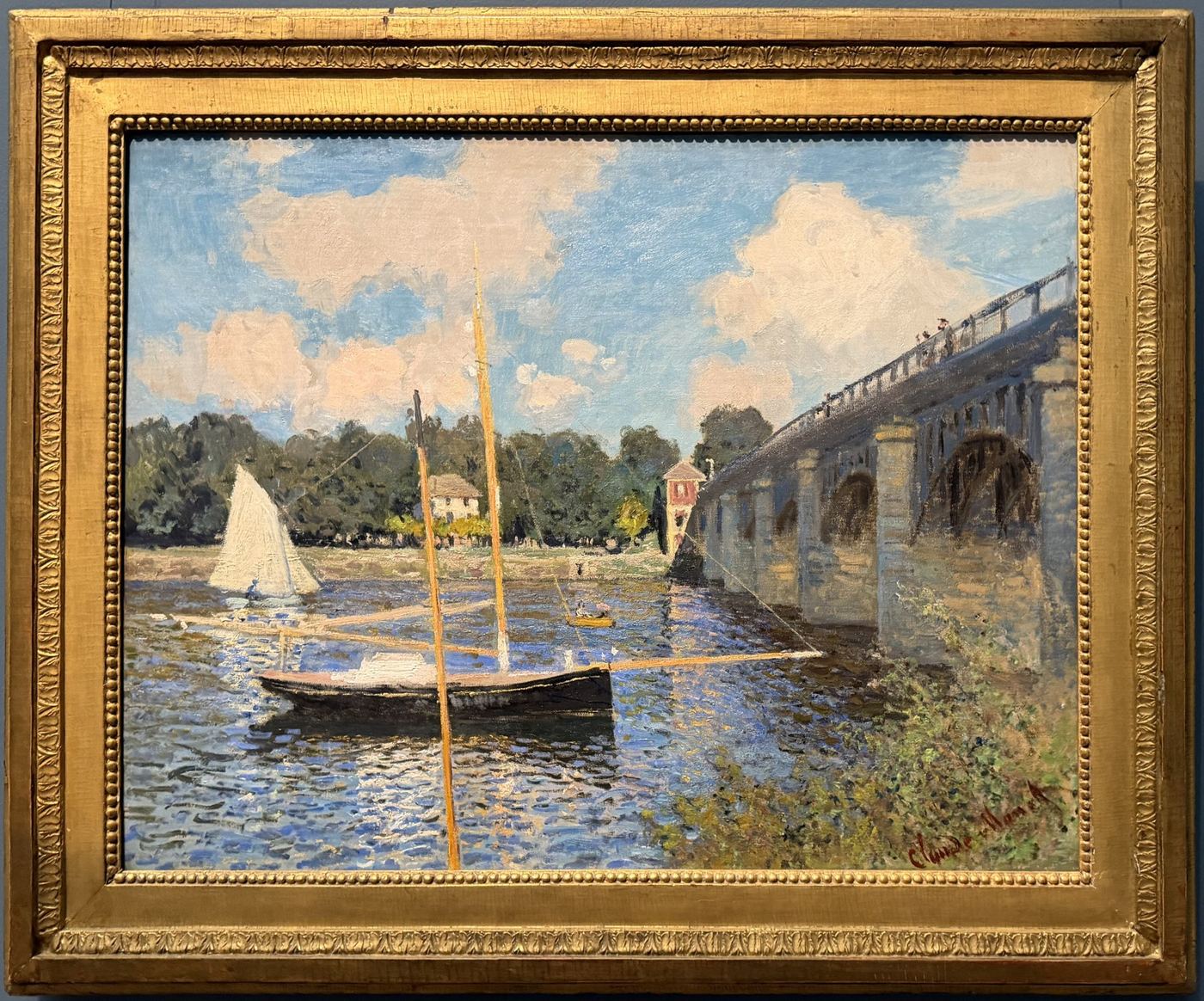
Claude Monet, The Bridge at Argenteuil
1
Claude Monet
The Bridge at Argenteuil
French, 1840 – 1926
1874
oil on canvas
Collection of Mr. and Mrs. Paul Mellon 1983.1.24

The wall cardThe Bridge at Argenteuil, 1874

The pictureA river scene split by a bridge. The bridge enters at the right edge and runs diagonally into the middle distance on heavy piers and round arches, with a few small figures at the rail. In the center a dark-hulled sailboat sits moored, its tall yellow mast rising past the treeline, and a second yellow pole crosses in front of the hull and runs off the bottom edge. Beyond it a white sail leans on the water, a small yellow rowboat carries two figures, and a pink tower-like building stands at the bridge's far end against a dense green bank. Cumulus clouds drift over a pale blue sky, and the water breaks into dashes of blue, white, and ochre. Green brush fills the lower right, where the red signature sits.

Beyond the labelThe National Gallery's own text sets the scene: the pleasure boats on this stretch of the Seine "drew tourists to Argenteuil." The bridge carried its own recent history, since Monet had earlier painted Argenteuil's highway bridge under repair after it was blown up in the Franco-Prussian War. The picture's first private owner, from 1890, was Henri Vever, the Paris jeweler whose Art Nouveau pieces at the 1900 World's Fair made his name and who was one of the earliest Europeans to collect Japanese woodblock prints; it left his hands at his sale in 1897. [X01-01, X01-10, X01-11]

In his words"When you go out to paint, try to forget what objects you have before you, a tree, a house, a field or whatever. Merely think here is a little square of blue, here an oblong of pink, here a streak of yellow, and paint it just as it looks to you, the exact color and shape, until it gives your own naïve impression of the scene before you." (Monet's advice to Lilla Cabot Perry, as she recalled it.)

Look forLook at the water against the poles. The river is broken color: short horizontal dashes of blue, white, violet, and ochre set side by side and barely blended, so the surface reads as scattered light, not modeled form. The yellow poles are single long strokes laid over that field, with the water strokes visibly running underneath. The clouds are the thickest paint here, creamy impasto that stands up off the thinner blue around it.

Photo IMG_7344; label IMG_7343

Room 6

Gallery M80: Painting with Monet

The museum calls this gallery Painting with Monet, and its panel sets the task: to watch how his brushwork "evolved over time." Nine Monets hang here, dated 1880 to 1908: the 1880 flowers and the riverbank at Vétheuil, a pair of Rouen Cathedral façades, the Seine at Giverny, three views of Waterloo Bridge in London, and a Venetian palace.

The panel traces the arc from "short, broken brushstrokes of pure color" in the 1870s and 1880s, to the 1890s habit of painting the same subject "many times under different lighting and weather conditions," and on to late brushwork that is "broader and freer." The Rouen pair and the three bridges are that habit on the wall: one motif, different light, side by side.

The room also holds a different Paris: five Toulouse-Lautrecs from 1891 to 1896, four of them painted on cardboard, Steinlen's laundresses in the street, and Vuillard's five-panel screen of a city square. Gauguin's Eve, a glazed ceramic figure, stands in a case.

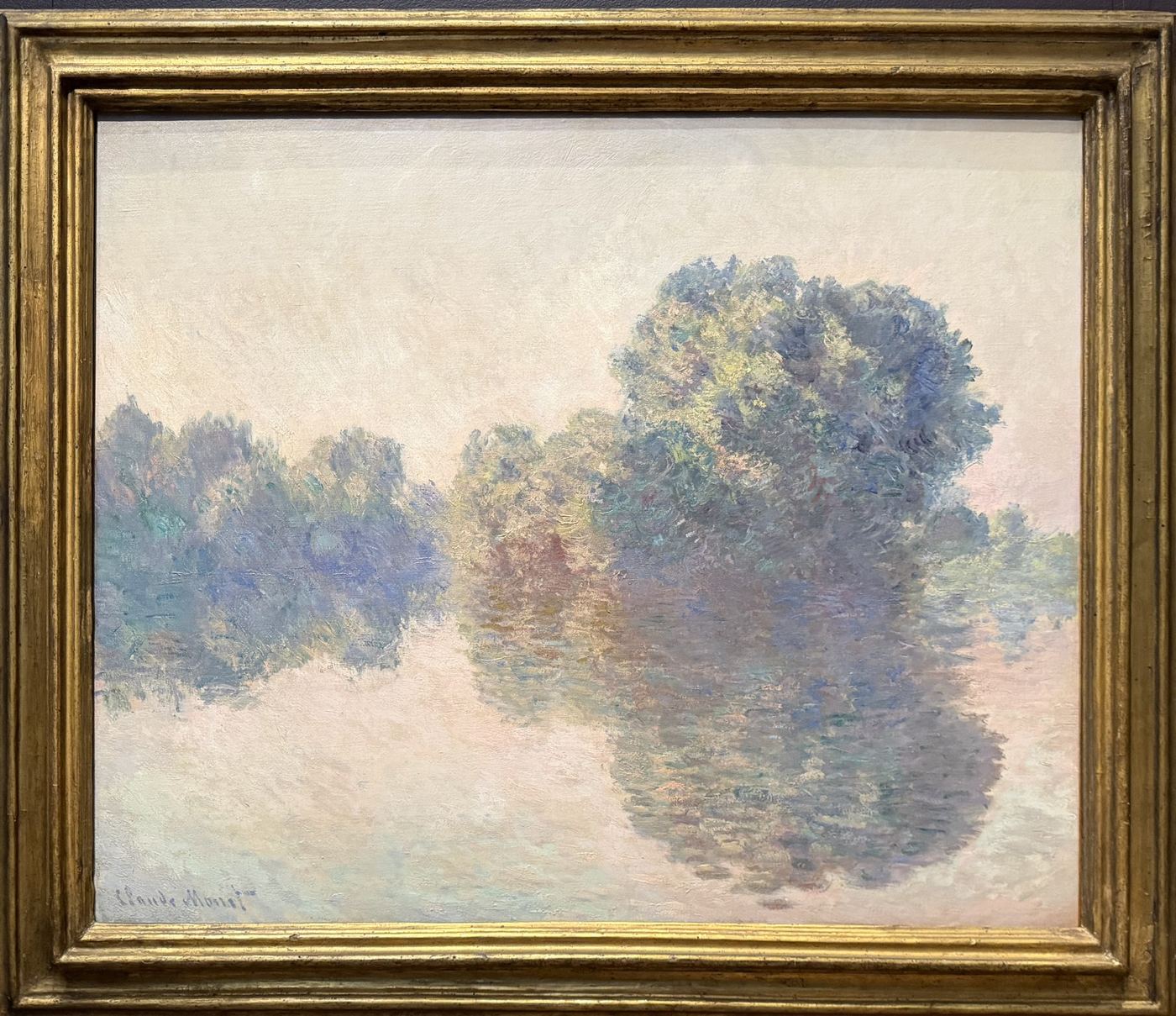
Claude Monet, The Seine at Giverny
77
Claude Monet
The Seine at Giverny
French, 1840–1926
1897
oil on canvas
Chester Dale Collection 1963.10.180

Label match: The label is visible at the right edge of the work photo, with the same title line.

The wall cardThe Seine at Giverny, 1897

The pictureA still river with wooded banks. A pale sky of cream and pink fills the top half. A low line of trees runs in from the left, and a larger rounded mass of trees rises at center right, its crown reaching above the middle of the canvas. Every tree drops a full reflection into the water below, so the lower half nearly mirrors the upper. The trees are blue, violet, sage, and yellow, all softened by the pink of the air, and nothing has a hard edge. Signed at lower left.

Beyond the labelIn 1896 and 1897 Monet was at work on the series called Mornings on the Seine, rising at about 3:30 and taking a small boat, his floating studio, to a set spot on the river near Giverny to paint before sunrise; the Kreeger Museum, here in Washington, owns one of those canvases. He had built his first studio boat in the 1870s, following Charles-François Daubigny, who painted the Seine from a converted barge. The Gallery's record does not say whether this 1897 canvas belongs to that series; it went from Monet to the New York collector James F. Sutton, like two others in this room. [X06-19, X06-18, S0010]

In his wordsNo verified quote found for this work.

Look forWatch the direction of the strokes. The sky goes on in long diagonals from upper left; the trees are short curved commas in several colors, laid wet into wet so they melt at the edges; the reflections switch to horizontal strokes. The colors stay close in value throughout, so the picture holds together by hue and stroke, not by light and dark.

ReadingsA reading, not the museum's: the close values and near-mirror reflections here are the qualities the Kreeger describes in its Mornings canvas, so the picture is worth hearing beside that series even though its membership is unconfirmed.

Photo IMG_7509; label IMG_7510

Glossary

Terms used in this tour. Underlined words in the text open their definition.

Terms

Broken color
Small strokes of separate colors placed side by side instead of mixed on the palette, so the eye blends them at a distance.
Contour
The drawn outline of a form. Here it is a line of dark paint laid along an edge, separate from the color that fills the shape.
Ground
The priming layer brushed onto a canvas before painting, usually white or cream. Where it is left bare, it shows as the lightest tone in the picture.
Impasto
Paint laid on thickly enough to stand up from the surface and keep the marks of the brush or knife.
Value
How light or dark a color is, apart from its hue. Colors close in value read as nearly the same lightness even when the hues differ.
Wet into wet
Painting a new stroke into paint that is still wet, so the two colors drag and merge at the edges.
Tap a painting to listenAudio plays here; your screen can lock

The model ends here

What each part does

The same explanations as the walkthrough, as plain text. Each heading names a part of the tour page.

The title and the counts

The top of the page names the museum and the show. Two paragraphs say how the walk runs and what every stop carries. The four counts under them are buttons.

Sorting the grid

Tap a count to re-sort the picture grid. "128 stops" puts the tiles in walking order. "10 galleries" groups them by room. "32 artists" lists them A to Z by surname. A heading marks each group. The tour keeps your choice on this phone.

Jumping to the detours

"20 detours" scrolls the grid to the first detour tile and flashes every detour tile, so you can see where the detours sit in the walk.

Picture tiles

Each tile is a stop, numbered in walking order. Tap one: its narration starts and the page scrolls to that stop. Tap the same tile again to pause.

Detour tiles

A detour sits in the grid at its place in the walk, outlined in orange with its title. Tap it to hear the detour and scroll to it. Detours go beyond the walls: the war, the collectors, the politics, and what became of the pictures.

Gallery talks

The named buttons under the grid are the gallery talks: a short talk for each room, and the critics at the end. Tap one to hear it.

Played marks

After you have heard nine tenths of a track, its tile gets an X and a talk gets a line through it. The marks stay on this phone, so your next visit starts where you left off.

Mark seen

Tap Mark seen, then tap any tile or talk to X it off yourself, or to clear a mark. Dashed outlines show the mode is on. Tap Done to leave it. Each stop card also has its own Mark seen button.

The counter and Reset marks

The counter shows how many of the tour's tracks you have heard or marked. Reset marks clears them all; it asks you to tap a second time within three seconds.

Descriptions

Every stop opens with one sentence saying what the picture shows. With Descriptions on, the full description of the canvas follows. With Descriptions off, the narration goes from that sentence straight to the background, and the stop runs about 45 seconds shorter. The setting is kept on this phone.

The bell

When a track ends, the tour waits for you to reach the next picture. Bell sets a quiet ding every 60, 90, or 30 seconds while it waits, or off. Tap the button to cycle through the four. The ding is an audio file, so it keeps sounding with the screen locked. Tap the play button to silence it; tap play again to repeat the stop.

Play through

Play through on runs every track into the next, stops and detours alike, to the end of the tour with no bell between. While it is on, the Bell button reads off and is locked. Your bell choice comes back when you turn Play through off. The setting is kept on this phone.

Twenty minutes

Nine stops that carry the show's argument, for a short visit. Tap one to jump to its card, then tap Listen there to hear it.

Artist timeline

One lane per artist, ordered by birth year, with each work at the date on its card. Slide the block sideways with a finger; the page stays put. Tap a work to hear its stop. A dashed border means circa, a bar means a date range, and undated works sit at the right end. Played marks appear here too.

Context

Context adds bands across all lanes for movements and events, such as the eight Impressionist exhibitions and the war of 1870, and dots on an artist's lane for events in that life. Tap a band or a dot for one line about it. Tap Context again to hide them.

The room menu

The gallery names stay at the top while you scroll. Tap one to jump to that room's wall text. The last link opens the glossary. Swipe the row sideways to see every room.

Room wall

Each room opens with a dark band: the gallery's name, what hangs there, and what to watch for. "The wall panel, verbatim" unfolds the museum's own panel text as photographed.

The photograph

A photograph of the work as it hangs. Tap it to look closer with your phone's zoom.

The label block

The plum block is the museum's label, word for word: artist, title, date, medium, and credit line, with the stop number in the corner.

Listen and Mark seen

Listen plays this stop's narration without scrolling. It reads Pause while the track plays and Resume after you pause. Mark seen marks the stop as done by hand and reads Seen once it is.

The wall card

Every sentence the museum printed on the card, quoted as the card's words.

The picture

A description of what is on the canvas: composition, color, and marks. The narration reads it after the opening sentence; the Descriptions switch skips it.

Beyond the label

Researched background: who owned the picture, its history, the people in it, and what critics said. The bracketed ids at the end name the sources the passage rests on.

In his words, in her words

The artist's own words, quoted from a source that prints them, with the citation in parentheses. Where no quote could be verified, the stop says so. In the narration a second voice reads the quote, with the French original under the English where one exists.

Look for

A maker's-eye note on technique: the support, the ground, and how the paint was put on. The orange rule marks it.

Readings

An interpretation not found in the museum's sources, in italics. Each one says so: "A reading, not the museum's".

Label match

A Label match line appears when pairing the photograph with its label took a judgment, and says why.

Photo numbers

The last line names the photographs the stop was built from: the work and its label.

Detours and gallery talks

A card with an orange left edge is a detour; a plain card is a gallery talk. Each has a kicker, a title, a few paragraphs with their sources, often a Look for, and its own Listen button.

Gallery talk

A gallery talk is a short talk on the movement, played where it first matters in the walk. The critics' talk closes the tour.

Slideshows

Every detour carries pictures. While the detour plays, the picture changes as the narration reaches its paragraph. The arrows step through them by hand at any time, and the counter shows where you are.

Glossary words

A dotted orange underline marks the first use of a technical term in a passage. Tap the word for a short definition above the player. "Full glossary" jumps to the complete list. Tap elsewhere or press Escape to close it.

The glossary

Every technical term in the tour, defined in plain words, at the end of the page. The room menu's last link brings you here.

The player

The bar stays at the bottom. It names the track playing and what comes next; the orange line is progress. Play or pause, skip to the next track, or stop. Audio keeps playing with the screen locked, and the lock screen shows the track with its own play and next controls.

Dark mode

The page follows your phone's light or dark setting. There is no switch on the page.